Japan's MMX spacecraft will launch soon from Tanegashima to study Mars' moons Phobos and Deimos and attempt to return at least 10 grams of material to Earth by about 2031. The mission includes the French IDEFIX rover and aims to determine whether the moons formed by a giant impact or by capture — a question with implications for how water and organics reached the inner planets. MMX will also test technologies for using Phobos as a staging point for future crewed Mars missions.
Japan's MMX Mission Targets Mars' Moons — Aiming to Return Phobos Samples by 2031
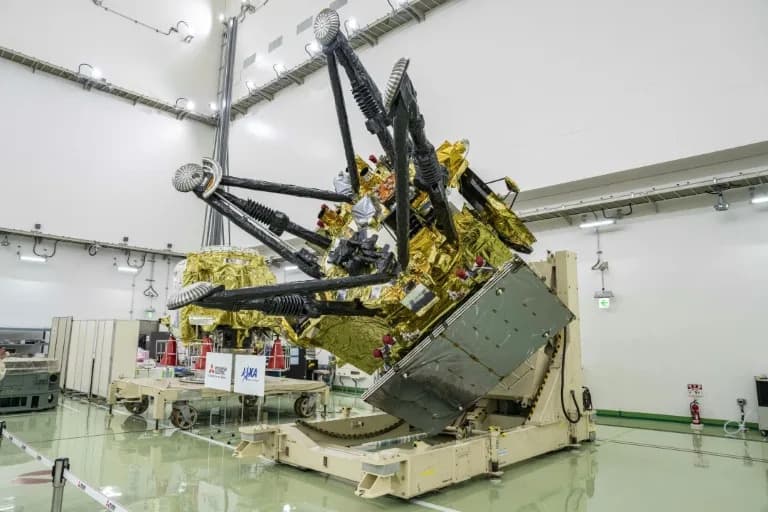
Japanese scientists are readying a mission to Mars' moons to retrieve samples that may unlock the origins of the Solar System and life on Earth (Yuichi YAMAZAKI)
Japanese scientists are preparing the Martian Moons eXploration (MMX) mission — an ambitious, unmanned probe designed to study Mars' moons and return surface samples that could illuminate the early Solar System and the origins of life on Earth. The spacecraft is scheduled to launch from Tanegashima Space Center in the coming months and will operate in the Martian system for roughly three years.
MMX will attempt to touch down on Phobos and collect at least 10 grams (0.35 ounces) of surface material. A small French-built rover named IDEFIX — a nod to the dog from the Asterix comics — will conduct close-range surface observations. The spacecraft will also perform remote observations of Deimos before dispatching a return capsule planned to land in Australia around 2031.
Impact Or Capture?
The Japan Aerospace Exploration Agency (JAXA) says MMX could resolve a long-standing question about how Phobos and Deimos formed. One leading idea, the "giant impact" hypothesis, proposes the moons formed from debris after a large body struck Mars. An alternative "capture" scenario suggests the moons are asteroids that Mars gravitationally captured. Determining which scenario is correct would help scientists understand how water, volatile compounds, and organic material may have been delivered to the inner rocky planets.
"MMX will shed light on the transport mechanisms that delivered water, volatiles, and organic compounds from the outer Solar System to the inner rocky planet region — processes that may have played a key role in making these worlds habitable," said Patrick Michel, a French astrophysicist involved with IDEFIX. "If Phobos and Deimos are remnants of these early delivery systems, they may hold clues to the transport of materials that were key to the emergence of life on rocky planets."
Martian Legs
Designing landing gear for Phobos posed a particular challenge because the moon's gravity is extremely weak. Engineers needed legs that will cushion touchdown without letting the probe bounce off or tip over. Akinari Uehara, an engineer at Mitsubishi Electric, noted the difficulty of preventing the spacecraft from escaping Phobos' very low gravity at landing.
Japan brings relevant landing and sample-return experience: the SLIM lunar lander (Smart Lander for Investigating Moon) survived a tipped touchdown in 2024 and continued to transmit useful data, and JAXA's Hayabusa-2 returned 5.4 grams of asteroid material to Earth in 2020.
Perseverance And Other Sample-Return Efforts
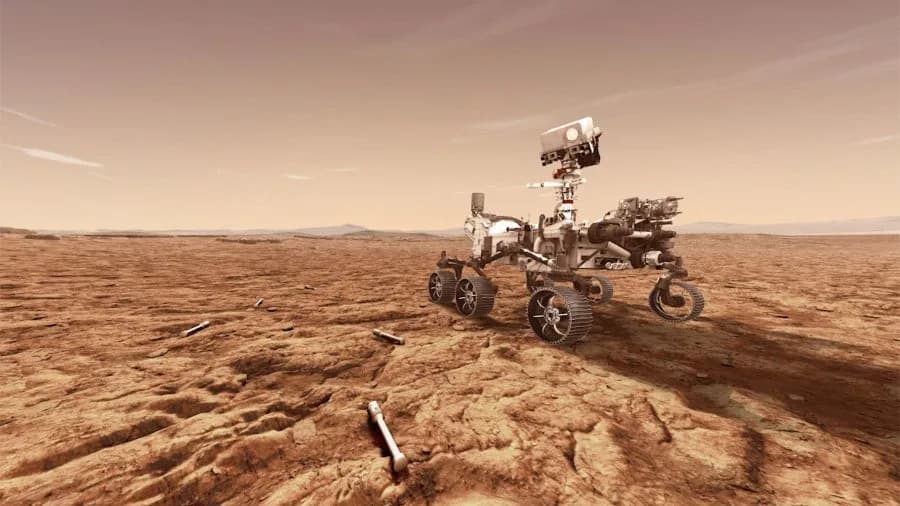
MMX is not the only program seeking extraterrestrial samples. NASA's Perseverance rover has been caching Martian rock samples since 2021 as part of a planned Mars Sample Return campaign being developed jointly by NASA and ESA; however, such multi-agency projects face schedule and funding uncertainties. China has announced Tianwen-3, a sample-return mission targeting a launch around 2028 and a return to Earth near 2031, which could potentially precede MMX's sample delivery.
MMX is an international collaboration that includes France's CNES, the German Aerospace Center (DLR), NASA and ESA, along with many universities and technology firms. Beyond pure science, JAXA says MMX will test technologies for using Phobos as a potential "natural space station," developing capabilities that could be important for future crewed round trips to the Martian surface.
Timeline Summary: Launch from Tanegashima in the coming months; ~three years in the Martian system; sample return capsule expected to land in Australia around 2031.
Help us improve.