
Deep MOTHRA images of the Helix Nebula reveal 22 bow shocks in the nebula’s outer halo, each marking fragments of stellar debris colliding with interstellar gas. The shocks show a clear erosion sequence — sharp near the center, increasingly fragmented farther out — implying individual fragments remain coherent for about 10,000 years before dissolving. Published August 12 in Nature, the discovery both highlights MOTHRA’s capabilities and offers a vivid preview of the Sun’s eventual fate.
MOTHRA Image Reveals Helix Nebula’s Slow-Motion Breakup — A Glimpse Of the Sun’s Distant Fate
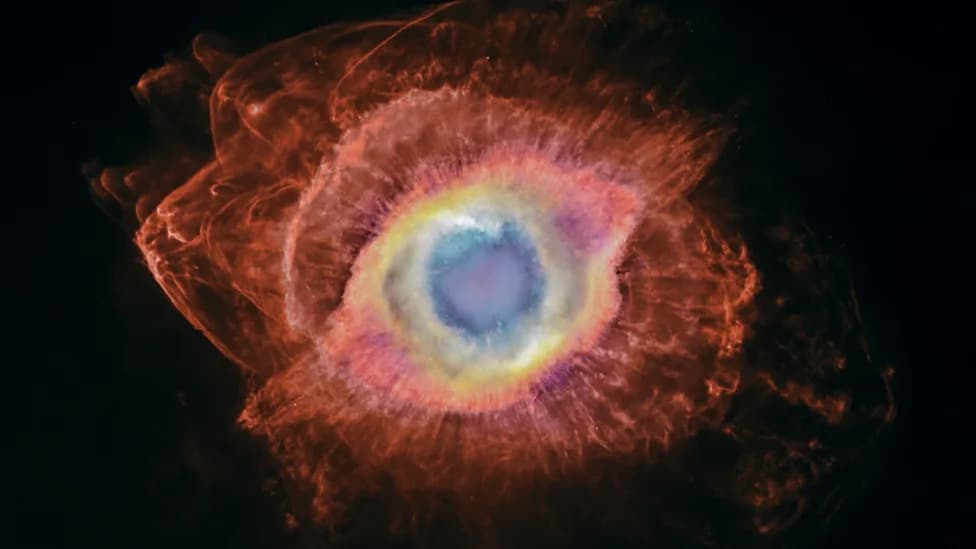
A dying star’s slow-motion breakup offers a rare preview of the Sun’s own fate
A new deep image of the Helix Nebula captured by the still-unfinished MOTHRA telescope in Chile reveals, for the first time in clear detail, how fragments of a dying star’s expelled material are breaking apart as they re-enter the interstellar medium. The observations document 22 curved bow shocks in the nebula’s faint outer halo and map a clear pattern of progressive erosion.
What the Team Found
Researchers identified 22 complete or partial bow shocks concentrated on the Helix’s eastern side. Each arc traces an invisible clump of stellar debris plowing into thin interstellar gas, producing a glowing shock front similar to the wake that forms in front of a moving boat. The shocks closest to the nebula’s central white dwarf appear large, thin, and sharply defined; those farther out grow smaller, fuzzier, and increasingly fragmented — a morphological sequence the team interprets as steady erosion over time.
Timescale And Significance
Using that progression, the researchers estimate a typical debris fragment remains coherent for roughly 10,000 years after its first collision with ambient gas. After that window the fragments disintegrate and their material mixes back into the interstellar medium, completing a recycling process that seeded the cloud that formed the Sun and will one day include some of the Sun’s own matter.
About The Telescope
MOTHRA (Modular Optical Telephoto Hyperspectral Robotic Array) is being assembled at the El Sauce Observatory in Chile. Instead of a single large mirror, the instrument combines many telephoto lenses fitted with narrowband filters tuned to detect extremely faint gas emission across wide fields. The full array is planned to house 1,140 lenses; only five were operational when these images were taken. The lead image served as a calibration test but yielded this unexpected discovery, demonstrating MOTHRA’s potential to find similar faint structures around other nearby planetary nebulae.
Context And Broader Implications
The Helix Nebula lies about 650 light-years from Earth and is one of the most photographed planetary nebulae. Its bright central ring is gas and dust the progenitor star shed near the end of its life; the remnant core is a white dwarf. Although the Helix’s progenitor was not an exact twin of the Sun, astronomers expect the Sun to follow a broadly similar evolutionary path in several billion years: expanding into a red giant, shedding its outer layers, and leaving behind a white dwarf surrounded by glowing expelled gas.
Why It Matters: These observations offer a rare, direct look at how stellar debris is returned to the galaxy — a slow-motion preview of the process that will eventually recycle some of the Sun’s material back into future generations of stars and planets.
Findings published August 12 in Nature. Lead author: Pieter van Dokkum (Dragonfly Focused Research Organization, Yale University). Co-author: Roberto Abraham (Dragonfly FRO, University of Toronto).
Help us improve.





















