UT Austin has proposed a streamlined undergraduate core that reduces required credits from 42 to 36 and replaces a roster of more than 600 qualifying courses with a curated set organized into three pillars: Arts & Humanities, Social Sciences, and STEM. A 22-member faculty task force drafted the recommendations and designated four courses that must be taken at UT Austin. The plan prioritizes small, in-person classes and writing instruction, and — pending Board approval — would take effect in Fall 2028 amid broader state-level curricular review requirements (SB 37).
UT Austin Proposes Major Overhaul of Undergraduate Core Curriculum: Fewer Credits, More Focus
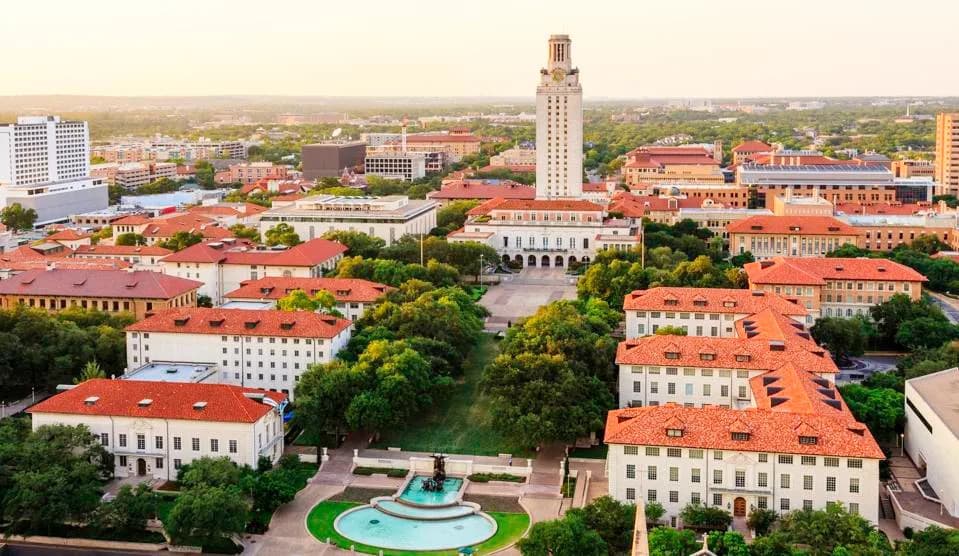
The University of Texas Austin has unveiled its plan for a completely revamped undergraduate core curriculum.getty
The University of Texas at Austin has unveiled a comprehensive proposal to replace its sprawling undergraduate core with a tighter, more focused curriculum designed to give students foundational grounding in the arts and humanities, social sciences, and STEM.
Announced Thursday during a Board of Regents meeting by President Jim Davis, the plan would dramatically shrink the range of courses that qualify for core requirements — collapsing a catalog of more than 600 eligible classes into a curated set of offerings developed across departments. The recommendations were produced by a 22-member faculty task force appointed last year.
Key Changes
Under the proposal, required core credits would fall from 42 to 36. Although students could still meet those requirements through multiple classes, the variety of acceptable options would be narrowed. The task force emphasizes that "all courses must be genuine core courses, that is, broad courses on fundamental questions and themes," and that faculty across departments should be invited to design these courses so that "no department should have a monopoly on any of its parts."
Three Pillars
The recommended core is organized around three pillars — Arts & Humanities, Social Sciences, and STEM — which together encompass 12 subject-area requirements.
- Arts & Humanities (15 credits): Culture and the Arts; Great Questions of Human Life; Masterworks of Literature; U.S. History; Western Civilization.
- Social Sciences (9 credits): Principles of American Politics; World Politics and Cultures; Foundations of Social Science.
- STEM (12 credits): Great Ideas in Science; Natural Science & Engineering; Math, Statistics & Data Science; Computer Science & AI.
Four courses are given special status: Great Questions of Human Life, Principles of American Politics, Great Ideas in Science, and Computer Science & AI. The task force explains these courses "reflect the spirit of the new core by offering students the chance to discuss enduring questions and great ideas, prepare themselves for thoughtful citizenship, and work with cutting-edge technology." Consequently, it recommends these classes be taken at UT Austin rather than accepted through dual enrollment or transfer credit.
Instructional Priorities
The task force also recommended that core courses be taught in small sections when possible, delivered primarily in person rather than online, and emphasize development of writing and critical-thinking skills.
Context and Next Steps
The curriculum review takes place against a broader Texas policy backdrop: a 2025 state law (SB 37) requires governing boards of public universities to review undergraduate curricula to ensure students are prepared for life and the workforce. SB 37 also included changes to university governance that reduce faculty senates to advisory roles, a controversial provision that has received significant attention.
UT Austin launched its review before SB 37 passed. The Board of Regents has not yet voted on the task force’s recommendations. Faculty are expected to begin developing the new course offerings now, with the revised core slated for implementation in Fall 2028.
Observers say UT Austin’s plan could set a precedent: whether spurred by legislative mandates or institutional initiative, more universities may reassess and streamline core curricula in the coming years.
Note: This article was originally published on Forbes.com.
Help us improve.