
Using JWST/MIRI, astronomers have obtained the first continuous mid-infrared spectrum of IRS 3, an AGB star only 0.6 light-years from Sagittarius A*. The data show IRS 3 is oxygen-rich with strong silicate features and multiple concentric dust shells, and reveal clear water absorption near 6–7 μm consistent with warm H2O. The star is undergoing a powerful superwind (≈ 6 × 10⁻⁵ M☉/yr), creating a large envelope that can shield molecules in the hostile Galactic centre; future ELT/METIS observations should resolve its structure in more detail.
JWST Detects Water and Massive Dust Shells Around a Dying Star Near the Milky Way’s Central Black Hole
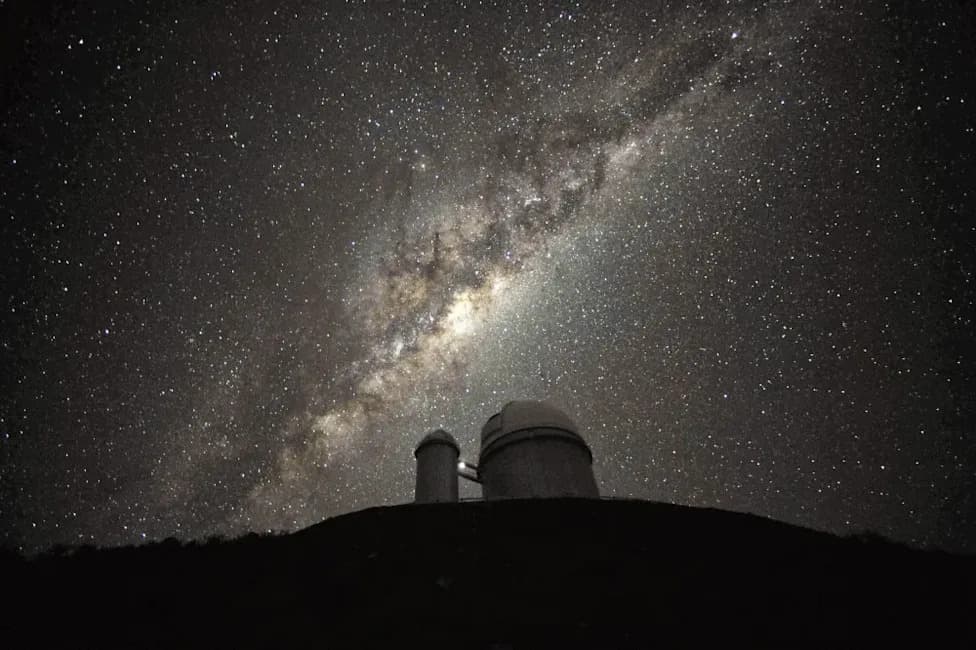
JWST detects water around IRS 3, a dying star shedding huge amounts of gas and dust near the Milky Way's central black hole. (CREDIT: Serge Brunier / ESO)
Just 0.6 light-years from the Milky Way’s supermassive black hole, Sagittarius A*, astronomers using the James Webb Space Telescope have found an oxygen-rich, aging star surrounded by a vast, water-bearing dusty envelope. The star — known as IRS 3 — is shedding mass at an extraordinary rate, yet its dense cocoon appears to protect molecules that would otherwise be destroyed in the hostile Galactic centre.
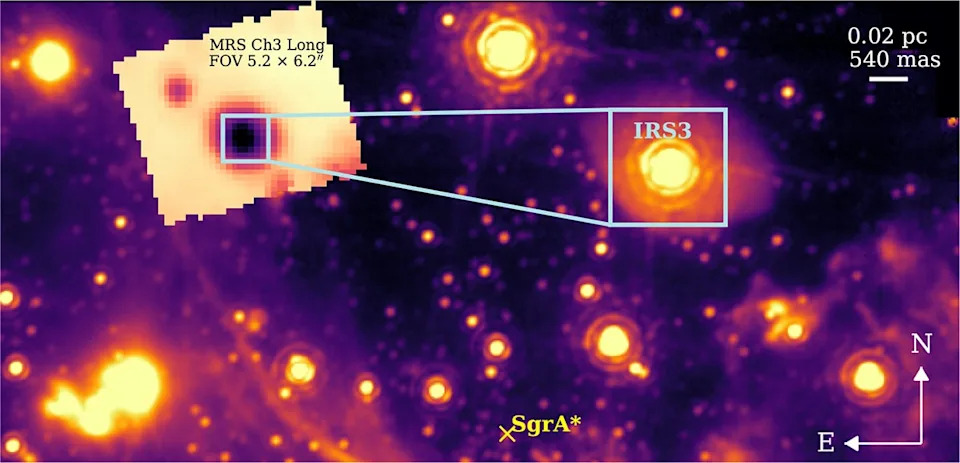
Mid-infrared image of the IRS 3 environment, observed with NACO (VLT) and MIRI/MRS (JWST). (CREDIT: Florian Peißker et al, Astronomy and Astrophysics)
What Webb Observed
Using the Mid-Infrared Instrument (MIRI), the team led by PD Dr. Florian Peißker (University of Cologne) produced the first continuous mid-infrared spectrum of IRS 3 between 4.9 and 27.9 μm. The spectrum shows strong silicate absorption features at 9.7 μm and 18.5 μm (measured optical depths 2.98 ± 0.07 and 0.85 ± 0.01, ratio ≈ 3.5), signatures that point to an oxygen-rich AGB (asymptotic giant branch) star whose envelope is dominated by silicate dust rather than carbonaceous material.
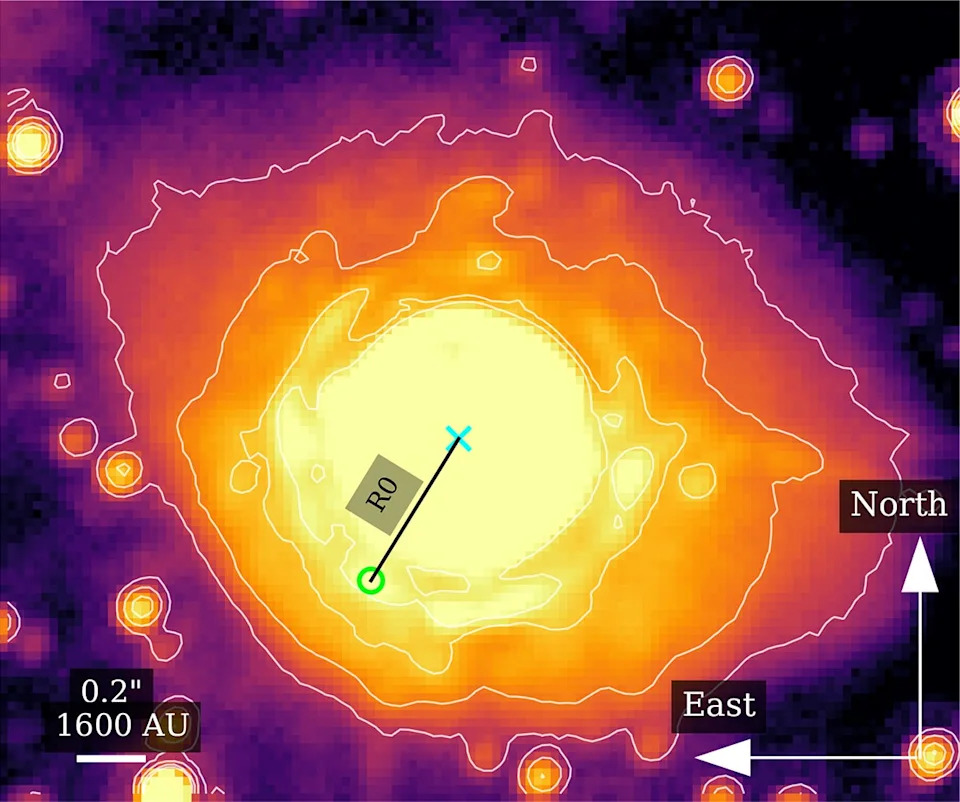
Projected stand-off distance estimate for the bow shock of IRS 3. The stand-off distance is a measure of the ambient ISM and the ram pressure of the star. (CREDIT: Florian Peißker et al, Astronomy and Astrophysics)
Water in a Harsh Environment
Most strikingly, the MIRI spectrum reveals absorption structures near 6.0–6.25 μm and additional features around 6.7–7.0 μm that match transitions of water (H2O). Modeling of the shorter-wavelength feature using HITRAN molecular data reproduces it with water at an excitation temperature of about 700 K and a column density near 1.5 × 10¹⁷ molecules cm−2. The detection demonstrates that a sufficiently dense circumstellar envelope can shield molecules even within the energetic Galactic centre.
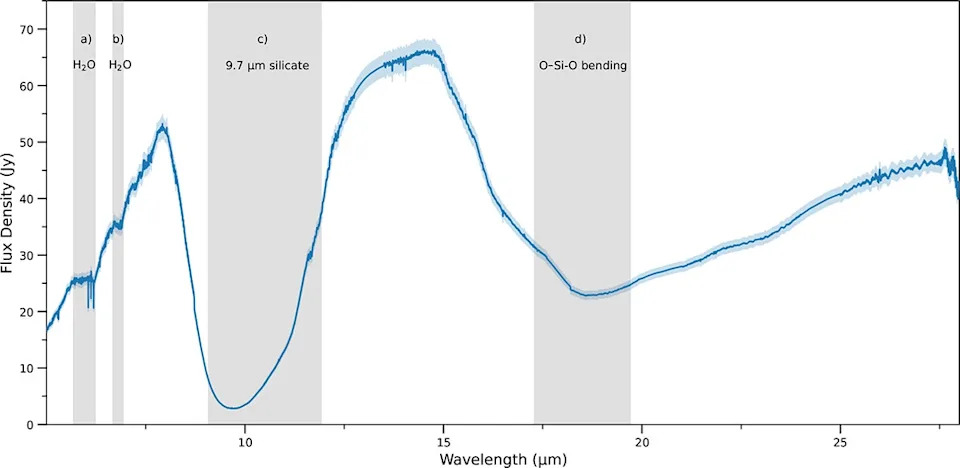
De-reddened MIRI spectrum of IRS 3 observed in 2025. We identify four spectral regions that are marked with gray bars, corresponding to features associated with the AGB star. (CREDIT: Florian Peißker et al, Astronomy and Astrophysics)
Envelope Structure and Mass Loss
IRS 3 is in an intense mass-loss phase (a so-called superwind) with an estimated rate of about 6 × 10⁻⁵ solar masses per year — roughly an Earth mass every 18 days. Its dusty envelope extends to roughly 10,000 AU and is structured into multiple concentric shells. Radiative-transfer models indicate inner dust temperatures near 1,200 K with outer components cooling to about 80–100 K. Assuming a typical AGB wind speed of ~15 km s−1, the shell radii correspond to expansion ages of approximately 300, 700, 2,000 and 3,200 years, while still more distant material seen by ALMA may trace outflows up to ~5,000 years old.
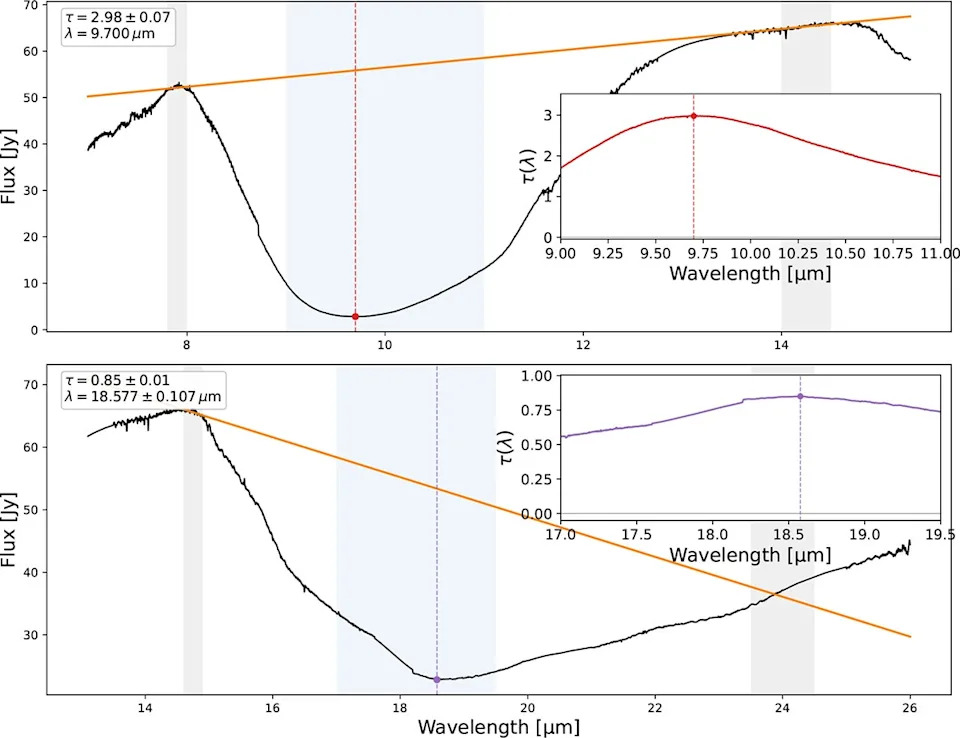
Optical depth estimates of the 9.7 μm (top) and 18.5 μm (bottom) silicate absorption features. Both panels include an inset showing the related optical-depth fit. (CREDIT: Florian Peißker et al, Astronomy and Astrophysics)
Interaction With the Surroundings
IRS 3 also drives a bow shock where its wind interacts with ambient interstellar material; the measured stand-off distance is about 4,316 AU. From that geometry the authors infer a highly inhomogeneous interstellar medium in the inner Galactic centre. Because IRS 3 is losing mass so rapidly and sustaining a large envelope, it may help replenish dust and molecules near Sagittarius A*, and may partly explain why few other large, dusty red giants survive intact so close to the black hole.
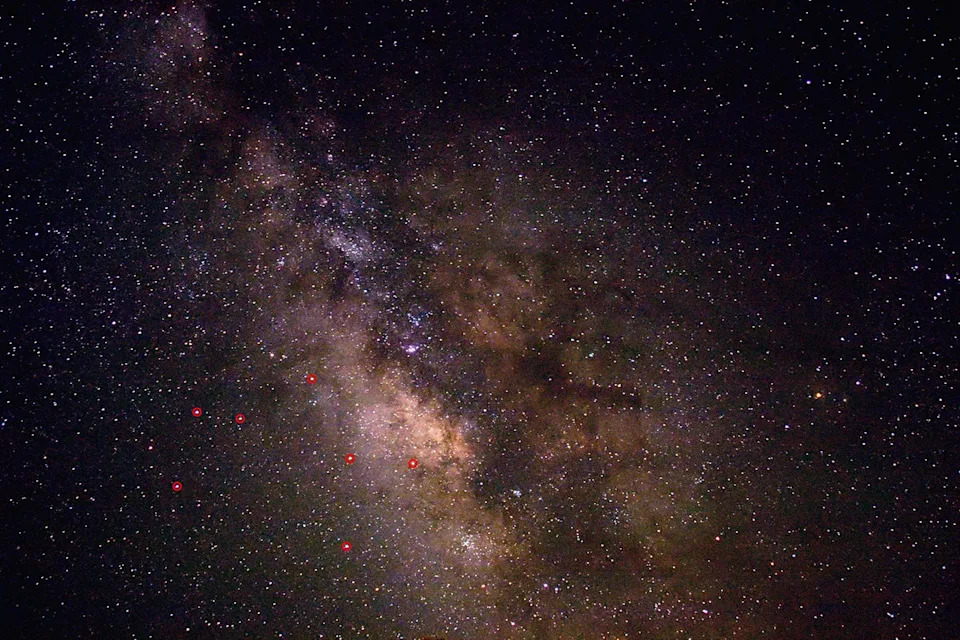
A view of the night sky near Sagittarius, enhanced to show better contrast and detail in the dust lanes. The principal stars in Sagittarius are indicated in red. (CREDIT: Wikimedia / CC BY-SA 4.0)
Why This Matters
The study, published in Astronomy & Astrophysics, overturns an earlier classification of IRS 3 as carbon-rich and shows how evolved, oxygen-rich stars can produce and preserve complex chemistry — including water — even in extreme environments. Future instruments such as METIS on the Extremely Large Telescope will be able to map the envelope in greater detail, test whether episodic outflows, environmental shaping, or a companion sculpt the shells, and refine estimates of the star’s properties (temperature ≈ 2,800 K, luminosity ≈ 60,000 L☉, mass ≈ 6 M☉, age ≈ 72 Myr).
Quick facts: IRS 3 is ~42,000 AU from Sgr A* (≈ 0.6 ly), losing mass at ~6 × 10⁻⁵ M☉/yr, possesses silicate dust features at 9.7 and 18.5 μm, shows H2O absorption at ~6–7 μm, and has a dusty envelope extending to ~10,000 AU.
Help us improve.





















