
The DESI Legacy Imaging Surveys team has released a 5.6-trillion-pixel, 2D color mosaic cataloguing nearly 4 billion celestial objects from over 263,000 exposures. Assembled from multiple telescopes and processed on the Perlmutter supercomputer, the map has guided DESI target selection since June 2026 and supports the mission through 2028. Publicly available via the Legacy Survey Sky Viewer, the dataset is a key resource for dark energy research and future astronomical facilities.
Astronomers Release 5.6-Trillion-Pixel Sky Map Cataloguing Nearly 4 Billion Objects
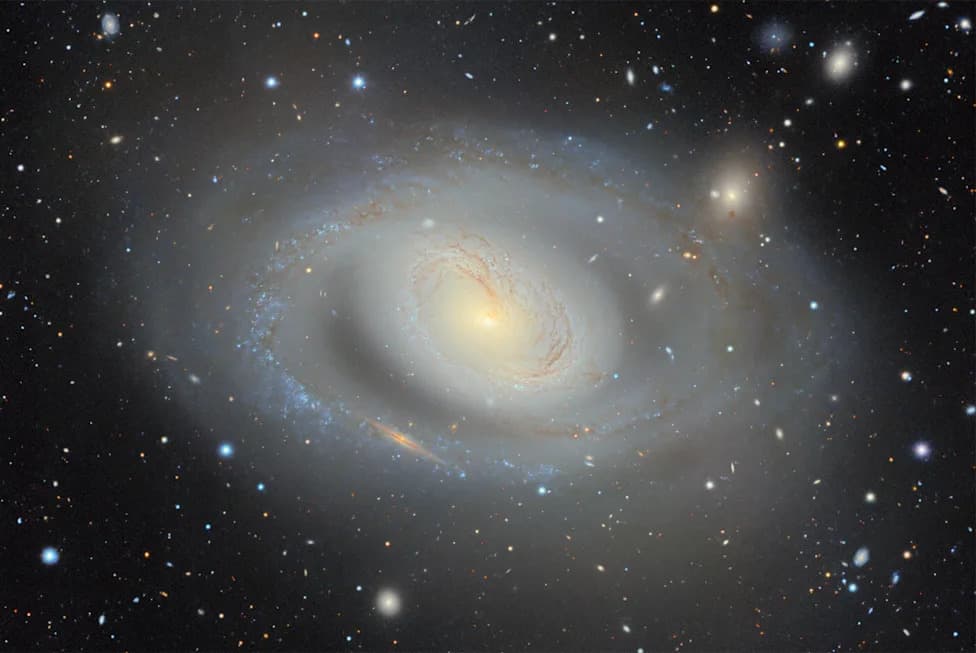
Astronomers just released a map of universe so big it contains 4 billion objects
The DESI Legacy Imaging Surveys team has published the largest-ever 2D color map of the sky: a 5.6-trillion-pixel mosaic that catalogs nearly 4 billion celestial objects from more than 263,000 telescope exposures taken over 2,285 nights. The full dataset is publicly available through the Legacy Survey Sky Viewer, allowing researchers and the public to explore the universe in unprecedented detail.
Not a Single Photograph, But a Gigantic Mosaic. The image is a composite stitched from multiple instruments, including the 570-megapixel Dark Energy Camera at Cerro Tololo in Chile and the Mayall 4-meter Telescope at Kitt Peak in Arizona. Individual exposures were captured under varied atmospheric and instrument conditions, so the team spent roughly a year developing software to harmonize the data. Final processing ran for eight weeks on the Perlmutter supercomputer at the National Energy Research Scientific Computing Center in Berkeley.
2D Imaging vs. 3D Cosmology. A 2D sky map functions like a very deep photograph: it records where stars and galaxies appear on the sky and their brightness across visible and near-infrared wavelengths. The 3D survey — DESI's primary scientific mission — adds the third dimension by measuring spectra and deriving redshifts to determine distances. DESI depends on the 2D Legacy Surveys map to identify targets before it measures their spectra.
Map Informs an Ambitious Spectroscopic Campaign. The expanded 2D map has guided DESI's target selection since June 2026. DESI completed its original five-year 3D survey ahead of schedule in April 2026, collecting spectra for 47 million galaxies and quasars (versus an initial target of 34 million) and more than 20 million nearby stars.
"It became clear we might run out of galaxies to look at and run out of sky, and we better start doing something about that," said David Schlegel of Berkeley Lab, who works on both DESI and the Legacy Surveys.
To extend DESI's scientific reach, the team expanded the imaging footprint, producing the record-setting 5.6-trillion-pixel map now available to the public. With DESI continuing observations through 2028, this enlarged catalog will supply new targets for follow-up spectroscopy and support the instrument's extended mission.
Why It Matters: Dark Energy and Future Facilities. Both the 2D and 3D maps are essential for studying dark energy, the poorly understood component that makes up roughly 70% of the universe and drives cosmic acceleration. Early DESI measurements have hinted that dark energy might not be constant and could be evolving over time — a result that, if confirmed, would require revising the standard cosmological model.
The Legacy Surveys map is also being distributed as a foundational reference for upcoming astronomical facilities. Astronomers and citizen scientists can use the Sky Viewer to search the nearly four billion catalogued objects for rare phenomena and unusual features in the imaging data.
Help us improve.





















