
Certified solar-viewing glasses have rapidly sold out across Europe ahead of Wednesday's rare total solar eclipse. Government and science institutions distributed millions of free pairs in some countries, but many pharmacies and opticians still ran dry. Health officials warn against uncertified eyewear and note that several unsafe models were pulled from sale.
Europe Scrambles for Certified Eclipse Glasses as Supplies Run Out Ahead of Rare Solar Event
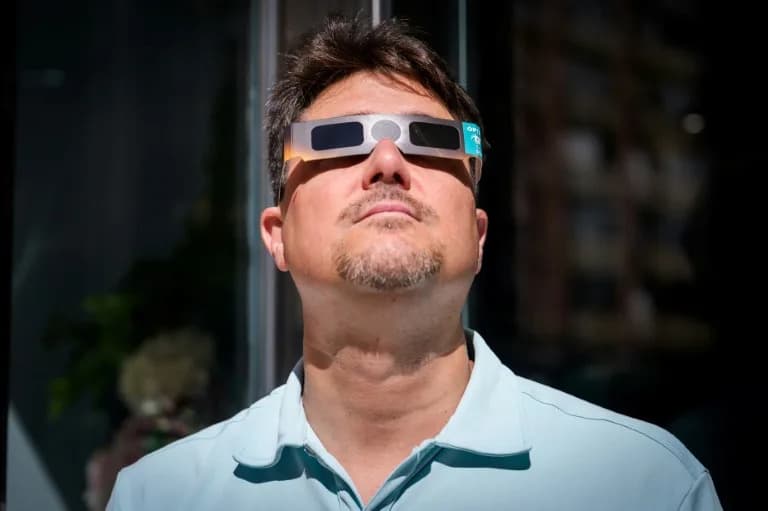
Doctors warn that looking directly at the Sun during a solar eclipse can damage the retina (CESAR MANSO)
Demand for certified solar-viewing glasses has surged across Europe as communities prepare for Wednesday's rare total solar eclipse, leaving pharmacies, opticians and other retailers struggling to keep stock available.
In Spain — where parts of the country lie in the eclipse's path of totality — many distribution points report they have exhausted supplies of certified protective eyewear. A sign at the entrance to Madrid's National Museum of Natural Sciences announced that the museum had run out of its allocation. The museum was one of 30 science centres nationwide participating in a government-backed campaign to hand out two million free pairs of glasses.
Some central Madrid pharmacies still had stock on Tuesday, typically selling certified eclipse glasses for between €3 and €4 (about $4.60) a pair, but retailers in major cities from Barcelona to Brussels said they were struggling to meet demand. Carles Sisquella, who owns an optical shop in Barcelona, said his store had been without supplies for 10 days. “There are now a lot of people who obviously won't be able to get glasses,” he said.
Shortages and Last-Minute Rushes
The same scramble has played out in other capitals. In Brussels — where roughly 90% of the Sun will be obscured — shoppers raced to secure certified glasses. Pastry chef Arno Dossogne, 37, managed to find a small optician that received a last-minute delivery and bought pairs for himself and friends whose online orders had been cancelled. "It was this or nothing. You can't mess around, or you'll burn your eyes," he said.
One Brussels optician reported that two boxes containing about 100 pairs were sold within 30 minutes. In Paris, customers queued outside La Pharmacie du Soleil hoping to buy glasses priced at €5.95 a pair, only to be shown empty boxes. The pharmacist urged customers to return later, calling the demand “pure madness.”
Supply Chain Strain and Safety Concerns
Suppliers were overwhelmed by orders: some pharmacy networks said allocations of roughly 200 pairs per outlet were insufficient. In one instance, a pharmacy employee said deliveries were so disrupted that suppliers arranged drop-offs using alternative courier services, including ride-hailing apps.
Health professionals emphasise that looking directly at the Sun during an eclipse can damage the retina and potentially cause permanent loss of central vision. Eye specialists are warning consumers not to use uncertified alternatives. Spanish authorities on Monday withdrew six models from the market over concerns they could harm the eyes.
In Portugal, the Club da Visao network of more than 600 opticians has been distributing certified glasses free of charge, limited to one pair per person, but even with repeated restocks many outlets ran dry.
What to remember: Only use certified solar-viewing glasses that meet international safety standards; if certified glasses are unavailable, do not look at the Sun directly and use safe projection methods (for example, pinhole projectors) to observe the eclipse.
Help us improve.





















