
Wednesday brings three major sky events: a pre-dawn alignment of six planets, a solar eclipse affecting parts of North America and Europe (with narrow areas of totality), and the peak of the Perseid meteor shower. Mars and Saturn will be the most prominent planets; Jupiter and Mercury will be low at twilight, and Uranus and Neptune will require optical aid. The Perseids are expected to produce about 40–60 meteors per hour after nightfall—clear skies are essential.
Wednesday’s Triple Treat: Planetary Parade, Solar Eclipse and Perseid Meteor Peak
AccuWeather.com
Wednesday will be a standout night for skywatchers, offering a three-part celestial show: a pre-dawn planetary parade, a solar eclipse visible to parts of North America and Europe, and the peak of the Perseid meteor shower after nightfall.
Pre-Dawn Planetary Parade
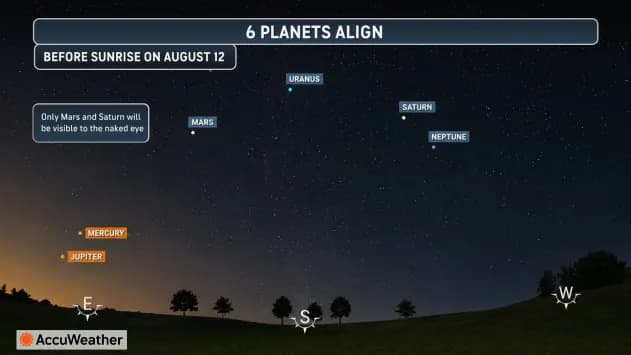
A line of six planets—Jupiter, Mercury, Mars, Uranus, Saturn and Neptune—will be stretched across the sky before sunrise. Mars and Saturn will be the easiest to spot, both shining high in the southern sky. Jupiter and Mercury will sit just above the eastern horizon as morning twilight begins to brighten, making them hard to see with the naked eye.
Uranus and Neptune will also be above the horizon but are too faint for unaided eyes. Binoculars or a small telescope will reveal the pair: Uranus will appear almost directly between Mars and Saturn, while Neptune will lie below and slightly to the right of Saturn.
Midday Solar Eclipse
Later on Wednesday a partial solar eclipse will be visible across parts of North America and Europe. Small regions of Iceland, Greenland, Spain and Portugal will experience totality. If you plan to observe the eclipse, use certified solar eclipse glasses or a properly filtered telescope—never look directly at the Sun without approved protection.
Perseid Meteor Shower Peaks
The night concludes with the peak of the Perseid meteor shower, with expected rates of roughly 40–60 meteors per hour under dark, clear skies. The first meteors may appear soon after nightfall, with activity increasing through the second half of the night. Because the Perseids are visible across broad regions, observers anywhere with clear skies should have a chance to see the show.
Viewing Tips
- Find a dark, open sky away from city lights and give your eyes 20–30 minutes to adapt to the dark.
- Check the local timing for the eclipse and planetary positions using a sky app or star chart—local visibility depends on your location.
- Bring binoculars to hunt for Uranus and Neptune, and a reclining chair or blanket for comfortable meteor watching.
- For the eclipse, use certified solar viewers or projection methods; never view the sun through an unfiltered camera, telescope or binoculars.
Bottom line: Clear skies and a little planning will let observers enjoy a rare tripleheader—planets before dawn, an eclipse for some regions, and a dazzling Perseid meteor peak after nightfall.
Help us improve.





















