
The James Webb Space Telescope imaged a compact cluster of young stars inside a cavity nicknamed the "Treasure Chest" in the Carina Nebula, about 7,500 light-years away. Carina spans roughly 260 light-years and is the nearest high-mass star-forming region, home to massive stars and tens of thousands of protostars. ESA estimates the cluster at ~1.3 million years old (earlier estimates as young as 100,000 years). Webb's infrared view penetrates dust to reveal these embedded stellar nurseries and how young stars shape their environment.
James Webb Reveals a 'Treasure Chest' of Young Stars in the Carina Nebula
(SWNS)
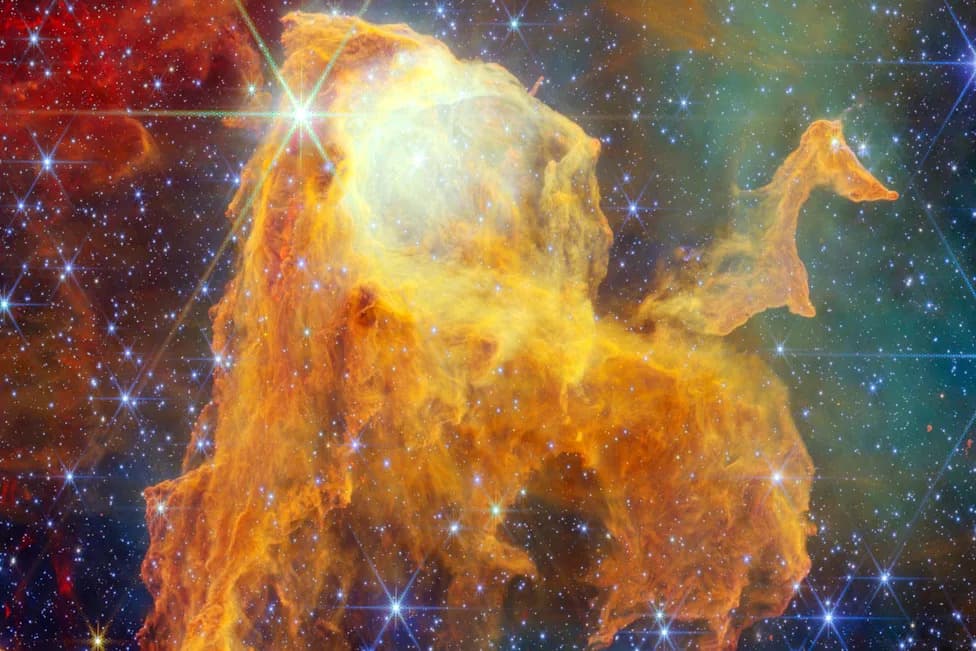
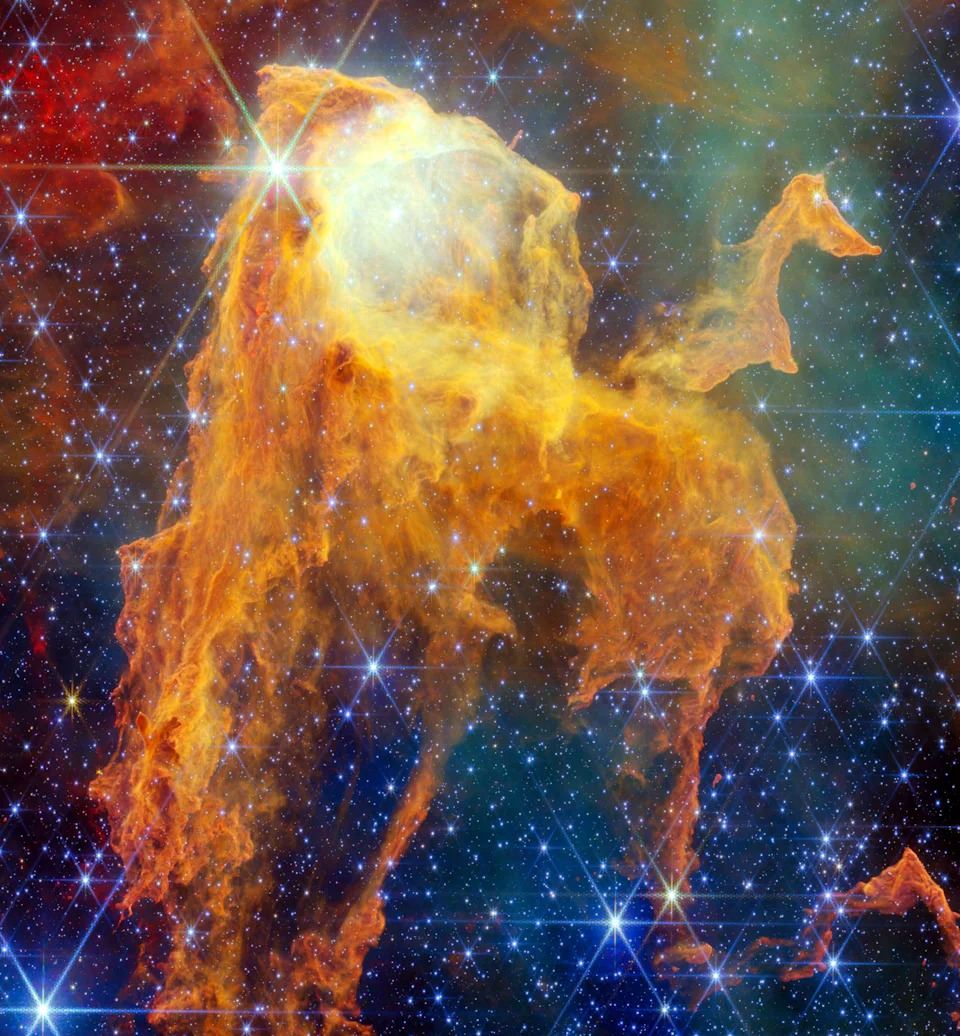
The James Webb Space Telescope has captured a striking infrared image of a compact cluster of newborn stars hidden inside a cloud formation now nicknamed the "Treasure Chest." The feature lies in the Carina Nebula, roughly 7,500 light-years from Earth in the constellation Carina (the Keel).
The European Space Agency (ESA) described the surrounding region as a "celestial sculpture garden," noting that the Treasure Chest resembles "a wooden chest with its lid wide open" carved out of gas and dust. Rather than jewels, the cavity shelters a dense group of very young stars that remain shrouded in dust.
(SWNS)
"These clouds often somewhat resemble comets, but the Treasure Chest looks distinctly like a wooden chest with its lid wide open. However, this chest doesn't contain jewels or gold coins, but instead a compact cluster of young stars." — ESA
Spanning roughly 260 light-years, the Carina Nebula is the closest high-mass star-forming region to Earth, making it an exceptional laboratory for studying the full range of star formation. The nebula hosts some of the Milky Way's most massive stars and contains tens of thousands of protostars, giving astronomers a chance to observe how newly forming stars sculpt and energize their surroundings.
ESA estimates the Treasure Chest cluster is likely around 1.3 million years old, though earlier studies have suggested ages as young as 100,000 years. Because the cluster is so young and still embedded in dusty clouds, Webb's infrared sensitivity is especially valuable for peering into the stellar nursery and revealing objects hidden at visible wavelengths.
Images like this demonstrate how infrared observatories such as Webb can penetrate dust to reveal the early stages of stellar evolution and the complex interactions between newborn stars and their natal clouds.
Help us improve.





















