The Department of Justice will award up to $300M through a new Model Cities Initiative to two‑four large cities, but the grants include strict policy conditions. Recipients must demonstrate local government buy‑in, cooperate with federal immigration enforcement, adopt tougher anti‑homelessness rules and may be required to repay federal costs tied to future interventions. Critics say the program uses funding to push conservative policing priorities; several city leaders and councils have already rejected or paused applications.
DOJ’s $300M 'Model Cities' Grants Come With Strict Conditions — Critics Call It Political Pressure
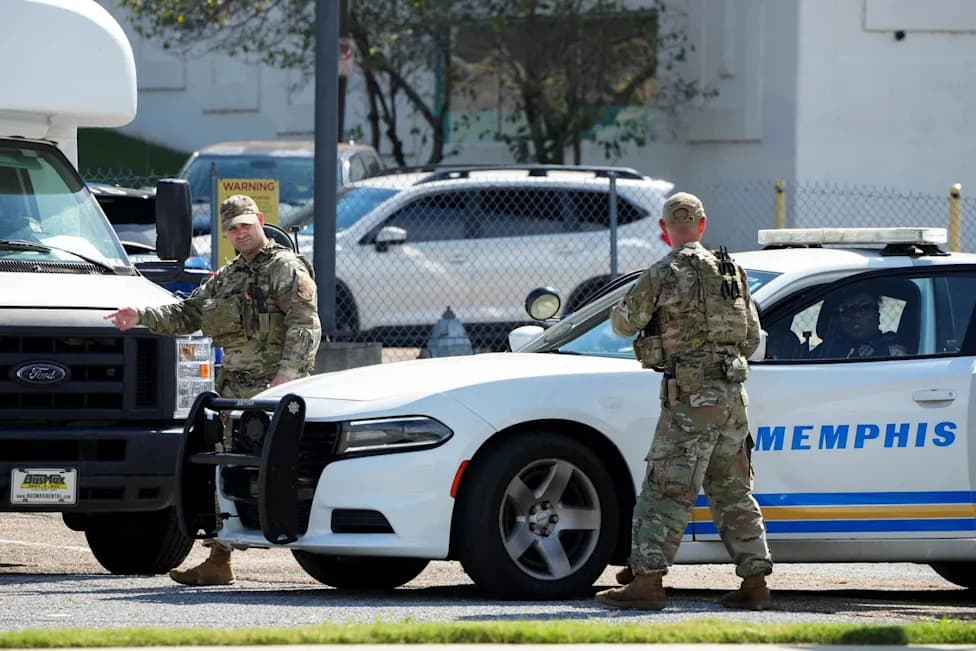
National guard members and Memphis police in downtown Memphis, Tennessee, on 10 October 2025.Photograph: Karen Pulfer Focht/Reuters
The U.S. Department of Justice plans to award up to $300 million through a new Model Cities Initiative (MCI) that would fund policing and public‑safety programs in two to four municipalities with populations above 100,000. The program offers unusually large, multi‑year grants — but comes with conditions that have drawn immediate criticism from city leaders, advocates and policy experts.
What The Grants Offer
The MCI would distribute roughly $300 million across two to four finalist cities, with funding intended to run for three years. Eligible cities could use grant money for police hiring, substance‑use recovery and re‑entry programs, facilities and training. The Justice Department frames the initiative as a targeted effort to reduce violent crime by surging federal resources into selected jurisdictions.
Controversial Conditions
Unlike many prior Justice Department grant competitions, the MCI ties awards to several policy and operational conditions that critics say reflect partisan priorities. According to the grant guidance and public statements, key conditions include:
- Local cooperation with federal immigration‑enforcement requests;
- Adoption and enforcement of stricter anti‑homelessness rules (including limits on urban camping and loitering) and measures that condition access to housing on compliance with treatment programs;
- Obligations to repay federal agencies for costs associated with future federal law‑enforcement interventions or assistance in the event of a surge in violent crime or public disorder;
- Documented "buy‑in and support" from local authorities — mayors, sheriff's offices, city councils and county commissions — as part of any successful application.
Selection Process And Models Cited
The department has cited Washington, D.C., and Memphis as models the MCI seeks to replicate; both cities have recently used National Guard or other federal resources in public‑safety operations. Observers note the selection process appears likely to rely on senior political appointees rather than the traditional, peer‑review processes used for many DOJ grants, a departure flagged by Amy Solomon, a senior fellow at the Council on Criminal Justice.
Amy Solomon: "To my knowledge, this funding condition is unprecedented. It forces applicants to agree — preemptively — to foot the bill for future, unspecified federal interventions in their own back yards."
Local Reactions
Several elected officials in large, predominantly Democratic cities have said they will not apply. Montgomery, Alabama Mayor Steven Reed reviewed the grant materials and declined to pursue the funds, calling the approach a short‑term fix that fails to address root causes of crime. City councils in Billings, Montana, and San Bernardino, California, have already voted against or paused MCI applications after public backlash.
A Justice Department spokesperson said jurisdictions have "expressed intense interest" and that senior department leaders are answering questions to help cities prepare competitive applications. The department declined to provide details about how the repayment clause would operate, whether it has received eligible applications, or whether national guard activations would be mandatory for recipients.
Context
The DOJ has long distributed local policing grants through the Office of Community Oriented Policing Services (COPS) — roughly $20 billion since 1994 and about $700 million offered this fiscal year for hiring, training and equipment. The MCI is funded through legislation supported by the current administration and would channel an additional $300 million specifically to a small number of cities under the new criteria.
Municipal leaders and advocacy groups say the MCI’s mix of policy conditions and financial incentives risks turning federal grants into leverage for adopting controversial law‑and‑order measures, raising legal, political and ethical questions about federal influence over local policing and homelessness policy.
Help us improve.