
Gaza's Health Ministry Director‑General Dr Muneer al‑Boursh has called for urgent action to "save" detained paediatrician Dr Hussam Abu Safia, saying his health is deteriorating after reported assaults in custody. Abu Safia, who led Kamal Adwan Hospital through an 85‑day siege, was detained on December 27, 2024, and is held without charge under Israel's Unlawful Combatant Law. Rights groups and the UN warn his life may be at risk, while Gaza's health system continues to collapse amid restricted aid and repeated ceasefire breaches.
Gaza Health Chief Urges Immediate Action To “Save” Detained Paediatrician Dr Hussam Abu Safia
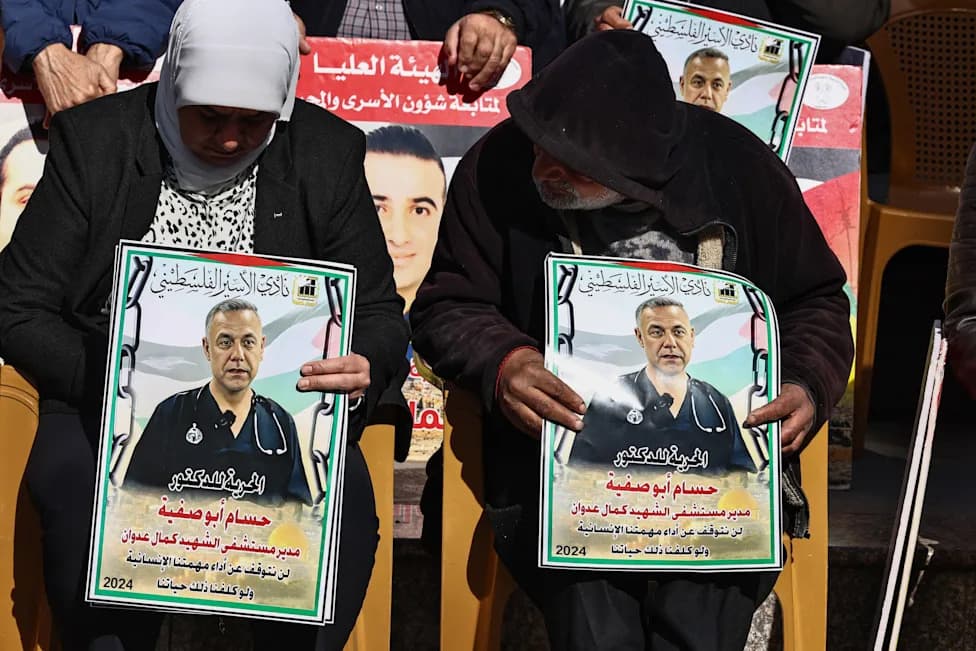
People lift placards bearing portraits of Palestinians detained by Israel, including Hussam Abu Safia, during a protest in solidarity with them in Ramallah, occupied West Bank [File: Zain Jaafar/AFP]
The director‑general of Gaza's Health Ministry has issued an urgent appeal to "save" Dr Hussam Abu Safia, a paediatrician detained by Israeli authorities since December 27, 2024, whose health is reported to be deteriorating.
Dr Muneer al‑Boursh said on X that "serious concerns are mounting" after reports that Abu Safia was assaulted while held in an Israeli detention facility and sustained injuries to his eye, head and chest. He warned that the absence of adequate medical care has made the doctor's condition "a source of extreme alarm that demands urgent action, not postponed statements."
"Dr Hussam Abu Safia, who stayed by his patients' side at Kamal Adwan Hospital in the bleakest of circumstances, now finds himself behind bars, stripped of his freedom, as fears grow for his physical safety and detention conditions," al‑Boursh wrote.
Abu Safia led Kamal Adwan Hospital — one of the last functioning hospitals in northern Gaza — through an 85‑day siege before Israeli forces entered the facility and detained him on December 27, 2024. He remains held without charge under Israel's Unlawful Combatant Law, a measure that permits indefinitely renewable detention; Israel's Supreme Court rejected an appeal for his release in June.
Abu Safia's lawyer, after a recent visit, reported new signs consistent with beatings and torture. Rights organisations, including Amnesty International and the United Nations Commission of Inquiry, have warned that his life may be in imminent danger. Al‑Boursh held the Israeli authorities "fully responsible for his life and safety" and demanded "an urgent, independent and comprehensive medical examination" and that the doctor receive necessary treatment.
The ministry chief also called for the release of Abu Safia and other detained health workers, and urged international bodies — including the International Committee of the Red Cross, the World Health Organization and the United Nations — as well as medical and human rights organisations, to intervene.
Broader Health Crisis in Gaza
The appeal came as Al Jazeera correspondents and UN officials described a sharp deterioration across Gaza's health sector nearly 10 months into a ceasefire that they say has been breached repeatedly. Reporters cited continued military operations in populated areas, restricted access through border crossings and severe shortages of medicines and supplies.
Al Jazeera's Noor Khaled reported that so‑called Israeli‑controlled "yellow" zones now cover more than 70% of the Gaza Strip, confining Palestinians to less than 30% of the territory. Crossings remain largely closed; of roughly 600 aid trucks expected daily, correspondents said no more than 250 are entering. Around 20,000 patients are reportedly waiting to be evacuated for treatment abroad.
From Deir al‑Balah, Ashraf Abu Amra reported that Nasser Hospital has been losing "three to four patients dying daily" owing to shortages of medicines and supplies. Last week, a medical supply warehouse serving nearly half a million people was destroyed near Al‑Aqsa Martyrs Hospital, according to local reports.
Ajith Sunghay, head of the UN human rights office in the Occupied Palestinian Territories, told Al Jazeera Gaza's health system is among the hardest hit and that recovery "will take generations." He warned that malnutrition, damaged shelter and lack of safe drinking water cannot be tackled while the entry of essential and dual‑use materials remains restricted.
Gaza's Health Ministry reported that hospitals received two people who had died of their wounds and six injured in the past 24 hours; the ministry says these casualties raise the death toll since last October's ceasefire to 1,257 with 4,131 wounded. The ministry also reports more than 73,000 Palestinians killed in the broader hostilities since October 2023. These figures are attributed to Gaza health authorities.
The situation surrounding Dr Abu Safia remains fluid. Independent international medical access and an impartial investigation into allegations of assault and inadequate care are being demanded by Gaza officials and several human rights groups.
Help us improve.





















