
SpaceX's Crew-13 is scheduled to launch no earlier than Sept. 12 from Cape Canaveral, carrying NASA astronauts Jessica Watkins and Luke Delaney, Canadian Josh Kutryk and Roscosmos' Sergey Teteryatnikov to the ISS for an ~seven-month Expedition 75/76 increment. The Dragon capsule Grace has completed final integration and will fly with updates including Rev. 3 spacesuits and metal mud flaps for Draco thrusters; Falcon 9 booster maintenance begins in August. The crew will conduct medical and agricultural experiments, perform station maintenance and several planned EVAs, and will overlap with Soyuz crews and members of Delaney's astronaut class.
A Very Busy Mission: SpaceX's Crew-13 Set to Launch Four Astronauts to the ISS on Sept. 12
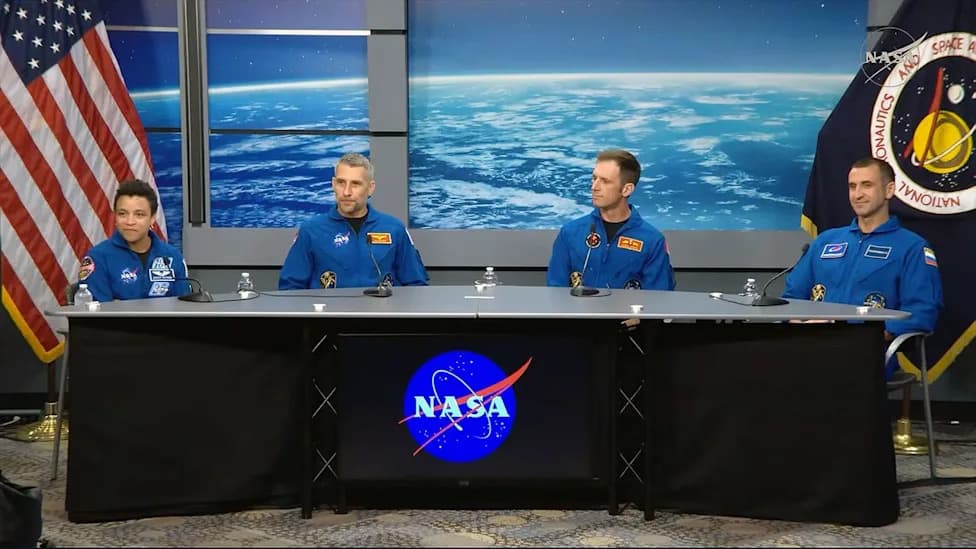
A woman and three men wearing blue coveralls sit at a table with the NASA logo on its front and flags to both sides.
SpaceX and its international partners remain on track to launch Crew-13 no earlier than Sept. 12 from Space Launch Complex-40 at Cape Canaveral Space Force Station in Florida, mission managers and the astronauts confirmed during a press briefing at NASA's Johnson Space Center in Houston on Aug. 3.
The four-person crew assigned to fly aboard SpaceX's Crew Dragon Grace includes NASA commander Jessica Watkins and pilot Luke Delaney, Canadian Space Agency mission specialist Josh Kutryk, and Roscosmos mission specialist Sergey Teteryatnikov. The team is scheduled to rendezvous with the International Space Station the day after launch for an approximately seven-month increment as part of Expedition 75/76.
Mission Goals and Science
Watkins, the only Crew-13 member with prior spaceflight experience, said the team expects "a very busy mission" with extensive station maintenance, several planned EVAs (extravehicular activities), visiting-vehicle operations and a robust science agenda. Planned investigations include:
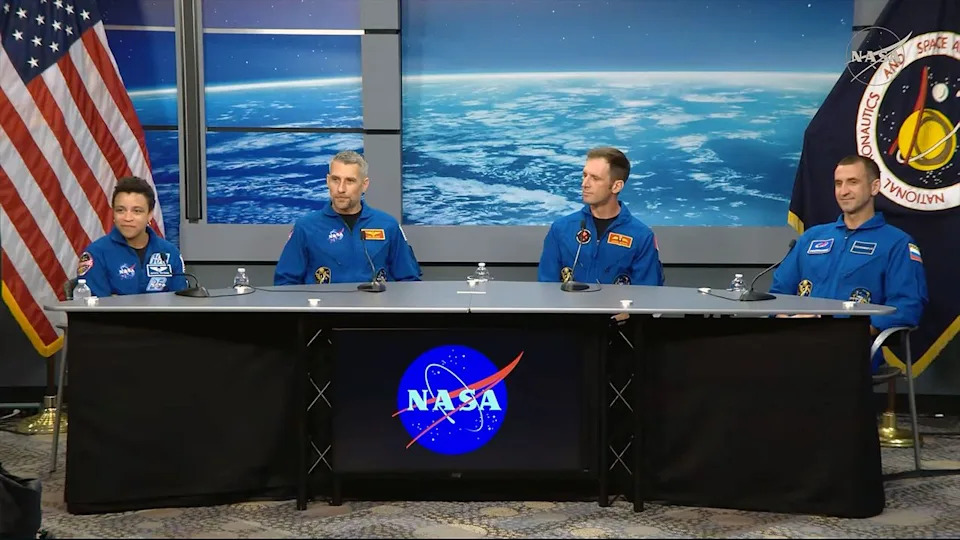
From left to right, Crew-13 commander Jessica Wakins and pilot Luke Delaney, both of NASA, Canadian Space Agency astronaut Joshua Kutryk and Roscosmos cosmonaut Sergey Teteryatnikov, both mission specialists, take questions from reporters during an Aug. 3, 2026 press conference at NASA's Johnson Space Center in Houston, Texas. | Credit: NASA
- Studies using human stem cell–derived tissues to advance understanding of heart disease and Parkinson's disease.
- Crop-production experiments relevant to longer-duration missions.
- Research to better characterize blood-flow abnormalities observed on long missions.
- Evaluation of new diagnostic medical equipment to monitor crew health in space.
"Every time we do a human spaceflight mission, it gives us an opportunity to strengthen our understanding of low Earth orbit," said Joel Montalbano, NASA's deputy associate administrator for human spaceflight. "It also broadens international relationships and showcases what we can do for human spaceflight in LEO."
Vehicle, Hardware and Preparations
Dana Weigel, manager of NASA's Low Earth Orbit Program at Johnson, said final integration of the Dragon is complete: "The capsule was stacked on the trunk just last week and mission preparations are proceeding well for a mid-September launch." Falcon 9 booster maintenance is set to begin in August; the booster designated for this flight previously supported Crew-12 and officials reported no major issues for the campaign.
The crew will rehearse suit-up and ingress procedures on Aug. 7 when they first don SpaceX's updated "Rev. 3" spacesuits and climb into Grace. The Rev. 3 suits offer improved donning and doffing, plus adjustments to accommodate spinal lengthening that can occur on orbit. Managers say the dress rehearsal builds muscle memory and provides a psychological boost before flight.
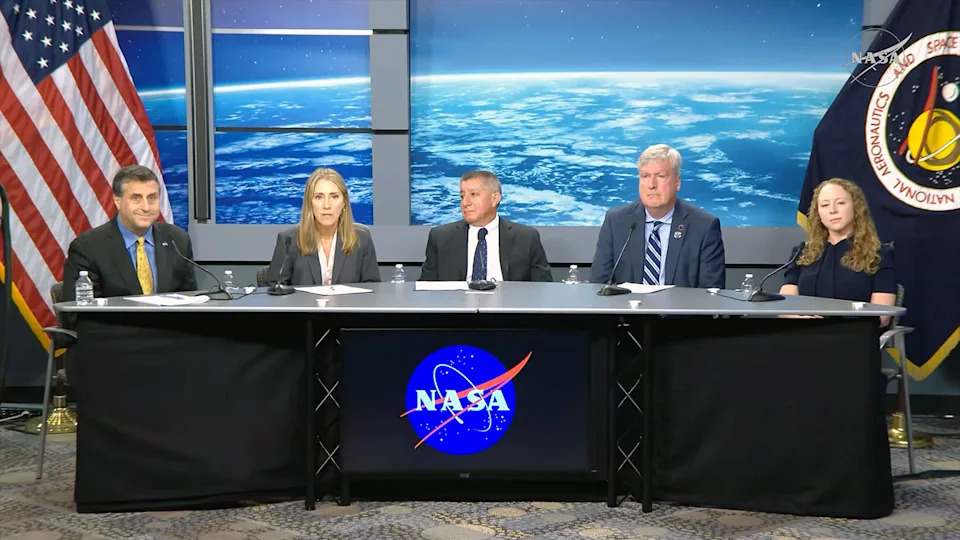
Crew-13 mission managers take part in a pre-flight press conference on Monday, Aug. 3, 2026 at NASA's Johnson Space Center in Houston. From left to right: Joel Montalbano, deputy associate administrator, Human Spaceflight Mission Directorate, NASA Headquarters; Dana Weigel, manager, Low Earth Orbit Program, NASA Johnson; Richard Jones, deputy director, NASA's Commercial Crew Program; Mathieu Caron, director, Astronauts, Life Sciences, and Space Medicine, CSA; and Julianna Scheiman, director, NASA Science and Dragon Programs, SpaceX. | Credit: NASA
Grace will also carry hardware updates: new metal "mud flaps" for Draco abort thrusters replace earlier carbon-fiber components, and, for the first time, SpaceX will use Tesla Cybertrucks to evacuate crew from the pad area in a pre-launch emergency. Richard Jones, deputy program manager for NASA's Commercial Crew Program, described extensive certification to ensure Cybertruck controls work with gloved hands and that crew can egress while wearing bulky suits.
Crew Notes and International Partners
Josh Kutryk will be the fourth Canadian to serve on an ISS crew and the second Canadian to fly this year after Jeremy Hansen's Artemis II lunar mission in April. Kutryk reflected on his background growing up on a cattle farm and thanked the many teams whose work makes missions like this possible.
Delaney said he is excited to share station time with members of his astronaut candidate class, nicknamed "The Flies" (selected in 2021), and joked about hoping for a slight delay so several class members can overlap on station. The Crew-13 increment will overlap with incoming and outgoing Russian Soyuz crews as part of normal station operations.
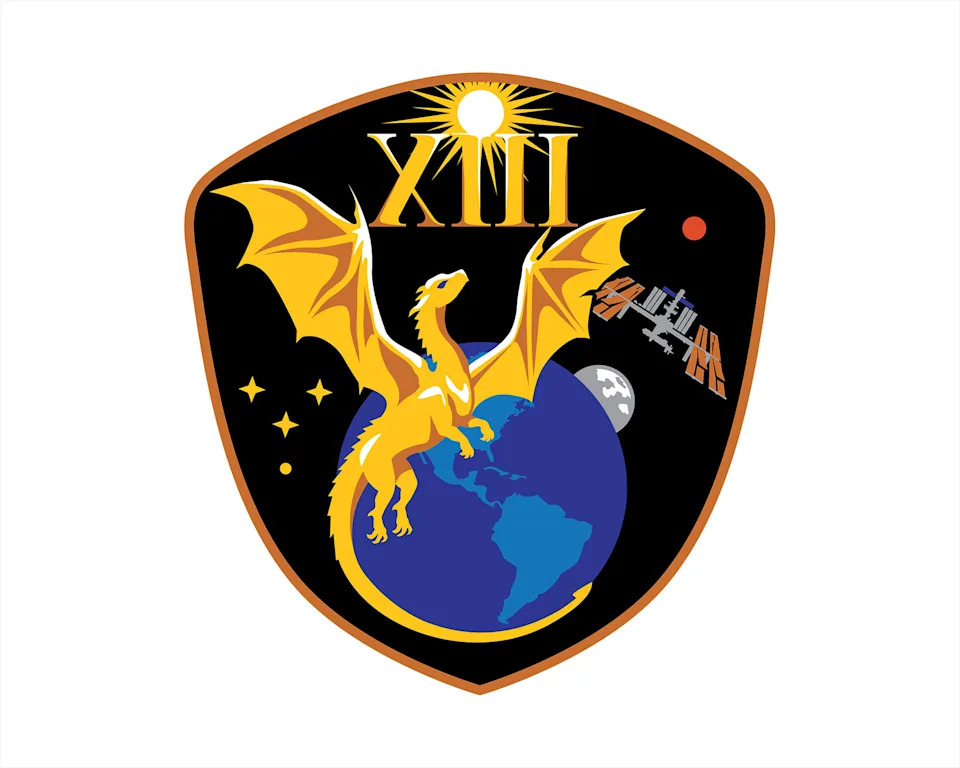
The central golden dragon on NASA's SpaceX Crew-13 patch harkens back to Apollo 13, embodying resilience and gazing upward to the dawn of a new era of discovery. | Credit: NASA
Some timing is beyond mission control: Kutryk is expecting his third child while assigned to the station. He noted that previous astronauts have experienced similar timing and said his family and support network are prepared for the unique circumstances.
"We expect a very busy mission with lots of station maintenance, both internal and external, with a few EVAs on the docket," said Watkins. "Lots of science — very interesting science experiments that will be flying with us — and plenty of outreach."
The pre-flight briefing included mission managers and program leads from partner organizations: Joel Montalbano; Dana Weigel; Richard Jones; Mathieu Caron, director of Astronauts, Life Sciences and Space Medicine at the Canadian Space Agency; and Julianna Scheiman, director of NASA Science and Dragon Programs at SpaceX.
Photo credits: NASA
Help us improve.





















