
US forces struck three Iranian nuclear sites — Fordow, Natanz and Esfahan — in an operation President Trump said involved a "full payload of bombs" and "obliterated" key facilities. The IRGC declared "War starts right now," and Israel raised its national alert level. US officials cited B-2 stealth bombers and large bunker-buster munitions as likely tools used, but details and full damage assessments remain unclear.
US Strikes Iran's Nuclear Sites — Trump Says They Were 'Obliterated' as IRGC Declares 'War Starts Right Now'
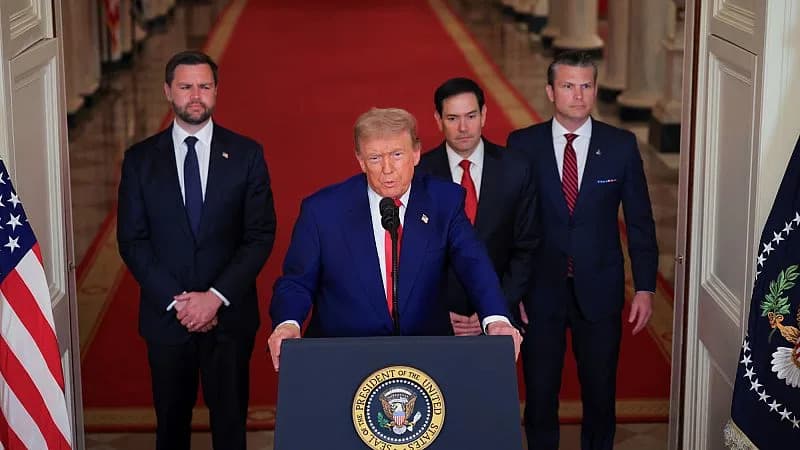
US 'obliterates' Iranian main nuclear sites, Tehran declares 'war starts now'
US forces carried out strikes on three Iranian nuclear sites — Fordow, Natanz and Esfahan — an operation President Donald Trump described on Truth Social as dropping a "full payload of bombs" that "obliterated" the targeted facilities. The White House said B-2 stealth bombers were used but provided limited operational details.
Operation Details
Speaking from the White House, Mr. Trump called the mission a "spectacular military success" and warned that "if they do not [make peace], future attacks will be far greater and a lot easier." Officials from the US and Israel have pointed to the use of B-2 stealth bombers and very large bunker-buster munitions as the most likely means of reaching deeply buried infrastructure.
Those bunker-busters are believed to be capable of penetrating roughly 60 metres per strike; however, some reports indicate parts of the Fordow complex may lie hundreds of metres underground, so the extent of damage to all facilities may remain uncertain.
Responses And Regional Escalation
The Islamic Revolutionary Guard Corps (IRGC) declared "War starts right now," saying the strikes escalated a prior exchange of missile and drone attacks into a broader confrontation. Israel announced it had raised its national alert level and suspended many civilian activities, restricting operations to essential sectors.
Domestic US reactions were sharply divided. Senator Lindsey Graham praised the president's decision, while House Democratic Leader Hakeem Jeffries accused Mr. Trump of misleading the nation and warned the strikes increased the risk of a wider war and endangered US troops in the region.
Forces And Readiness
Between 40,000 and 50,000 US service members are stationed in the region and are reported to be on heightened alert following the strikes. The Pentagon and White House have not released a detailed assessment of damage or collateral effects, and intelligence updates are likely to follow.
What Remains Unclear
Officials have not publicly confirmed the exact munitions used or released a full damage assessment. Iran's Supreme Leader Ayatollah Ali Khamenei had warned that attacks on Iran would "result in irreversible damage" for the attackers; Tehran has previously pledged retaliation if the US directly engaged in strikes. The risk of broader regional escalation remains high.
Key takeaway: The strikes mark a significant escalation of US involvement in the Israel–Iran confrontation and leave immediate regional stability and long-term outcomes uncertain.
Help us improve.





















