
The Vera C. Rubin Observatory released a 3,200‑megapixel composite of the COSMOS Field that reveals more than 500,000 galaxies and 50,000+ stars. Compiled from hundreds of exposures taken during commissioning (Apr 2025–Jan 2026), the mosaic covers roughly one‑sixth of the southern visible sky and was released with Data Preview 2. The LSST Camera — the largest digital camera built for astronomy — weighs ~3,000 kg and uses mirrors plus three large lenses to feed its 3,200MP sensor. Repeated visits over the coming years will enable discoveries of transients and variable objects for community follow‑up.
Rubin Observatory’s 3,200‑Megapixel Mosaic Reveals 500,000+ Galaxies and 50,000+ Stars
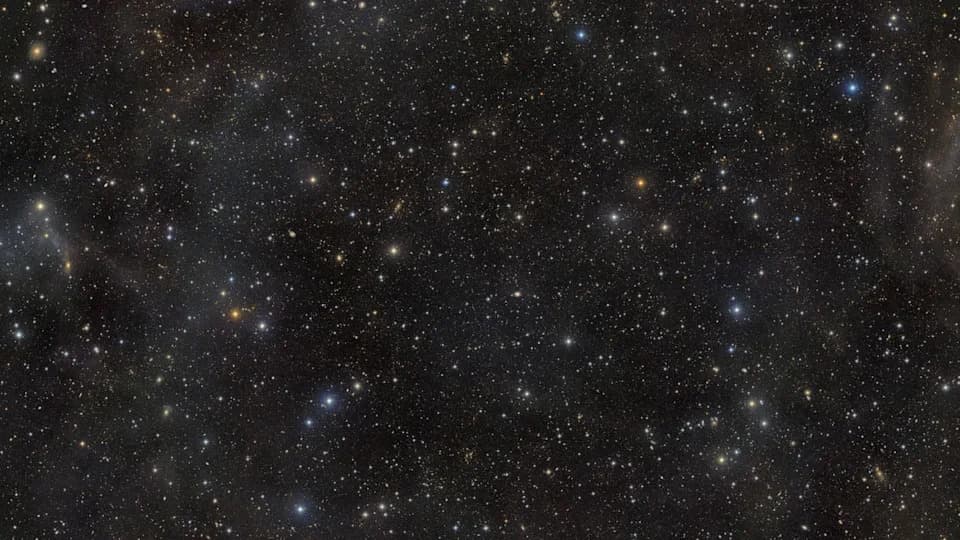
Credit: NSF–DOE Vera C. Rubin Observatory/NOIRLab/SLAC/AURA
A newly released 3,200‑megapixel composite image from the Vera C. Rubin Observatory’s LSST Camera captures more than half a million galaxies and over 50,000 stars, offering an unprecedented wide‑field view of the COSMOS Field and a preview of the survey's discovery potential.
The COSMOS Field is a heavily studied patch of sky chosen for its low foreground obscuration by the Milky Way. Because relatively few Milky Way stars and little dust lie along this line of sight, the mosaic exposes an extraordinary variety of distant systems: spiral and elliptical galaxies, interacting and merging systems, and red, distant galaxies that probe earlier eras of cosmic history. The frame spans roughly one‑sixth of the visible night sky in the southern hemisphere.
Rather than a single shot, the mosaic is built from hundreds of individual LSST exposures collected during commissioning between April 2025 and January 2026. The image release accompanies the first phase of the Rubin Observatory’s Data Preview 2 and is intended to showcase what the full Legacy Survey of Space and Time (LSST) will deliver over its decade‑long campaign.
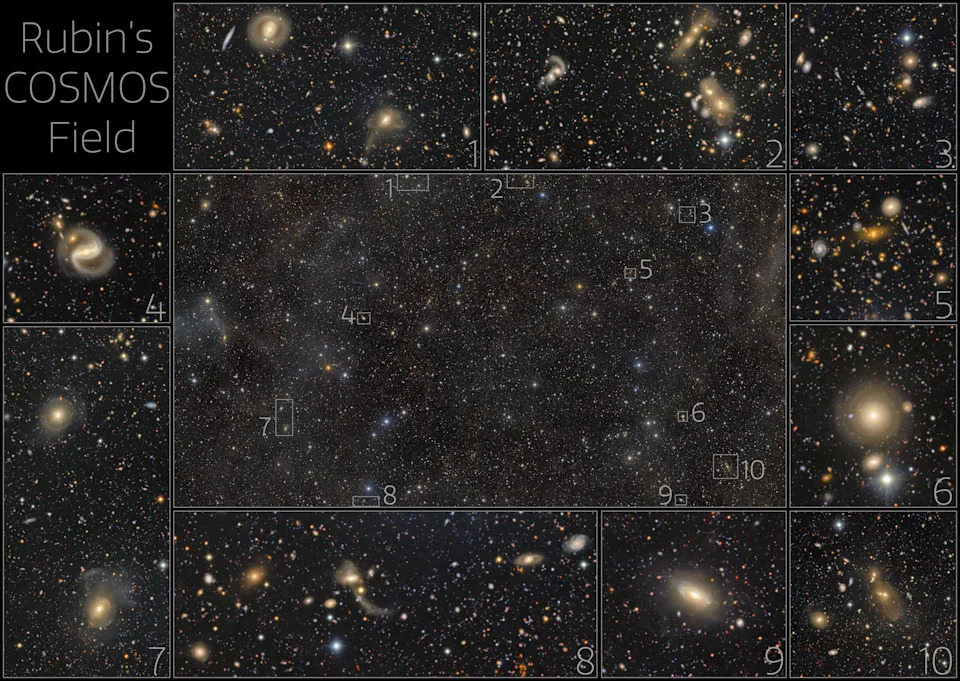
This graphic shows close-up details for several parts of the original image, showing off different shaped galaxies | Credit: NSF–DOE Vera C. Rubin Observatory/NOIRLab/SLAC/AURA
About the LSST Camera
The LSST Camera is the largest digital camera ever constructed for astronomy. It carries a 3,200‑megapixel focal plane and an optical assembly that uses mirrors plus three large lenses to focus light onto the sensor. The camera weighs about 3,000 kg (roughly the size and mass of a small car); according to NOIRLab, matching its raw resolution with a typical smartphone sensor would require on the order of 260 phones. Even the interchangeable filters are substantial, each weighing about 40 kg (90 lb).
“The COSMOS deep image is just the beginning for Rubin in this region,” said Bob Blum, Director of the Rubin Observatory at NSF NOIRLab. “Repeated visits in the coming years will demonstrate our survey design by delivering very large samples of transient and variable objects, including supernovae and other explosive events that the community can follow up and study in detail.”
Although Rubin’s formal decade‑long survey only recently began, these commissioning mosaics already hint at the observatory’s power. Repeated imaging of the same fields will allow astronomers to detect transient phenomena, monitor variability, and build statistically powerful samples for follow‑up observations.
Early images from the commissioning period are publicly accessible for inspection and pixel‑level exploration through the Vera C. Rubin SkyViewer web app, where researchers and enthusiasts can zoom in on galaxies and other objects across the COSMOS mosaic.
Help us improve.





















