
NASA’s Juno spacecraft used its Microwave Radiometer to measure, for the first time, a steep subsurface temperature increase on Jupiter’s moon Io — more than 40°F within a few feet. Two close flybys in Dec. 2023 and Feb. 2024 sampled depths from inches to tens of feet using six frequencies between 0.6 and 22 GHz. Models point to either conductive heat flow (~1–3 W/m2) or buried cooling lava flows covering ~8% of the area, though neither fully explains the data. The technique gives researchers a new tool to study tidal heating on Io and other moons that may hide subsurface oceans.
Juno Detects a Sudden Heat Spike Just Below Io’s Surface — First Direct Subsurface Measurements
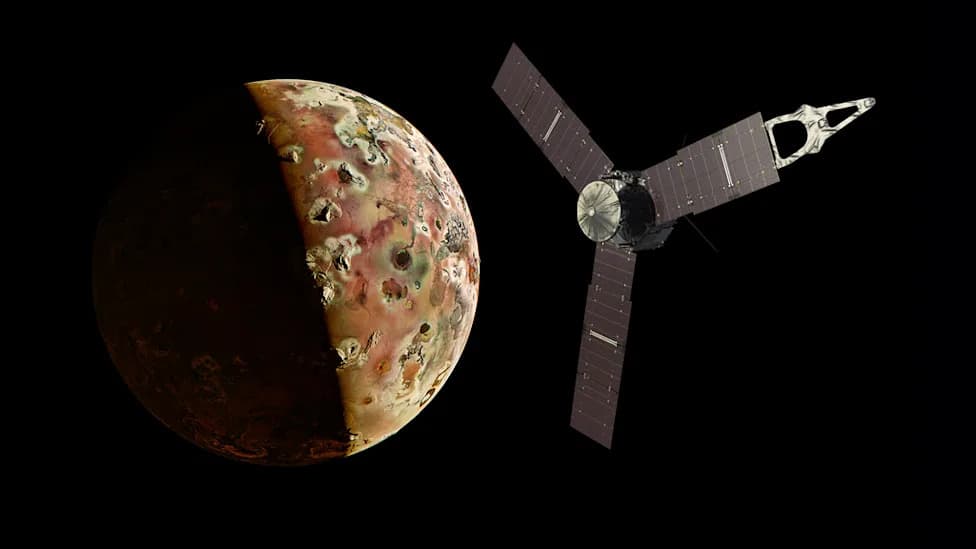
NASA's Juno spacecraft made the first direct measurements of the temperature beneath the surface of Jupiter's moon Io using the Microwave Radiometer, (MWR), invented and designed by Southwest Research Institute's Dr. Scott Bolton. (CREDIT: NASA/JPL-Caltech/SwRI/MSSS/Thomas Thomopoulos)
Io looks frozen from afar, but NASA's Juno spacecraft has for the first time directly measured intense heat buried just beneath the moon’s crust. Data from Juno’s Microwave Radiometer (MWR) show temperatures rising by more than 40°F within only a few feet of the surface — a steep gradient that reveals how efficiently Io sheds the enormous internal energy that powers its volcanoes.

This infrared image was derived from data collected by the Jovian Infrared Auroral Mapper (JIRAM) instrument aboard Juno. In this image, the brighter the color, the higher the surface temperature recorded by JIRAM. (CREDIT: NASA/JPL-Caltech/SwRI/ASI/INAF/JIRAM)
These findings come from two close flybys on Dec. 30, 2023 (1,494 km) and Feb. 3, 2024 (1,506 km), and are published in the Journal of Geophysical Research: Planets. The MWR uses six microwave bands from 0.6 to 22 GHz, with each frequency sampling different depths from inches to tens of feet. That lets the instrument probe thermal emission far deeper than infrared sensors, which typically sense only millimeters to centimeters into the ground.
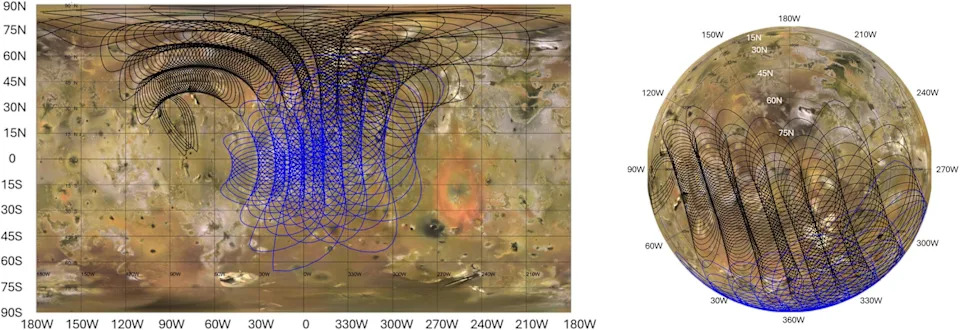
MWR sampling and footprints on Io for PJ57 (black) and PJ58 (blue) for the 12° beams. (CREDIT: Dr. Scott Bolton et al, Journal of Geophysical Research: Planets)
What Juno Saw
Across the Jupiter-facing hemisphere that Juno sampled, microwave measurements consistently showed a sharp temperature increase with depth. Shannon Brown of NASA’s Jet Propulsion Laboratory, the paper’s lead author, notes that "that is a gradient far steeper than solar heating alone can explain." The microwave data also indicate that Io’s uppermost surface behaves like a relatively smooth, specular reflector at large scales and has dielectric and density values lower than expected for solid basalt.
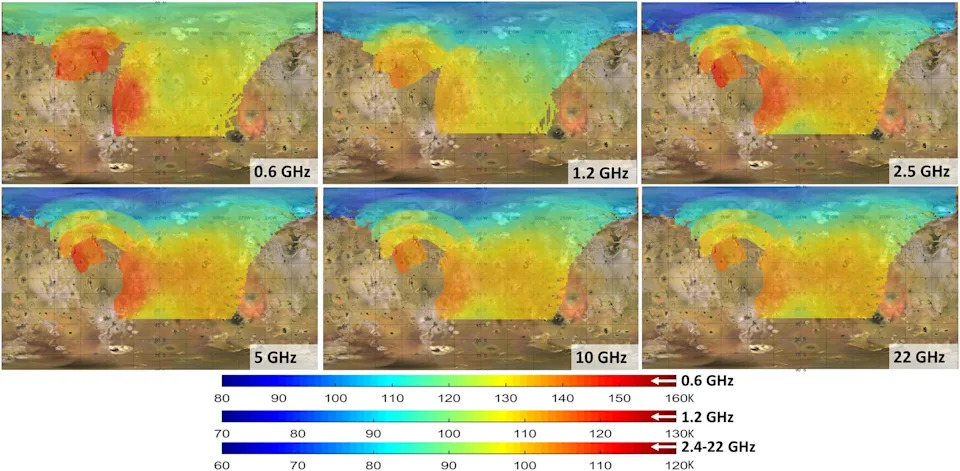
MWR upwelling surface brightness temperature mapped on the surface of Io for each channel. (CREDIT: Dr. Scott Bolton et al, Journal of Geophysical Research: Planets)
"The Juno microwave radiometer directly observed Io's heat output by looking below the surface," said Scott Bolton of the Southwest Research Institute, Juno’s principal investigator. "Seeing below the surface of a rocky moon was a surprise with important implications for studying volcanic heat on Earth and other worlds."
Layer Properties and Porosity
Under the study’s model assumptions, the top layer’s bulk density is estimated at roughly 0.7–1.1 g/cm3, consistent with porous volcanic materials such as ash, pumice or scoria rather than dense basalt. Modeled porosities are high — near ~85% if the layer were pure basalt or ~75% for pure sulfur — implying a very loose, low-density veneer over a denser substrate several meters below, which the lower-frequency microwaves appear to sense.

Context map for the model fit indicating the area sampled (3 dB footprint at 0.6 GHz) in black, with bright flow units outlined in red, dark flow units in blue and undivided flow units in white. The red triangles indicate hot spot locations. (CREDIT: Dr. Scott Bolton et al, Journal of Geophysical Research: Planets)
Two Plausible Explanations
The team tested two main interpretations to explain the subsurface warming:
- Conductive Heat Flow: A steady upward flow of heat through Io’s crust could produce heat fluxes on the order of 1–3 W/m2. That range matches global estimates of Io’s tidal heat output (roughly 2–3 W/m2), far above Earth’s average (~0.06 W/m2). The conductive scenario could also imply stronger heating toward higher latitudes, though that depends on uncertain thermal and microwave absorption properties.
- Buried Cooling Lava Flows: Alternatively, cooling lava flows buried beneath an ~11 m crust could account for the microwave pattern if such flows occupy on the order of ~8% of the sampled area — a value comparable to independent estimates of fresh lava coverage on Io.
Neither model fully reproduces the detailed frequency-dependent temperature profile Juno observed: both predict a smoother change across microwave channels than measured. The mismatch may indicate depth-varying temperature gradients, heterogeneous subsurface structure, or frequency-dependent microwave absorption by different materials.
Why This Matters
Microwave radiometry opens a new window into subsurface heat on rocky and icy worlds. For Io, continued MWR observations could map where heat escapes and help determine where conduction dominates versus where buried lava plays a larger role. The same processes of tidal heating that power Io’s volcanism also operate on icy moons such as Europa and Enceladus and can sustain subsurface oceans — making Io a valuable laboratory for understanding heat and energy in the outer solar system.
The full results are available in Journal of Geophysical Research: Planets. These measurements expand the toolkit for studying planetary heat transport beyond what infrared observations can reveal.
Help us improve.





















