
The Hillsborough meteorite fell on July 16, 2024, and a homeowner’s quick recovery of about 1.35 kg of fragments preserved exceptionally pristine material. Laboratory analyses classify the rock as a rare CM1/2 carbonaceous chondrite and reveal evidence of past saline fluids (brines), enhanced water alteration, ~1.8% carbon, and a diverse suite of organics including amino acids. These findings show that small asteroids can host brine-driven mineral-organic chemistry capable of producing complex molecules that may have been delivered to early Earth.
Hillsborough Meteorite Crashes Through New Jersey Home, Revealing Briny Clues to Life’s Origins
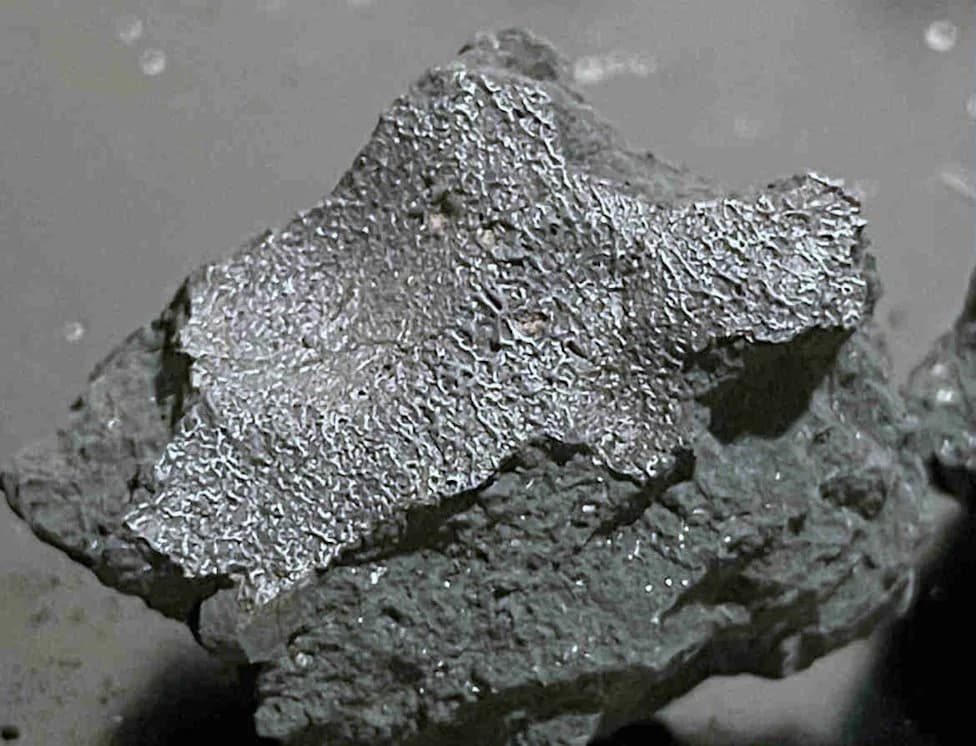
A meteorite that crashed into a New Jersey home contains rare evidence of ancient salty water and organic molecules tied to life's origins. (CREDIT: SETI Institute)
On the afternoon of July 16, 2024, a bright meteor streaked across the northeastern United States and produced a shockwave felt by some observers. Traveling at roughly 32,000 miles per hour, the object passed just south of the Statue of Liberty before fragmenting as it plunged through the atmosphere.
Cameras in Northford, Connecticut, Douglassville, Pennsylvania, and a doorbell camera in Wayne, New Jersey, captured the fireball, enabling researchers to reconstruct a trajectory that traced back to the low asteroid belt. Radar tracked a descending cloud of debris after the meteor became invisible at an altitude near 22 miles. The largest pieces landed in and around Hillsborough, New Jersey.
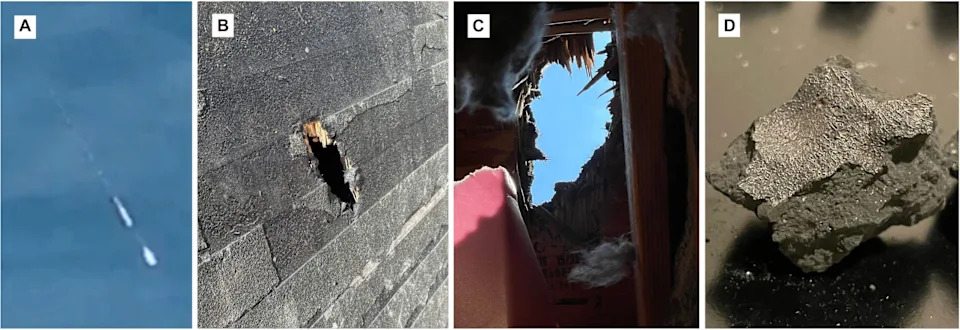
Impact and recovery of Hillsborough. (CREDIT: Science Advances)
One fragment struck the roof of a private home and crashed into the master bedroom, scattering black fragments and dust across the bed and floor. The homeowner, who heard a loud crack, described finding a hole in the ceiling and smelling a strong sulfur-like odor. Wearing gloves, he quickly gathered the fragments and stored them carefully — a response scientists later credited with preserving unusually pristine material.
Researchers recovered about 1.35 kilograms of fragments from the fall; the material is now known as the Hillsborough meteorite. Laboratory analysis confirmed it as a carbonaceous chondrite in the CM group, but unusually it was classified as an intermediate CM1/2 subtype — a rare classification for a witnessed fall. According to scientists, only one other CM1/2 meteorite has ever been observed falling to Earth.
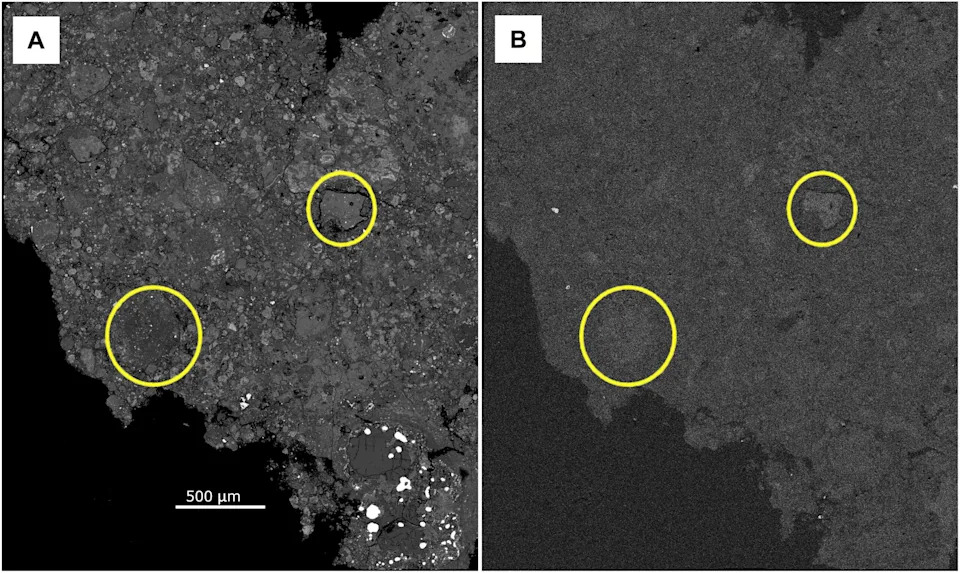
C1 clasts in Hillsborough. (CREDIT: Science Advances)
Pristine Preservation
Because the homeowner collected pieces immediately and fragments avoided exposure to rain or soil, the samples retained delicate chemical signatures often lost in typical finds. That rare preservation allowed high-resolution laboratory studies of fragile minerals and organic compounds.
Evidence of Brines and Water Alteration
Detailed studies revealed salt-rich veins and regions within the rock, indicating that liquid saline fluids (brines) once flowed through parts of the meteorite's parent asteroid near its surface. Researchers described these as concentrated salty fluids that would have concentrated dissolved elements and fostered mineral-organic reactions.
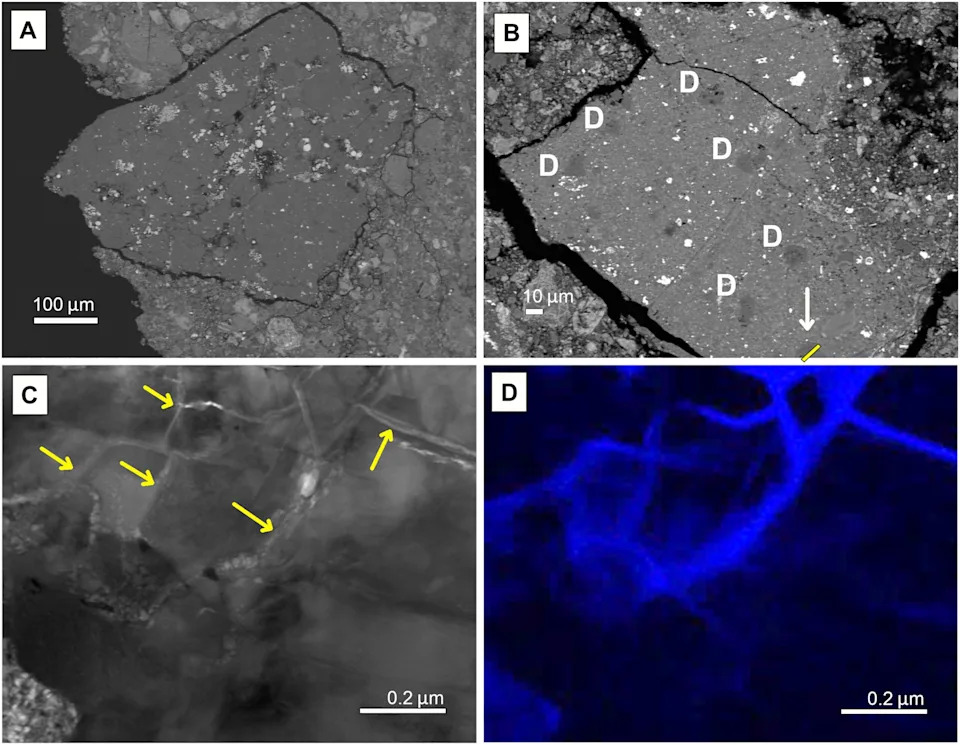
Na enriched veins in C1 clasts. (CREDIT: Science Advances)
"A forensic study of the fragments revealed preserved bits from near the surface of a primitive asteroid where it experienced concentrated salty fluids," said Peter Jenniskens of the SETI Institute.
Earlier related work identified uranium-iron-oxygen compounds in similar meteorites; in the Hillsborough samples, investigators focused on salt-rich zones and sodium-enriched veins that point to past movement of liquid water. Brine-mediated chemistry is important because brines keep elements dissolved and reactive, creating favorable environments for building complex organic molecules.
Rich Organic Inventory
Hillsborough contains roughly 1.8 percent carbon and measurable nitrogen — levels consistent with other primitive carbonaceous chondrites linked to early Earth chemistry. Scientists detected a diverse suite of organic compounds, including many amino acids. Some amino acids are rare on Earth, supporting an extraterrestrial origin.
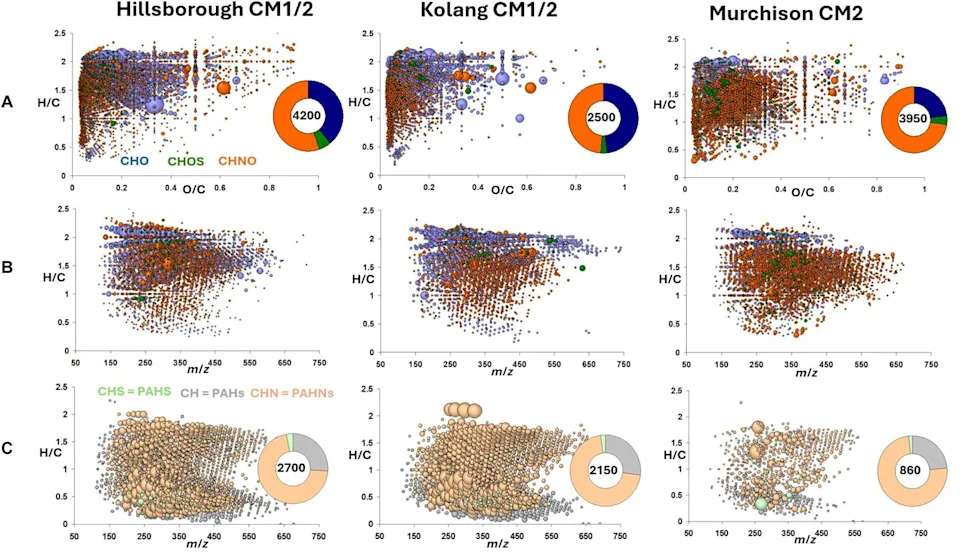
Diversity of organic compounds. (CREDIT: Science Advances)
"Isotope studies of carbon and nitrogen align with the pattern seen in primitive carbonaceous chondrites and support the idea these meteorites delivered organic matter to early Earth," explained Queenie Chan of Royal Holloway University of London. Danny Glavin of NASA Goddard Space Flight Center and colleagues concluded that many of the amino acids and organics likely formed inside the asteroid itself under the influence of brine chemistry. Phil Schmitt-Kopplin of Technical University Munich added that a large fraction of compounds appear to derive from reactions between organics and minerals.
Implications for Origins of Life and Planetary Science
The Hillsborough meteorite preserves a record of water activity, salt formation and mineral-organic interactions that likely occurred billions of years ago on a parent body in the main asteroid belt. These findings broaden the types of small bodies considered capable of producing complex, life-related molecules and strengthen the idea that chemically active asteroids contributed molecular precursors to early Earth.
Beyond origins-of-life questions, the discovery suggests that brine-related chemistry may have been more widespread across small solar system bodies than previously thought. That has implications for future exploration: salty, water-bearing environments on asteroids, icy moons or other worlds could host similar prebiotic chemistry.
Research on the Hillsborough meteorite and its astrobiological implications is published online in Science Advances. The original account of the fall was reported by The Brighter Side of News.
Help us improve.





















