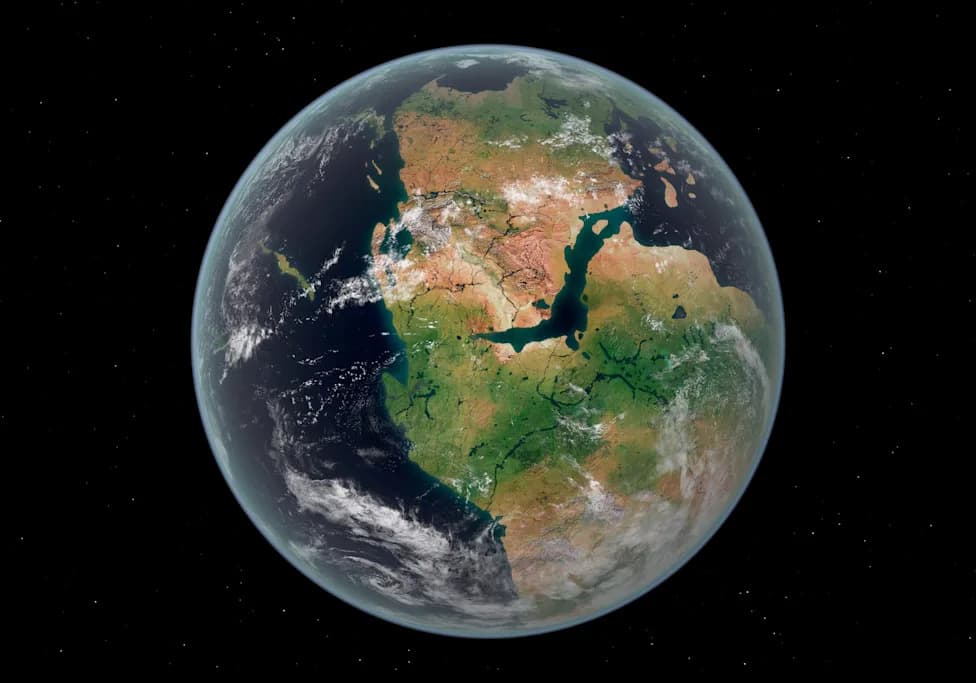
Researchers led by Richard Ghail argue that widespread polygonal fracture networks, extremely long canali and wrinkle ridges on Venus may be relics of ancient seafloor processes. The team estimates oceans could once have covered about 90% of Venus and contained roughly 40% as much water as Earth's oceans. While each line of evidence can be interpreted differently, taken together they form a persuasive — though still debated — case that Venus was once watery before a runaway greenhouse transformed the planet. Future high-resolution mapping by EnVision and VERITAS could confirm or refute this hypothesis.
New Study Argues Venus May Once Have Been Covered by Oceans on 90% of Its Surface
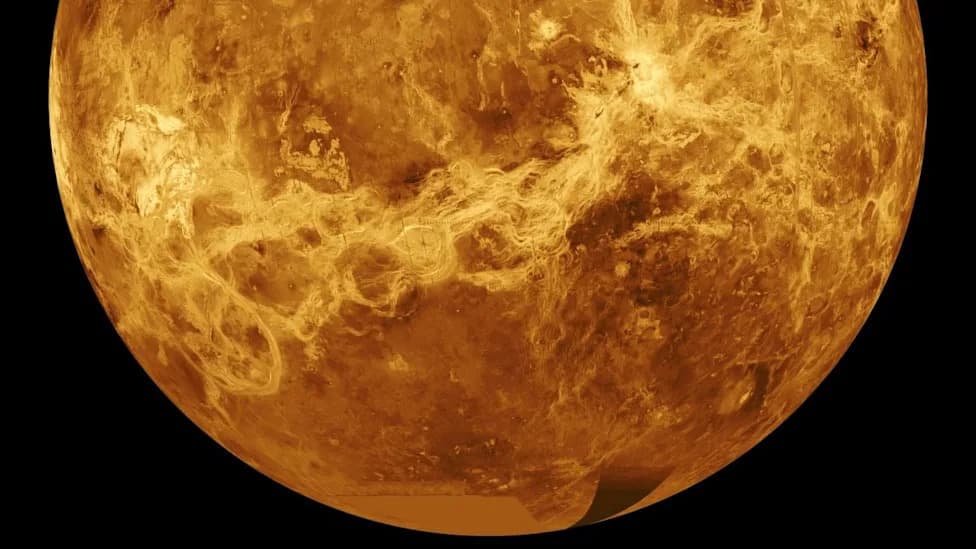
A radar-based global view of Venus created from Magellan spacecraft data. The false colors are based on images returned by the Soviet Venera 13 and 14 landers. (NASA/JPL)
Earth and Venus are planetary near-twins in size, density and composition, yet their surfaces could not be more different. Earth is temperate, watery and alive; Venus is a hellish world with a dense carbon dioxide atmosphere, sulfuric acid clouds, crushing surface pressure and temperatures hot enough to melt lead.
A new paper in Earth and Planetary Science Letters, led by geologist Richard Ghail (University of London), re-examines Venus's radar-mapped surface and argues that several widespread landforms may be best explained as the remains of ancient seafloor rather than purely volcanic features. If correct, the implication is that oceans once covered roughly 90% of Venus and may have contained about 40% as much water as Earth's oceans.
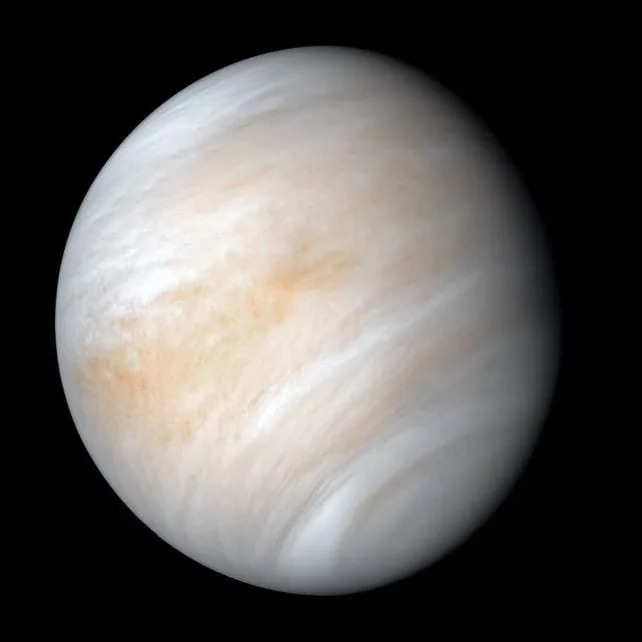
Venus photographed by NASA's Mariner 10 spacecraft in 1974. (NASA)
Three Lines of Geological Evidence
The authors focus on three classes of features that, together, form a coherent — though not definitive — case for former seas:
1. Large Polygonal Fracture Networks. Vast plains on Venus are patterned by kilometer-scale polygonal fractures. Previous studies often interpreted these as cooling cracks in volcanic flows. Ghail and colleagues note these polygons closely resemble polygonal fault systems formed in clay-rich marine sediments on Earth, where thick buried seafloor muds expel water, compact and shrink to produce similar patterns.
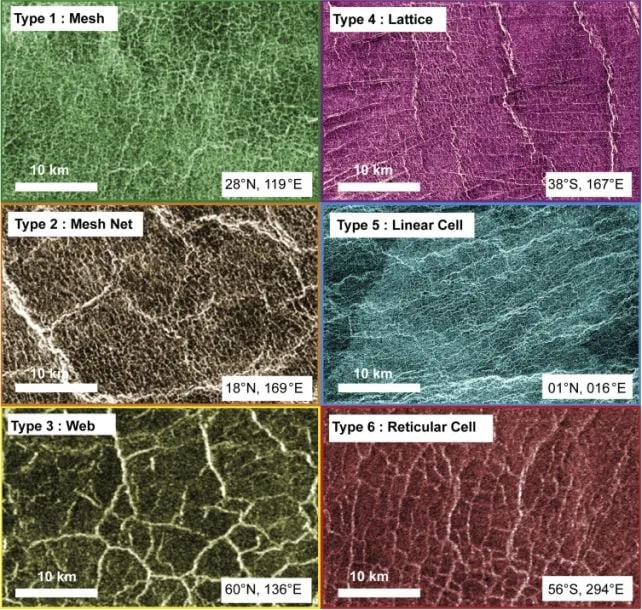
Some of the polygons on the surface of Venus, not all of which are easily explained by volcanic processes. (Ghail et al.,Earth Planet. Sci. Lett., 2026)
2. Long Canali (Channels). Venus hosts exceptionally long, sinuous channels called canali, some extending for thousands of kilometers. While often assumed to be lava channels, the lengths and morphologies of many canali challenge this interpretation. The new study highlights similarities with submarine channel systems on Earth, carved by dense, sediment-laden currents. Roughly one-third of the polygonal terrains are spatially associated with canali that appear to originate without clear volcanic sources and terminate in deeper basins — consistent with underwater channels rather than surface lava flows.
3. Wrinkle Ridges Over Potential Evaporites. Wrinkle ridges that crisscross Venus's lowlands may overlie thick evaporite (salt) deposits left behind as oceans evaporated. The authors draw an analogy to Earth's Messinian Salinity Crisis in the Mediterranean, when large salt layers were deposited and influenced regional tectonics. Ghail's team estimates Venus could have accumulated evaporite layers at least 64 meters (210 feet) thick — conceivably thicker — enough to affect crustal deformation and ridge formation.
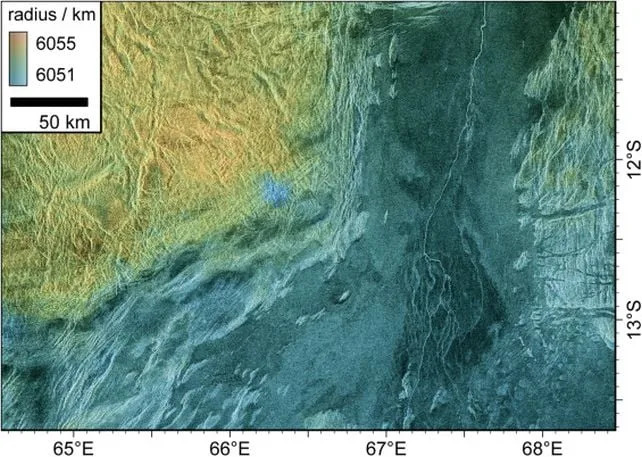
Features consistent with marine formation pathways. (Ghail et al.,Earth Planet. Sci. Lett., 2026)
Interpretation and Limits
None of these three features is conclusive on its own: polygonal patterns, canali and wrinkle ridges can also be produced by volcanic, tectonic or other geologic processes unique to Venus. The authors acknowledge the interpretation is ambiguous and emphasize that the argument is strongest when the lines of evidence are considered together.
If the marine interpretation is correct, the transition from ocean-bearing Venus to the current runaway greenhouse state may have occurred less than a billion years ago. That timing raises profound questions about the potential for life on an early Venus and the fragility of habitable climates on Earth-like worlds.

Subscribe to ScienceAlert's free fact-checked newsletter
What's Next
Testing this hypothesis will require higher-resolution mapping than is available from NASA's Magellan radar mission of the early 1990s and earlier flybys. Two upcoming missions — ESA's EnVision and NASA's VERITAS — aim to map Venus in much greater detail and could help distinguish between volcanic and marine origins for these features.
"While the interpretation of these features is not unambiguous, there is a compelling case that Venus once supported oceans, and perhaps life, across most of its surface," the paper states.
Reference: Ghail et al., Earth and Planetary Science Letters (2026).
Help us improve.