
New supercomputer-driven 3D modeling of the Sun's atmosphere shows the star contains about 55% more silver than previous estimates, largely reconciling a long-standing difference with meteorite measurements. The revision stems from an improved interpretation of solar spectral lines, but results remain sensitive to how silver interacts with hydrogen. Further lab data and observations (for example from the SUNRISE SUSI instrument) should reduce uncertainties. The team will apply the method to other stars to trace silver production across the Milky Way.
Sun Has 55% More Silver Than Previously Thought — Solving a Long-Standing Meteorite Puzzle
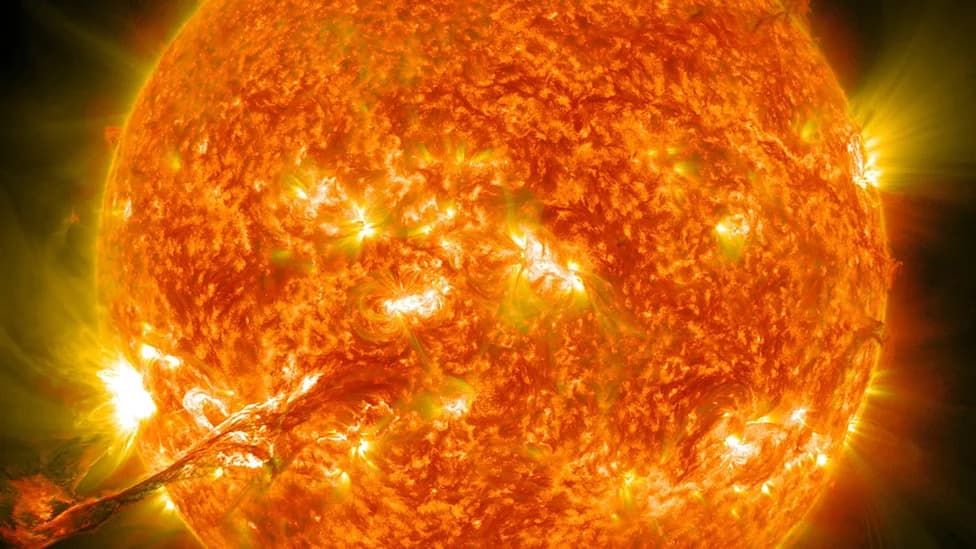
(NASA/Unsplash)
For years scientists have been puzzled that ancient meteorite fragments contain far more silver than measurements of the Sun suggested, even though both formed about 4.6 billion years ago from the same primordial cloud of gas and dust. A new study in Astronomy & Astrophysics offers a compelling explanation: the Sun contains substantially more silver than earlier analyses indicated.
Although hydrogen and helium still account for roughly 98.5 percent of the Sun's mass, the research team reports the star holds about 55 percent more silver than previous estimates found. That revision largely closes the gap between solar measurements and the silver abundance measured directly in meteorites.

The researchers studied the spectrum of light coming from the Sun to identify the elements within it. (DrPixel/Moment/GettyImages)
How the Change Happened
The revision follows a reassessment of the Sun's spectrum. As starlight passes through the Sun's outer atmosphere, atoms absorb light at precise wavelengths, producing dark spectral lines that reveal which elements are present. Each chemical element leaves a distinct fingerprint, and silver is detected through its own spectral features.
Using a supercomputer, the team applied a far more detailed three-dimensional model of the Sun's atmosphere and radiative transfer to reinterpret how silver atoms absorb and scatter solar radiation. That improved modeling changed how the silver spectral lines are read and led to the larger abundance estimate.

YouTube Thumbnail
“With our new model, we were able to interpret the spectral lines used to determine the solar silver abundance more accurately,” says astrophysicist Sema Caliskan of Uppsala University.
Implications and Remaining Uncertainties
Bringing the Sun's silver content up by 55 percent largely reconciles the difference between solar and meteoritic silver abundances — meteorites being direct samples of early Solar System material. Beyond resolving a compositional mismatch, the result has broader astrophysical importance: silver is produced in specific stellar processes and explosive events, so a more accurate solar abundance helps trace nucleosynthesis and the chemical evolution of the Milky Way.
The authors caution that their improved model still carries uncertainties. The calculations proved most sensitive to the input data describing how silver atoms collide and interact with hydrogen atoms. Those hydrogen-collision rates affect spectral-line shapes and therefore the inferred abundance.

Subscribe to ScienceAlert's free fact-checked newsletter
To reduce these uncertainties, the team recommends additional laboratory data and higher-resolution observations. Instruments such as the SUNRISE UV Spectropolarimeter and Imager (SUSI), which has collected detailed ultraviolet solar spectra, could help calibrate models and refine the measurement.
Looking ahead, the researchers plan to apply the enhanced modeling approach to other stars. By using silver as a tracer, astronomers hope to map where and when the element was produced across the Galaxy and build a clearer picture of the Milky Way's enrichment history.
The study is published in Astronomy & Astrophysics.
Help us improve.





















