The Freedom 250 Grand Prix, scheduled for August 22–23 around the National Mall, could subject museums and monuments to damaging noise and ground vibration. Key at-risk items include the Declaration of Independence, the Calder mobile, the Wright brothers' plane, and Ben Shahn's frescoes—some of which already show cracking. Federal review under Section 106 has been limited, and preservation experts warn sound levels may exceed 130–140 decibels; mitigation or postponement is urged.
Why the Freedom 250 Grand Prix Is a Risk to the National Mall and Its Treasures
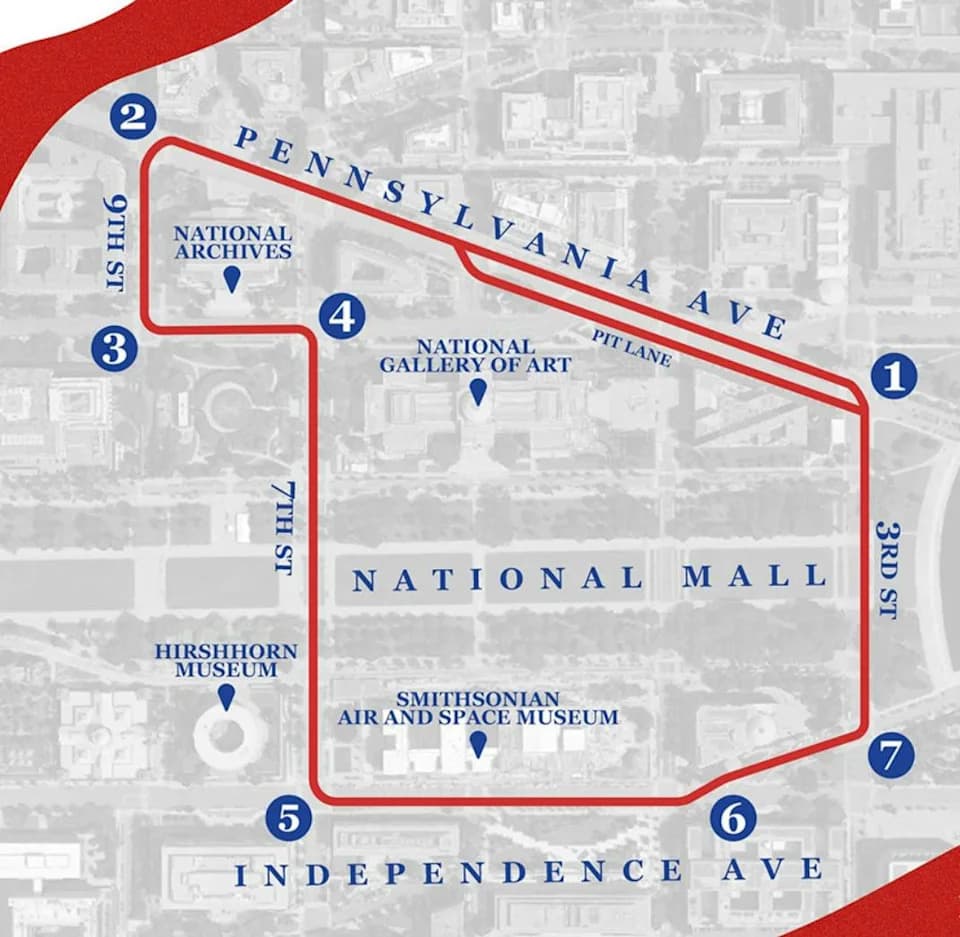
Map of the course planned for the Freedom 250 Grand Prix
The Freedom 250 Grand Prix—marketed as "Let Freedom Rev!"—is planned for August 22–23 to run an Indy-style course around Washington's National Mall. While billed as a patriotic celebration, two days of high-speed Indy cars producing intense noise and ground vibration could imperil a uniquely dense collection of historic, scientific, and artistic objects clustered along the race route.
What’s At Risk?
The race course runs past or alongside many nationally significant sites and collections, including:
- National Gallery of Art — including the 76-by-30-foot Calder mobile in the East Wing and the outdoor sculpture garden
- National Archives — home to the Declaration of Independence, the Constitution, and the Bill of Rights
- National Air and Space Museum — housing the Wright Brothers' plane and Charles Lindbergh's Spirit of St. Louis
- Wilbur J. Cohen Federal Building — containing New Deal frescoes by Ben Shahn, Philip Guston, and Seymour Fogel (already showing plaster cracking)
- Hirshhorn Museum and Sculpture Garden, National Museum of the American Indian, National Museum of Natural History, and the National Museum of American History (nearby, home to the Star-Spangled Banner and the Revolutionary-era gunboat Philadelphia)
- Independently listed outdoor works such as Michael Lantz's "Man Controlling Trade," the 1882 Temperance Fountain, and the Winfield Scott Hancock statue
How the Event Came Together
The race was promoted by Bud Denker (Penske Corporation) and Erik Shanks (Fox Sports) and gained the backing of Transportation Secretary Sean Duffy. After a proposed route that would have passed the U.S. Capitol was shortened, President Trump signed an executive order directing the secretary to expedite permits and approvals. The planned course is roughly 1.7 miles with seven turns.
Legal, Scientific, and Preservation Concerns
Federal law—Section 106 of the National Historic Preservation Act—requires review of federal actions that may affect historic properties. Section 106 regulations allow agencies to consider vibratory impacts (commonly from construction, trains, or heavy machinery). The Advisory Council on Historic Preservation (ACHP) has recently endorsed a proposed rollback of some Section 106 protections, but that proposed rule has not been finalized and cannot legally be applied before public notice and comment.
Despite these protections, there is little public evidence that any federal agency conducted a comprehensive vibration assessment for the Grand Prix route. The National Park Service consulted the D.C. State Historic Preservation Office and concluded there would be "no adverse effects," but that review did not appear to evaluate interior collections or consult with the National Trust for Historic Preservation. The General Services Administration said it identified "no areas of concern."
Sara Bronin (former ACHP chair): "You wouldn't want to see some of these things topple over because of the rumblings and the vibrations."
Independent experts and preservation advocates warn of high sound levels and vibrations. Mary Okin of the Living New Deal flagged potential sound levels "in excess of 130 decibels" during the race—well above common urban noise and comparable to levels produced by jet engines (Indy-style race noise is often estimated near 140 dB). Museums routinely monitor vibration from foot traffic; some studies note damage thresholds above roughly 80 dB for sensitive historic materials.
Preservation standards commonly measure vibration using peak particle velocity (PPV). Prior agreements for construction projects (for example, a 2012 memorandum covering projects in Kentucky and Indiana and a 2009 agreement for the Coast Guard headquarters project in Washington, D.C.) set maximum PPV limits around 0.20 inches per second. No similar PPV limit or comprehensive monitoring plan has been publicly applied to the Freedom 250 Grand Prix.
Recommendations and Mitigation Options
- Delay the event until independent vibration and acoustic impact studies are completed for buildings, collections, and outdoor works along the route.
- If the race proceeds, implement strict monitoring (on-site conservators and vibration sensors) and contingency plans that allow immediate suspension if thresholds are exceeded.
- Consider engineering mitigations such as temporary sound barriers, protective cases for the most fragile objects, and restrictions on spectator locations and temporary structures.
- Engage all relevant preservation stakeholders (ACHP, National Trust, museum conservation teams, DC SHPO) in a transparent public review under Section 106.
Bottom line: The Freedom 250 Grand Prix poses real preservation risks to irreplaceable national collections and monuments. Given the cultural and historic value concentrated along the Mall, prudence calls for a full, transparent assessment and enforced protections before any high-vibration event is allowed to proceed.
Help us improve.