
New research using archived ALMA observations suggests SETI efforts should broaden their search beyond the traditional 1.42–1.66 GHz "water hole." Louisa Mason led ALMA's first targeted search for narrowband signals at higher radio frequencies; no artificial transmissions were found. The authors stress that limited frequency coverage and a small dataset mean nondetections are not conclusive and call for wider-frequency surveys and more dedicated observations.
SETI May Be Tuning to the Wrong Frequencies — ALMA Survey Urges Broader Search
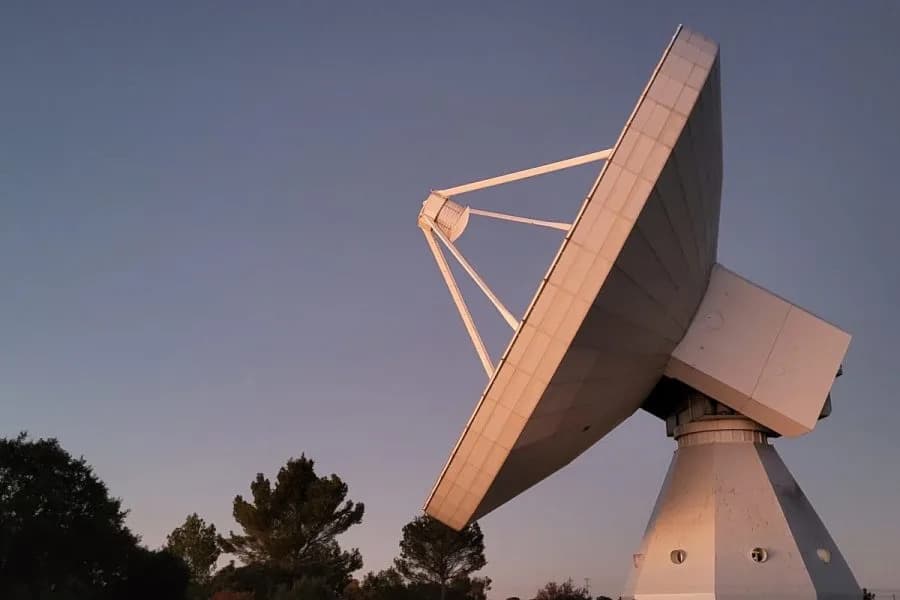
For decades, many efforts to find extraterrestrial intelligence have focused on a narrow slice of the radio spectrum known as the "water hole" — the band between 1.42 and 1.66 GHz where emissions from hydrogen and hydroxyl dip. The idea: an advanced civilization might view those quiet frequencies as a natural place to transmit or listen.
What Researchers Did
Researchers led by Louisa Mason, a PhD student at the University of Manchester, re-examined archived observations from the Atacama Large Millimeter/submillimeter Array (ALMA) in Chile to test whether useful SETI signals might be found at higher radio frequencies. This survey represents ALMA's first dedicated search for narrowband radio spikes—sharp spectral features that could indicate artificial transmissions rather than natural processes.
Results and Limits
The analysis found no clear evidence of engineered signals in the limited frequency windows examined. However, the study demonstrates that telescopes operating at higher radio frequencies can be viable tools for SETI work.
"For decades, SETI searches have concentrated on a relatively small part of the radio spectrum. We wanted to ask what might happen if we looked somewhere very different," Mason said.
Importantly, a nondetection in this survey does not rule out intelligent life. The study examined only two narrow frequency windows and relied on a relatively small set of archived observations, so many possible frequencies and observational strategies remain unexplored.
Why This Matters
Radio signals travel efficiently across interstellar distances and are comparatively inexpensive to monitor compared with sending probes, which is why radio SETI is attractive. Yet focusing too narrowly on the traditional water hole could miss transmissions located elsewhere in the radio spectrum. Mason and her colleagues urge the astronomical community to expand SETI searches across a broader range of frequencies and instruments to increase the chances of detecting technological signals, if they exist.
Future work should include more extensive frequency coverage, dedicated observing time on high-frequency radio facilities, and development of search techniques tailored to different parts of the spectrum.
Help us improve.





















