
NASA's Nancy Grace Roman Space Telescope is slated to launch Aug. 30 on a SpaceX Falcon Heavy and will travel to Lagrange Point 2 to begin wide‑field surveys. Roman will deliver more than 500 TB of data per year and image roughly 2 billion galaxies with a field of view about 50× wider than JWST. Its Wide‑Field Instrument and a coronagraph aim to map dark matter and dark energy at large scales and to image exoplanets near bright stars.
NASA’s Roman Space Telescope Set to Launch Aug. 30 — A Wide‑Field Observatory Poised to Revolutionize Astronomy
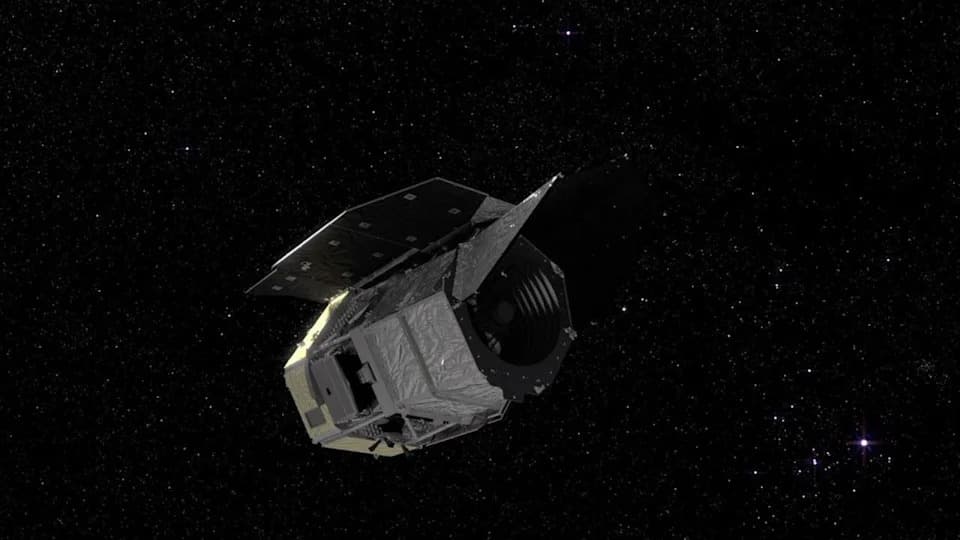
A visualization of the Roman Space Telescope in space. | Credit: NASA Goddard Space Flight Center Scientific Visualization Studio
NASA is preparing to launch the Nancy Grace Roman Space Telescope on Aug. 30 aboard a SpaceX Falcon Heavy. The observatory — a next‑generation wide‑field survey telescope — will travel to Lagrange Point 2 (L2) to begin a mission designed to map billions of galaxies, study dark energy and dark matter, and image exoplanets.
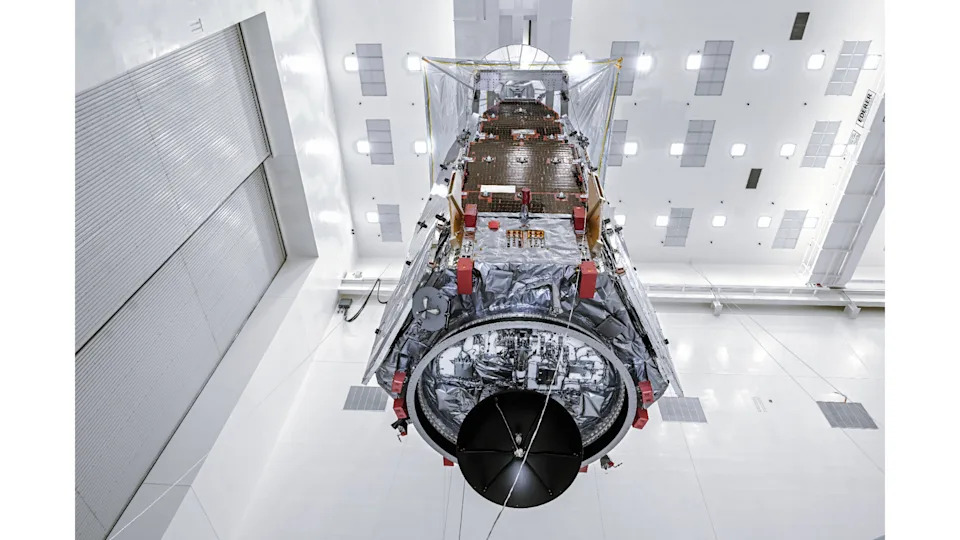
The Roman Space Telescope hangs in the clean room. | Credit: NASA/Sydney Rohde (Rocz)
Launch, Encapsulation, and Timeline
The Roman mission, with a development cost of about $4 billion, is scheduled to lift off at 7:26 a.m. EDT (1126 GMT). Encapsulation — installing the observatory into the Falcon Heavy fairing — is planned in the weeks before launch. After launch, Roman will transit to L2 and perform a final orbit insertion around day 100 to reach its stable operating orbit.
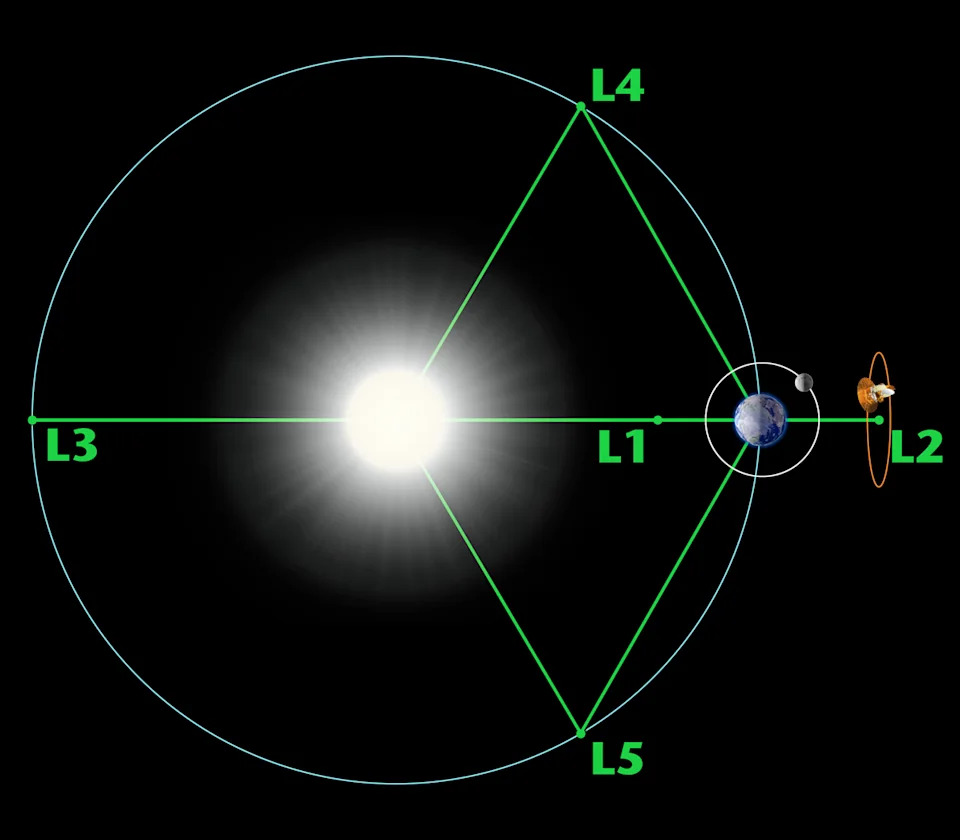
A diagram of the Lagrange points. | Credit: NASA / WMAP Science Team
Fuel and Operations
Roman has been loaded with hydrazine propellant. Hydrazine remains in use across many missions because of its high performance despite being toxic and chemically reactive; NASA continues to research safer alternatives. Perkins, Roman's telescope integration and test scientist, explained that the propellant budget covers midcourse corrections en route to L2 and provides enough fuel for momentum dumps and station‑keeping for at least five years.
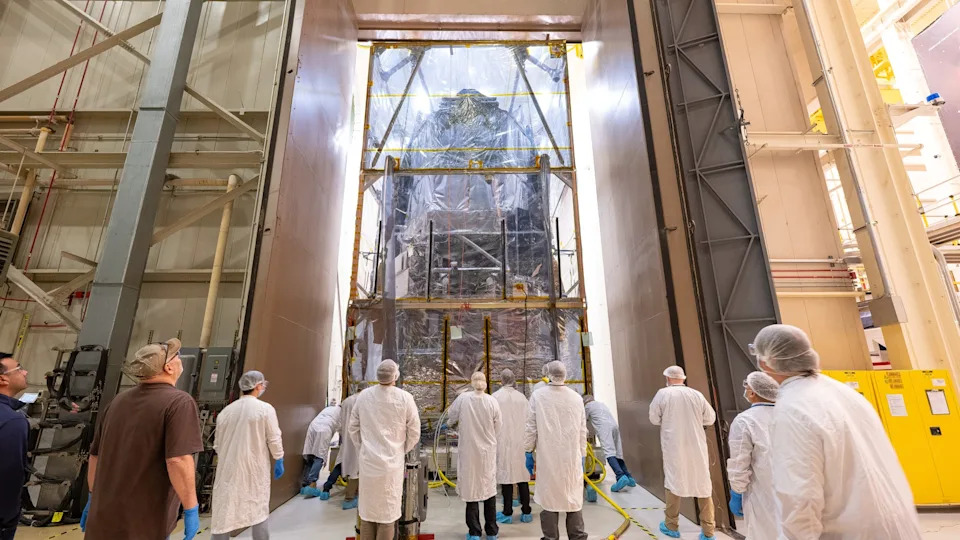
The Roman Space Telescope undergoing acoustic testing. | Credit: NASA/Jolearra Tshiteya
How Roman Compares To Hubble And Webb
On a per‑pixel basis Roman achieves sensitivity and sharpness comparable to the Hubble Space Telescope, but its Wide‑Field Instrument (WFI) surveys far more sky in far less time. Scientists estimate Roman will return more than 500 terabytes of data per year; by comparison, Hubble has produced roughly 400 TB over its ~35 years of service. Roman’s imaging footprint is roughly 50 times wider than that of the James Webb Space Telescope, trading some deep infrared sensitivity for vastly larger panoramic surveys.
"One month of observations to survey our Milky Way would take about a century with Hubble," said Julie McEnery, Roman's senior project scientist. "We would need over half a million 4K TVs to fully display a single Roman image from our largest survey — covering 45 Manhattan city blocks."
Key Instruments And Science Goals
Roman carries two primary science capabilities: a Wide‑Field Instrument that will image roughly 2 billion galaxies during its main surveys, and a technologically advanced coronagraph designed to suppress starlight so planets near bright stars can be directly imaged. Together, these tools will enable large‑scale studies of galaxy clustering and motions to probe dark matter and dark energy, and they will advance exoplanet characterization.
Discovery Potential And Legacy
As with past flagship observatories, Roman’s greatest breakthroughs may be the unexpected ones. Shawn Domagal‑Goldman of NASA noted that earlier observatories enabled practical advances — like improved asteroid tracking — that their builders did not anticipate. Roman is named for Nancy Grace Roman, NASA’s first chief of astronomy and an architect of the original Hubble mission. The team hopes the data Roman delivers will inspire future generations of astronomers.
"The next Dr. Nancy Grace Roman, sitting in a classroom somewhere next year, will be studying our data and hopefully catch the science bug," said project manager Jackie Townsend. "I could not be prouder to be part of this project."
What To Watch: Launch on Aug. 30; transfer and final orbit insertion around day 100; first light, deployment of the aperture cover, and downlinked science data shortly after arrival at L2.
Help us improve.





















