
Simulations of 25 Milky Way–like galaxies show that head-on mergers and dramatic disk reorientations can produce a slowly rotating stellar halo. The dwarf galaxy Gaia-Sausage-Enceladus, which collided with the Milky Way 8–11 billion years ago and had an estimated mass >10 billion solar masses, likely contributed to the halo's properties. A ~90° disk flip would temporarily misalign halo and disk rotation and could have affected the Sun's orbit if it occurred during the solar system's lifetime.
Simulations Suggest the Milky Way's Disk Flipped ~90° After an Ancient Collision
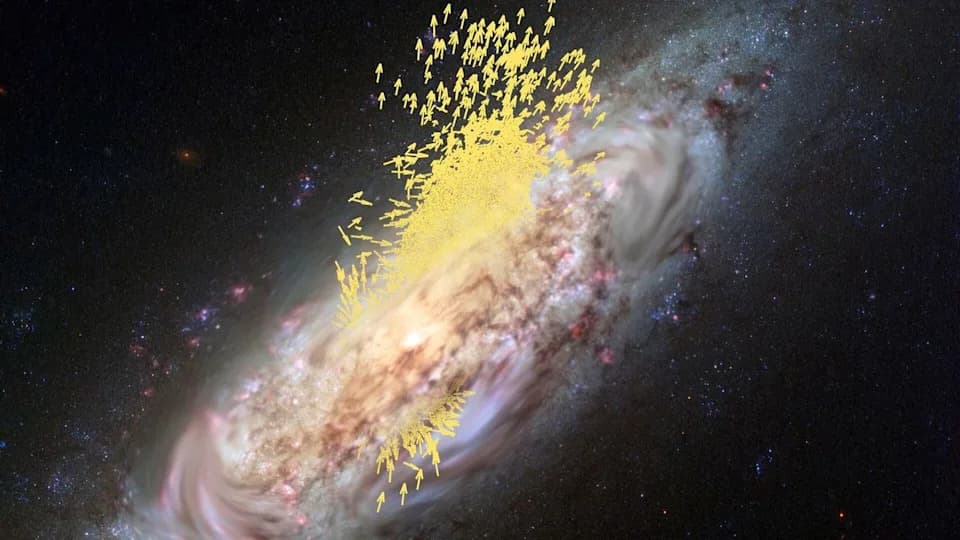
An artist's impression of the collision between the Milky Way and the Gaia-Sausage-Enceladus dwarf galaxy. The arrows indicate the motion of stars from the dwarf. | Credit: ESA (artist's impression and composition); Koppelman, Villalobos and Helmi (simulation); NASA/ESA/Hubble (galaxy image)
New supercomputer simulations indicate our galaxy's spiral disk may once have rotated by roughly 90°, a dramatic reorientation that could explain why the Milky Way's stellar halo rotates far more slowly than its disk.
Background
Spiral galaxies like the Milky Way are typically described by two visible components: a flattened disk containing most of the stars, gas, and the central black hole, and a more diffuse stellar halo made mostly of older stars that surrounds the disk. Data from the European Space Agency's Gaia mission revealed that the Milky Way's halo rotates more slowly and less coherently than the disk — a puzzling mismatch that prompted further study.
What the Simulations Found
Kirill Batrakov and colleagues at the University of Durham ran high-resolution simulations of 25 Milky Way–like galaxies across billions of years. They found two processes that can produce a slowly rotating halo:
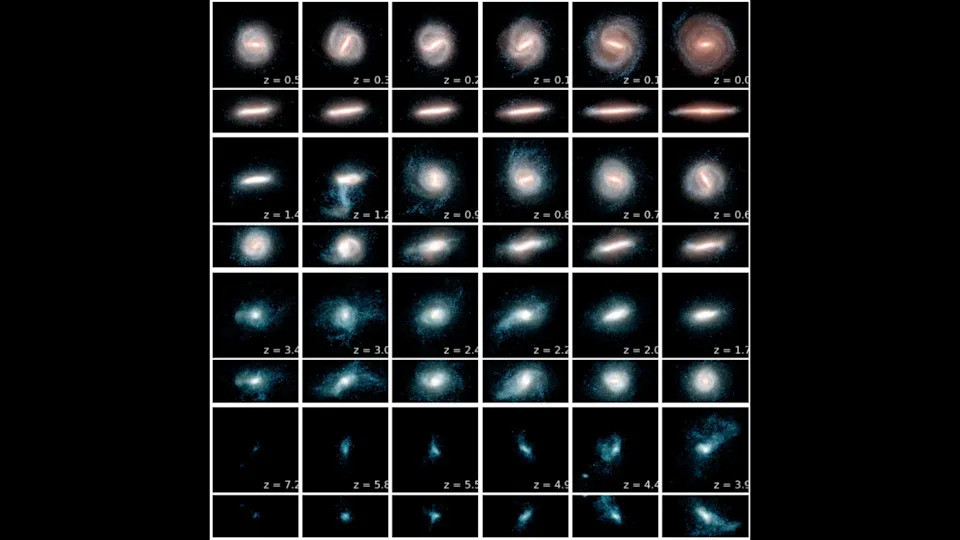
An example of the history of a simulated galaxy that has experienced a head-on merger and a disk flip (seen between redshifts – denoted by z – 1.4 and 0). | Credit: Auriga Project
- Head-on Mergers: Direct collisions can throw many incoming stars into the halo on trajectories strongly misaligned with the disk, lowering the halo's net rotation relative to the disk.
- Disk Flips (Reorientation): A galaxy's disk can change orientation by a large angle (in some cases ~90°). The halo does not instantly realign, so for a time the halo appears to rotate slowly with respect to the newly oriented disk.
"We already know that the Milky Way had a massive head-on collision in the past with a galaxy known as Gaia-Sausage-Enceladus," Batrakov said. "So, we think that the Milky Way disk likely flipped in the past."
Gaia-Sausage-Enceladus and the Milky Way's Past
Gaia-Sausage-Enceladus was a dwarf galaxy, estimated to have had more than 10 billion solar masses, that merged with the Milky Way roughly 8–11 billion years ago. Gaia's precise stellar motion measurements revealed elongated, "sausage-shaped" stellar streams — remnants of that violent event — many of which now populate the Milky Way's halo. The simulations suggest this collision was the last major impact, though disk flips in other galaxies sometimes occur without such a merger, implying multiple possible triggers for reorientation.
Implications For the Solar System
If the Milky Way's disk flipped while the Sun and planets already existed, our orbit around the galactic center could have been altered. "A disk flip means that most of the Milky Way's stars once moved on very different trajectories than they do today, possibly even our Sun," Batrakov noted, suggesting the solar system's long-term "stable" position may have shifted over time.
Why It Matters
Recovering a galaxy's complex history from present-day observations illustrates how much we can learn about galaxy formation and evolution. Understanding whether the Milky Way experienced a disk flip — and what triggered it — helps place our galaxy in a broader cosmological context and refines models of how stellar haloes form and evolve.
Batrakov presented these results at the Royal Astronomical Society's National Astronomy Meeting at the University of Birmingham (July 20–24).
Help us improve.





















