
A luminous tidal disruption event (TDE) has been linked to an "orphan" supermassive black hole tearing apart a star about 750 million light‑years away. Using a new AI‑driven search with the Zwicky Transient Facility, researchers found the flare roughly 30,000 light‑years from its galaxy center (J014656.04‑152214.7). The black hole is about 1 million solar masses; the flare briefly matched a luminosity of ~10 billion Suns and reached ~54,000°F. Scientists say the black hole was likely displaced during galaxy interactions, and upcoming facilities will help find more such wanderers.
Orphan Supermassive Black Hole Devours Star 750 Million Light‑Years Away
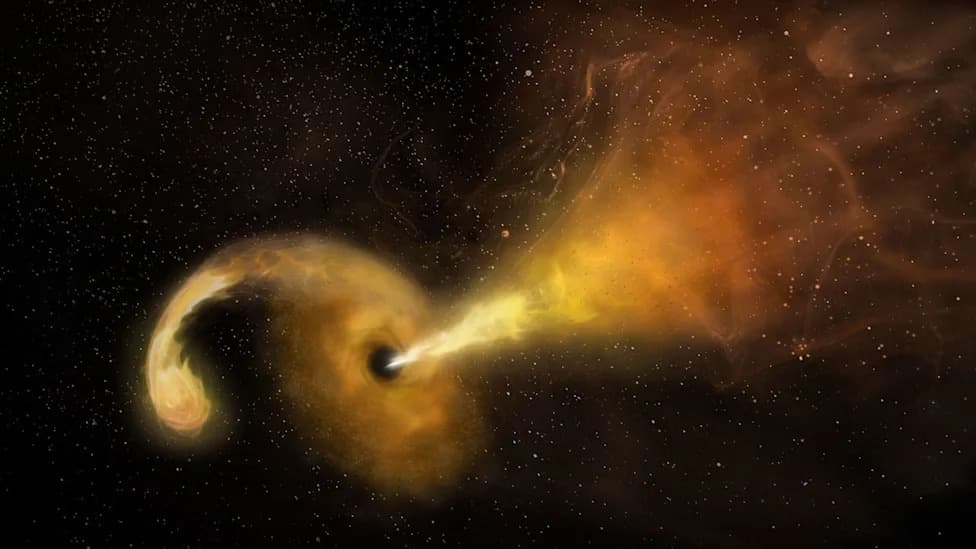
This artist's concept depicts a tidal disruption event, which occurs when a star passes fatally close to a supermassive black hole. Crumbs of the splintering star heat up as they swirl around the black hole, creating a glow astronomers can see from far across the cosmos, and the black hole launches a relativistic jet into space.
A brilliantly bright eruption in deep space — one of the rarest types of cosmic interactions astronomers observe — has been traced to an "orphan" supermassive black hole tearing apart a stray star about 750 million light‑years from Earth. Researchers identified the event using a new AI‑driven search method combined with observations from the Zwicky Transient Facility (ZTF); their findings appear in The Astrophysical Journal Letters.
Most galaxies host a supermassive black hole at their centers that steadily accretes nearby gas and stars. Far more rarely—roughly once every 100,000 years for any given galaxy—a star wanders too close and is shredded by tidal forces, producing a luminous tidal disruption event (TDE). Although TDEs are uncommon per galaxy, astronomers typically detect about 30 such events per year across the sky, usually concentrated in galactic nuclei.
That expectation shifted after a 2024 survey found TDE signatures located about 2,600 light‑years from a galaxy center. Motivated to search beyond galactic cores, astronomers developed new algorithms to scan ZTF detections for flares in unusual locations. In late 2025, a NASA collaboration using that AI method together with ZTF data from Palomar flagged another candidate.
"Out of the half‑million flashes ZTF detects each night, our new artificial‑intelligence algorithm automatically recognized a flare that looked a lot like a tidal disruption event, despite its unusual location in the outskirts of a galaxy," said Robert Stein, a study co‑author and astronomer at the University of Maryland and NASA’s Goddard Space Flight Center.
This confirmed TDE originated roughly 30,000 light‑years from the center of its host galaxy in the constellation Cetus, cataloged as J014656.04‑152214.7. The black hole is estimated at about one million times the mass of the Sun. Its disruption of the star produced an intense ultraviolet flare that outshone the host galaxy for months and, at peak, released the equivalent luminosity of roughly 10 billion Suns. NASA’s Neil Gehrels Swift Observatory measured a temperature near 54,000 degrees Fahrenheit.
While the event's brightness is extraordinary, what most intrigues researchers is the black hole's remote location. The team calls it an "orphan" because it appears displaced from the center where supermassive black holes normally reside.
The researchers propose two leading origins: the black hole may have arrived within a small dwarf galaxy that is merging into its current host, or it could have been flung outward during complex interactions in a multi‑galaxy collision, where gravitational dynamics eject the lightest black hole toward the galaxy's outskirts.
Looking Ahead
The discovery demonstrates the effectiveness of AI‑assisted searches for wandering black holes. Upcoming observatories — including the Vera C. Rubin Observatory and NASA's Nancy Grace Roman Space Telescope — will expand transient surveys and are expected to reveal many more roaming supermassive black holes, helping astronomers answer a central question: how common are these wandering giants?
Help us improve.





















