
U.N. Secretary-General Antonio Guterres has arrived in Cyprus to attempt to restart peace talks between Greek and Turkish Cypriots after almost a decade of stalemate. He will meet each leader separately before holding joint talks in the U.N. buffer zone amid reports (denied by U.N. officials) that a package of ideas has been prepared. The main obstacles remain the negotiating rules and the future role of Turkey — issues that have long divided the communities and affect relations between Greece, Turkey and the EU.
Guterres Visits Cyprus to Push Restart of Stalled Peace Talks
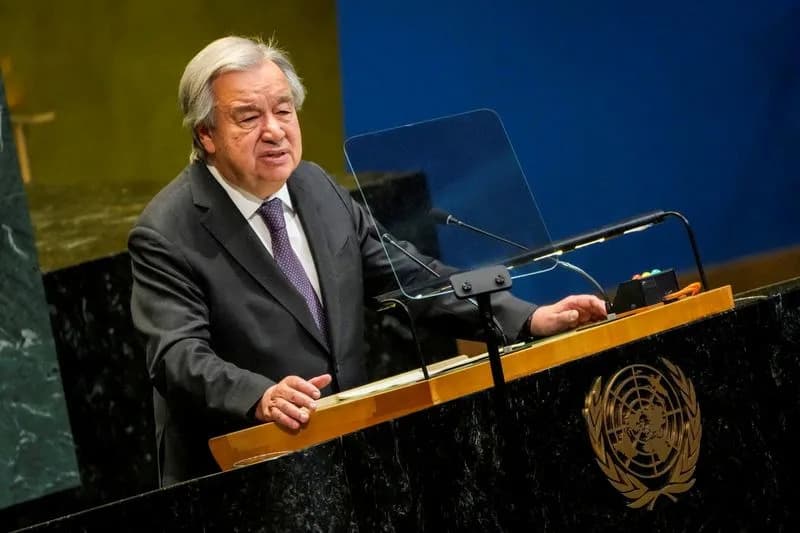
FILE PHOTO: United Nations Secretary-General Antonio Guterres speaks to delegates during a meeting on Nuclear Non-Proliferation Treaty at U.N. headquarters in New York City, U.S., April 27, 2026. REUTERS/Eduardo Munoz/File Photo
NICOSIA, July 28 — U.N. Secretary-General Antonio Guterres has flown to Cyprus to press rival Greek Cypriot and Turkish Cypriot leaders to resume peace negotiations after nearly a decade of deadlock. His visit, the first to the island since becoming U.N. chief, comes amid signs both sides may be willing to talk again, although they remain deeply divided over the rules and guarantees for any new process.
Meetings This Week
Guterres, whose term runs until the end of 2026, is due to meet Greek Cypriot leader Nikos Christodoulides and Turkish Cypriot leader Tufan Erhurman separately on Tuesday. The three principals will hold joint talks on Wednesday inside the U.N.-controlled buffer zone that separates the island's two communities.
Positions And Proposals
Christodoulides wants negotiations to resume from where they broke down in 2017 under a U.N.-backed framework aimed at a bizonal, bicommunal federation. Erhurman — elected last year and who campaigned on exploring a federal settlement — has signaled readiness to consider federal options, but says he will not enter another open-ended process without prior agreement on political equality and the procedural rules for talks.
Cypriot media have reported that U.N. envoys have assembled a set of ideas intended to bridge differences; U.N. officials, however, have denied a finalized plan exists. The parties remain far apart on one of the central issues: the post-settlement role of Turkey. Greek Cypriots oppose direct Turkish involvement in governance, while Turkish Cypriots consider Ankara's role essential. Turkey publicly supports a two-state solution — a stance rejected by Greek Cypriots and by Greece.
Historical Context
The island was effectively divided after a Turkish military intervention in 1974 that followed a brief coup backed by elements of the then-Greek military government. Under the 1960 independence treaty, Britain, Greece and Turkey are 'guarantor powers' with reserved rights to intervene. A bicommunal power-sharing administration collapsed in 1963, and the U.N. deployed a peacekeeping force less than a year later. That mission, one of the U.N.'s longest-running, now monitors a roughly 180 km (112 mile) ceasefire line across the island.
Today the internationally recognised government in the south represents Cyprus in the European Union and held the EU's rotating presidency in early 2026; the northern territory is a Turkish Cypriot breakaway entity recognised only by Ankara.
What’s At Stake
Failure to relaunch credible talks would prolong a dispute that strains ties between NATO allies Greece and Turkey and complicates Ankara's relations with the EU. If Guterres can help broker agreement on negotiating rules and guarantees, it could open the way for substantive negotiations. Observers say the immediate challenge is building mutual confidence and locking in an agreed process before substantive issues can be addressed.
Note: Reporting by Michele Kambas; Editing by Michael Perry.
Help us improve.





















