
On Aug. 28, 2026, up to 96% of the Moon will pass through Earth’s umbra, producing an "almost blood moon" — a mostly coppery-red lunar disk with a thin bright rim. The Americas will see the most dramatic views, with eastern North America possibly observing moonrise during maximum eclipse. Europe and Africa get excellent predawn moonset views; western Asia has limited visibility and eastern Asia will see little or none. The eclipse is safe to view with the naked eye; Space.com will provide local timings, viewing guides, photography tips and live coverage.
How to See the 'Almost Blood Moon' — Deep Partial Lunar Eclipse on Aug. 28, 2026
An almost full eclipsed moon with a majority of the surface appearing a rusty red hue and the lower left portion still bright white. there is a yellow notification bell graphic in the center.
One month away: On Aug. 28, 2026, a rare deep partial lunar eclipse will darken up to 96% of the Moon’s visible disk, producing an "almost blood moon" — a mostly coppery-red lunar surface with only a narrow bright rim remaining.
The countdown is on! Millions of skywatchers will have front-row seats to a dramatic 96% 'blood moon' lunar eclipse. Here's what you need to know. . | Credit: Created in Canva Pro
What to Expect
Because roughly 96% of the Moon will pass through Earth's central shadow (the umbra), the event will look very similar to a total lunar eclipse. Most of the lunar disk will take on a deep reddish-orange hue while a slim, silver crescent hugs the edge that remains outside the umbra.
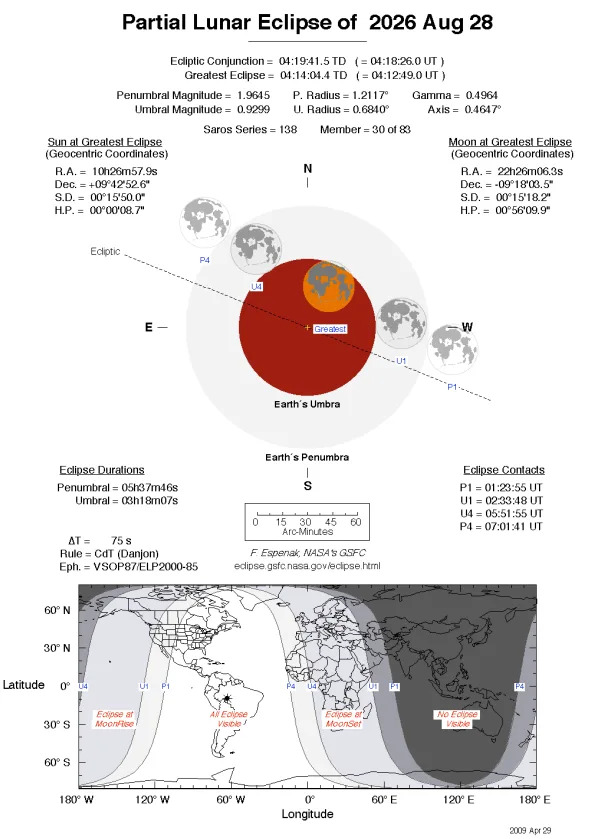
A map of the lunar eclipse on Aug. 27-28, 2026. Click the arrows in the bottom left corner to expand to full screen. | Credit: F. Espenak, NASA's GSFC
When And Where To Watch
- Americas: Best overall views. Many locations will see the Moon rise already deep in Earth’s shadow, with dramatic color and contrast immediately visible.
- Eastern North America: Observers may see the Moon rising during or just before maximum eclipse — a striking sight near the horizon.
- Europe & Africa: Excellent predawn views, with the final stages visible as the Moon sets in the west for the U.K. and western Europe.
- Western Asia: Limited views before moonset.
- Eastern Asia: Little or no visibility.
Viewing Safety & Tips
Lunar eclipses are completely safe to watch with the naked eye and require no special filters or eyewear. Binoculars or a small telescope will reveal more detail, but they are optional. To maximize your experience, find a clear horizon and an unobstructed view of the Moon.
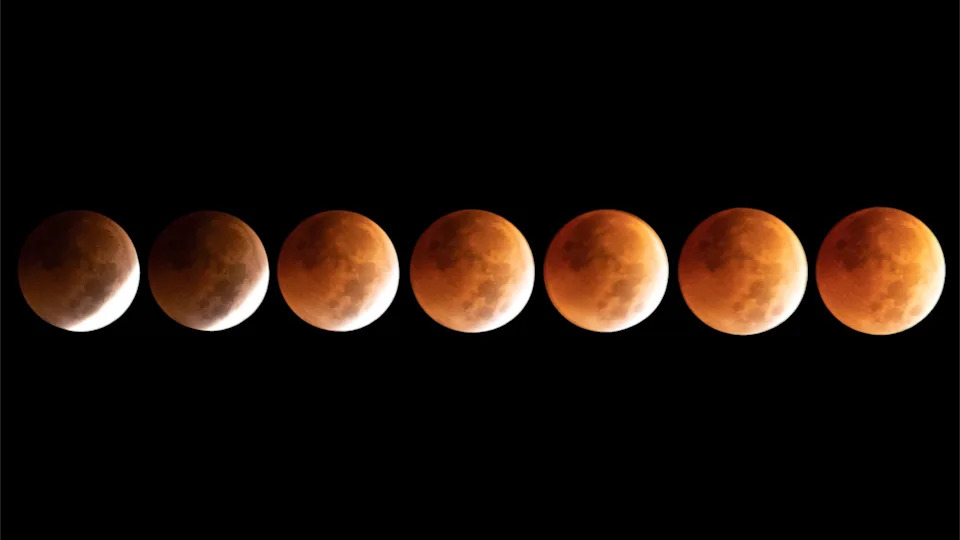
A deep partial lunar eclipse makes for an impressive skywatching event. | Credit: Laurie LaPorte via Getty Images
Quick Photography Advice
If you want to photograph the event: use a tripod, a remote shutter or self-timer to avoid camera shake, and bracket exposures as the moon’s brightness changes. For telephoto shots, start with exposures around 1/125 to 1/2 second depending on equipment and adjust; for longer views of the darkened surface, experiment with several-second exposures. Smartphone users can improve results with a simple clip-on tele lens and steady support.
Space.com will publish detailed local timing, viewing guides, photography tutorials and a live blog for the eclipse — plus links to online streams for anyone who cannot watch in person. For a global visibility map, see sources such as NASA and eclipse specialists (credit: F. Espenak, NASA GSFC).
Plan ahead: check local eclipse timings, monitor the weather, and arrive early to get a good horizon view — this will be the deepest partial lunar eclipse visible until New Year’s Eve 2028.
Help us improve.





















