Analyses of tiny impact‑melt fragments from Chang'e‑6 far‑side soil (1,935.3 g returned) yield 21 meaningful 40Ar/39Ar ages from 4.33 to 1.13 Ga. Three clasts cluster near 4.153–4.165 Ga, placing the Apollo basin at ~4.16 Ga and pushing major basin formation earlier than the proposed 3.9 Ga spike. The far‑side record lacks a strong 3.9 Ga peak found in near‑side Apollo samples and instead supports a long, gradual decline in large impacts, though sample size and local effects leave some uncertainty.
Chang'e-6 Far‑Side Rocks Rewrite Lunar Impact History: Evidence for a Multi‑Billion‑Year Decline in Bombardment
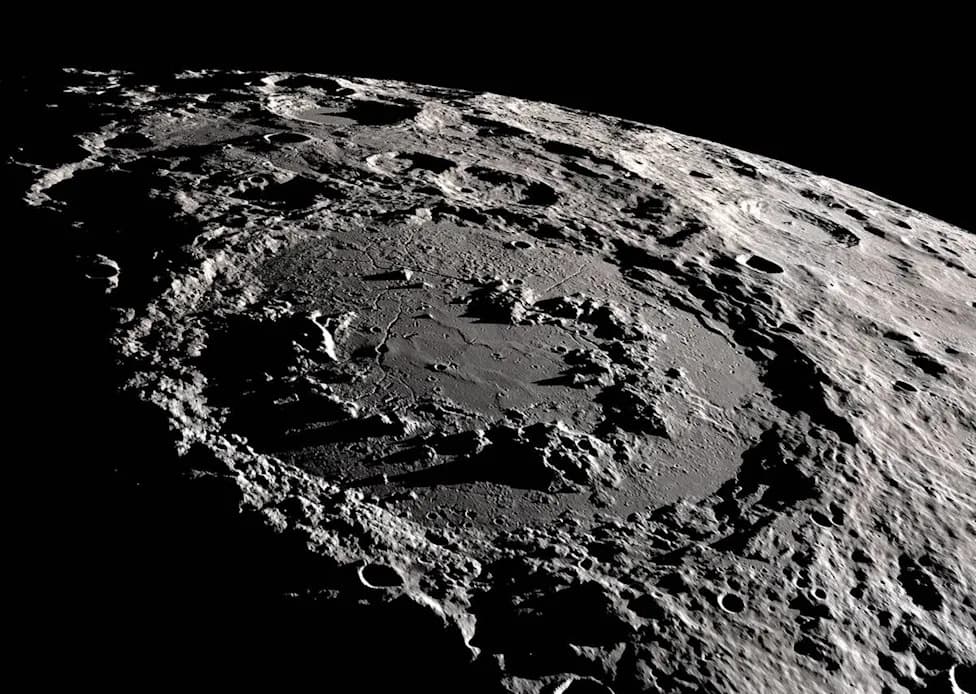
Schrödinger Basin: Moon far side asteroid impacts reveal a long decline in bombardment, challenging the idea of one violent peak 3.9 billion years ago. (CREDIT: NASA Scientific Visualization Studio)
New analyses of material returned by China's Chang'e‑6 mission suggest the Moon's far side recorded a long, steady decline in asteroid impacts over more than three billion years, rather than a single short-lived spike around 3.9 billion years ago. The results come from microscopic impact‑melt fragments recovered near the rim of the Apollo basin in the South Pole–Aitken region.
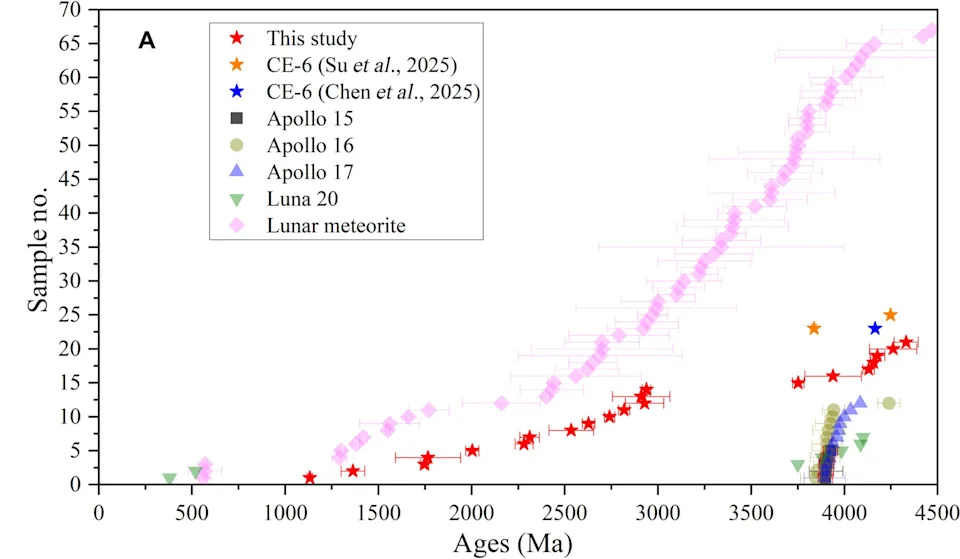
The published 40Ar/39Ar ages of Apollo, Luna, and meteorites, respectively. The red stars are the results in this study. The orange and blue stars denote the reported Pb-Pb ages for CE-6 impact melt rocks. (CREDIT: Fred Jourdan et al, Science Advances)
Key Findings
Scientists examined more than 100 particles from a 2‑gram subsample of the 1,935.3 grams of regolith returned on 25 June 2024. Of 28 clasts identified with impact‑melt textures, 21 produced meaningful 40Ar/39Ar ages ranging from about 4.33 billion to 1.13 billion years. Three fragments clustered at roughly 4.153–4.165 billion years, which places formation of the Apollo basin near ~4.16 Ga — well before the traditionally proposed 3.9 Ga “spike.”
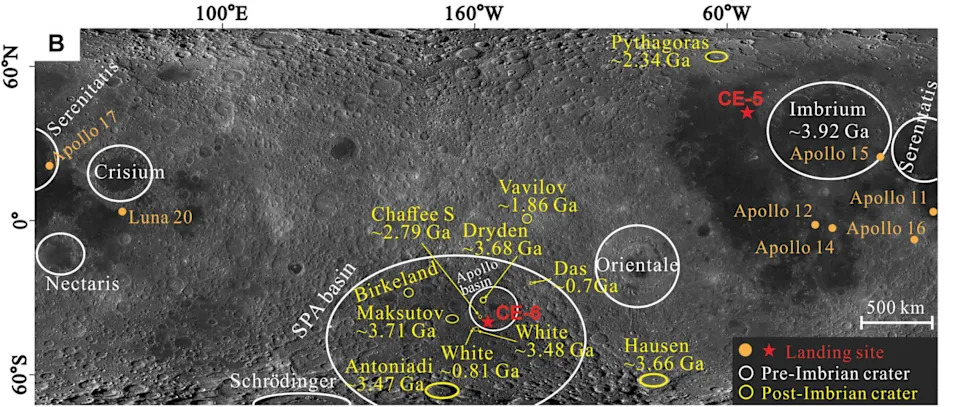
The geological context around the CE-6 landing site. (CREDIT: Fred Jourdan et al, Science Advances)
How the Dating Was Done
The team used laser stepwise heating combined with argon‑argon (40Ar/39Ar) dating to determine when impact heat reset the rocks' isotopic clocks. Chemical analyses — notably unusually high iridium (average ~89.2 parts per billion versus typical lunar values of 0.1–10 ppb) — support an impact origin for the melt fragments. Some fragments matched previously reported Pb–Pb ages, strengthening the chronology.
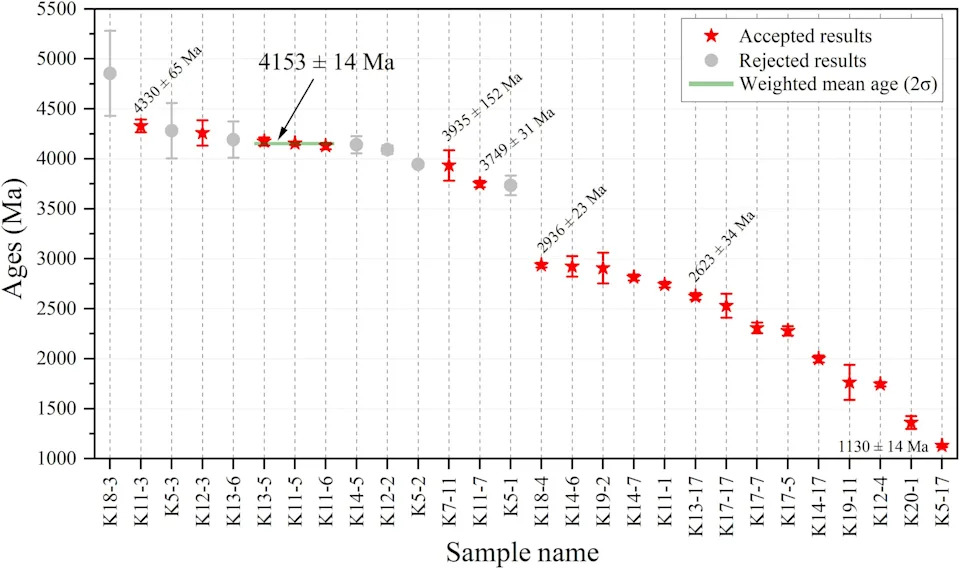
Summary of the 40Ar/39Ar ages of CE-6 impact melts obtained in this study. (CREDIT: Fred Jourdan et al, Science Advances)
Implications for Lunar and Solar System History
For decades, clusters of near‑side Apollo sample ages near ~3.9 Ga led many researchers to favor the Late Heavy Bombardment (a short, intense spike in impacts). However, most Apollo sites lie on the Moon's near side and may carry Imbrium ejecta (Imbrium dated ~3.92 Ga), biasing that picture. The Chang'e‑6 far‑side record shows relatively few ~3.9 Ga ages and instead supports a long decline in major collisions that began before 4.3 Ga and tapered gradually thereafter.
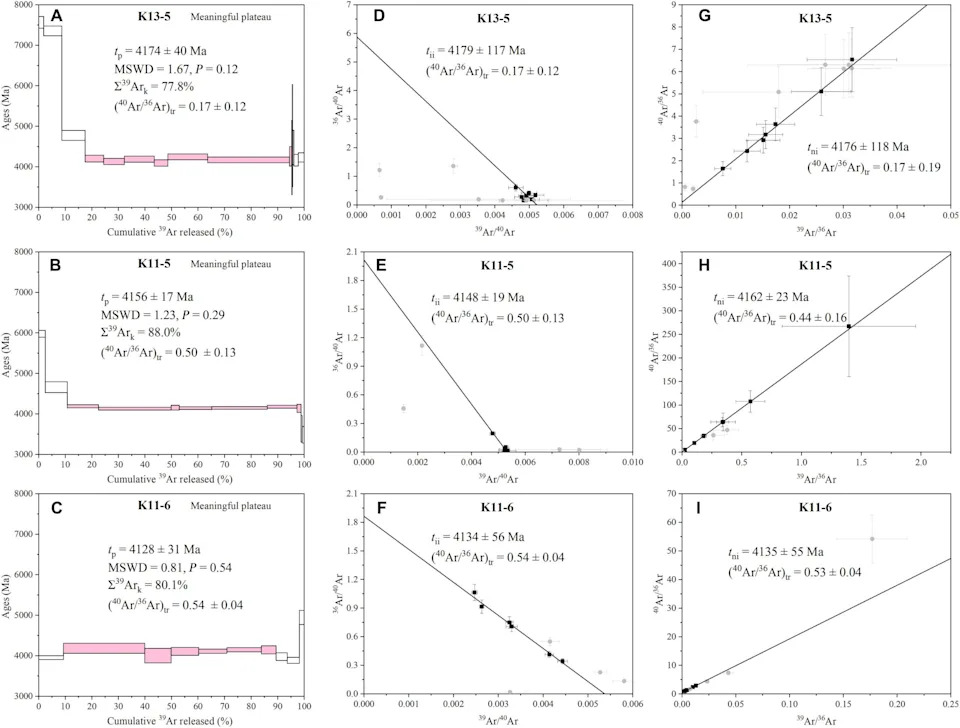
Laser stepwise 40Ar/39Ar dating results for three typical samples. (CREDIT: Fred Jourdan et al, Science Advances)
Caveats and Next Steps
Uncertainties remain: some isotopic systems appear partially reset; the study is based on a small, localized sample set; and the precise age of South Pole–Aitken is still debated (some fragments point to ~4.33 Ga). The dataset shows gaps (notably between ~3.7 and 3.0 Ga at this site) that could reflect later local resurfacing or simply limited provenance. Broader far‑side sampling and additional high‑precision dating (multiple isotopic systems) are needed to test whether the gradual decline seen here reflects the global inner Solar System.
Why It Matters
The Moon preserves impact evidence erased on Earth by erosion, volcanism and plate tectonics. A refined lunar impact timeline improves our ability to date early Solar System events and better constrains the environment experienced by the young Earth — including the timing and magnitude of collisions that may have influenced surface conditions and the origins of life.
Study Team: Researchers at Curtin University, the Guangzhou Institute of Geochemistry (State Key Laboratory of Deep Earth Processes and Resources), and the Chinese Academy of Sciences. Credit and figures reported by Fred Jourdan et al. (Science Advances).
Help us improve.