
TL;DR: JWST can look back about 13.5 billion years, letting us see the first stars and galaxies that formed a few hundred million years after the Big Bang. Its 6.5 m mirror and infrared instruments detect much fainter and more distant objects than Hubble, enabling discoveries such as the star Earendel (light ~12.9 billion years old). The Big Bang itself (about 13.8 billion years ago) is probed via the cosmic microwave background at ~380,000 years after that event, not by JWST.
Can a Telescope See the Beginning of Time? How the James Webb Telescope Peers Back 13.5 Billion Years
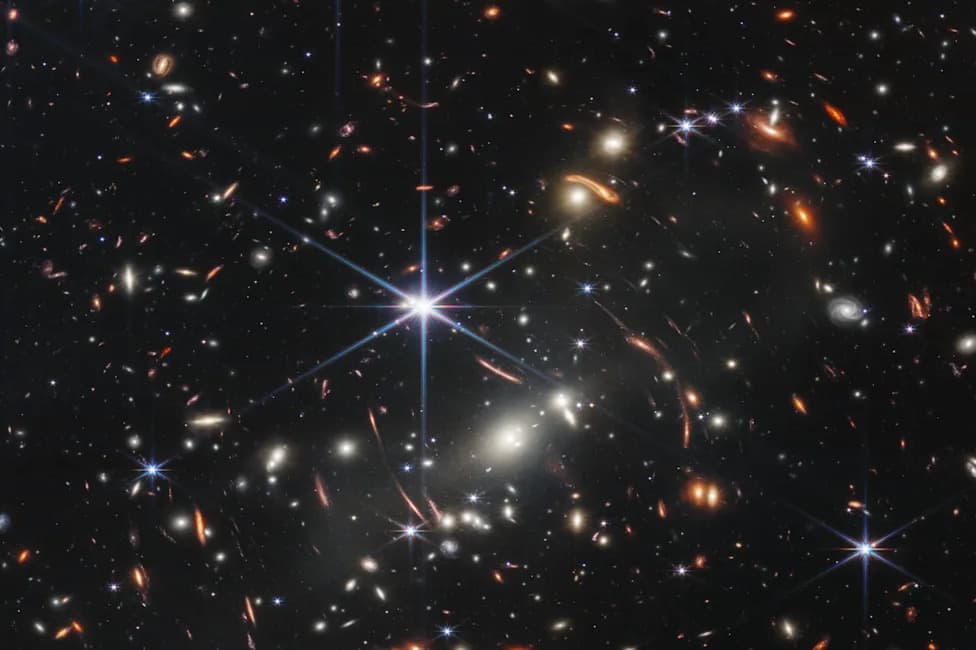
Thousands of galaxies, each containing billions of stars, are in this 2022 photo taken by the James Webb Space Telescope.NASA/ESA/CSA/STScI
The James Webb Space Telescope (JWST) is one of the most ambitious and powerful space telescopes ever built. Planning began more than 25 years ago, construction spanned over a decade, and it launched on Dec. 25, 2021. Within about a month it reached its observing station roughly 930,000 miles from Earth, near the Sun–Earth L2 point, where it enjoys a steady, unobstructed view of deep space.
Big Mirror, Deep Reach. JWST’s primary mirror is about 6.5 meters (21 feet) across — nearly three times the diameter of Hubble’s mirror. A larger mirror collects more light, allowing JWST to detect much fainter and more distant galaxies, stars and planets. Its instruments measure the composition, temperature and motion of these objects, giving astronomers detailed physical information.
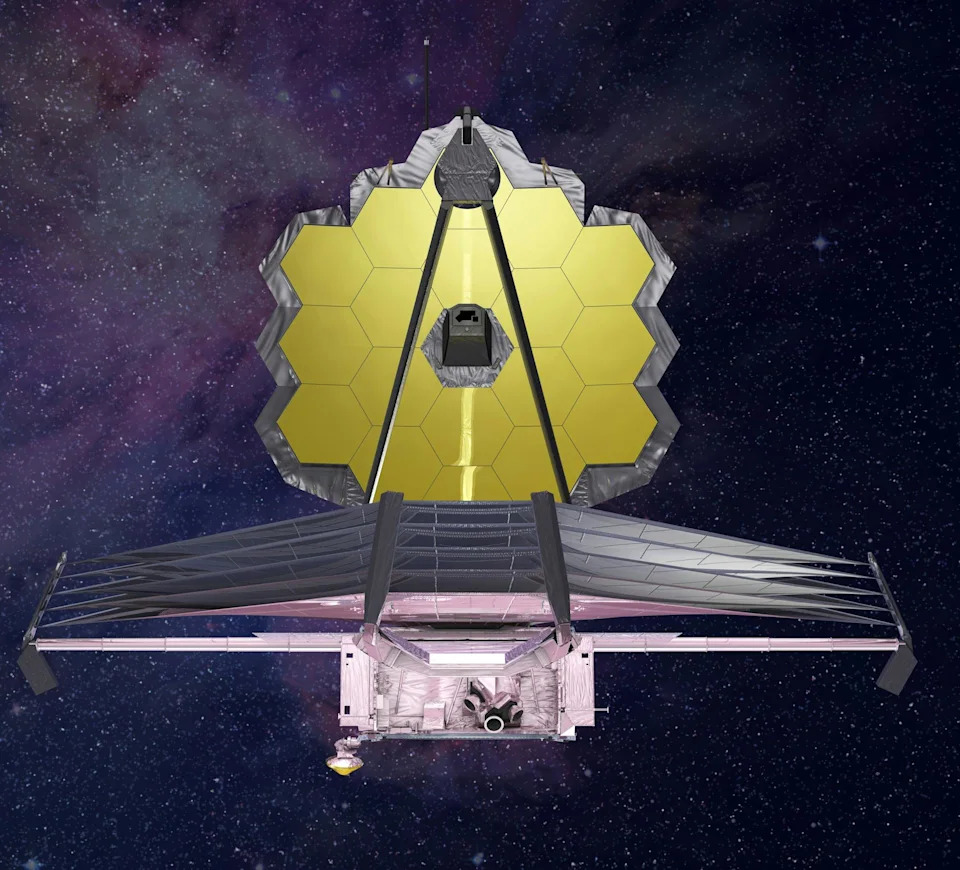
This illustration of the front view of the James Webb Space Telescope shows its sun shield and golden mirrors.NASA/ESA/CSA/Northrop Grumman
Looking Back in Time. Because light takes time to travel, telescopes are also time machines: when we look at distant objects, we see them as they were when their light left them. Sunlight, for example, takes about 8 minutes and 20 seconds to reach Earth. The nearest star after the Sun, Proxima Centauri, is about four light years away, so its light is four years old by the time it reaches us.
How Far Back Can JWST See?
JWST allows astronomers to observe objects as they were roughly 13.5 billion years ago. That means JWST can probe the era when the first stars and galaxies were assembling and beginning to shine — a few hundred million years after the universe began.
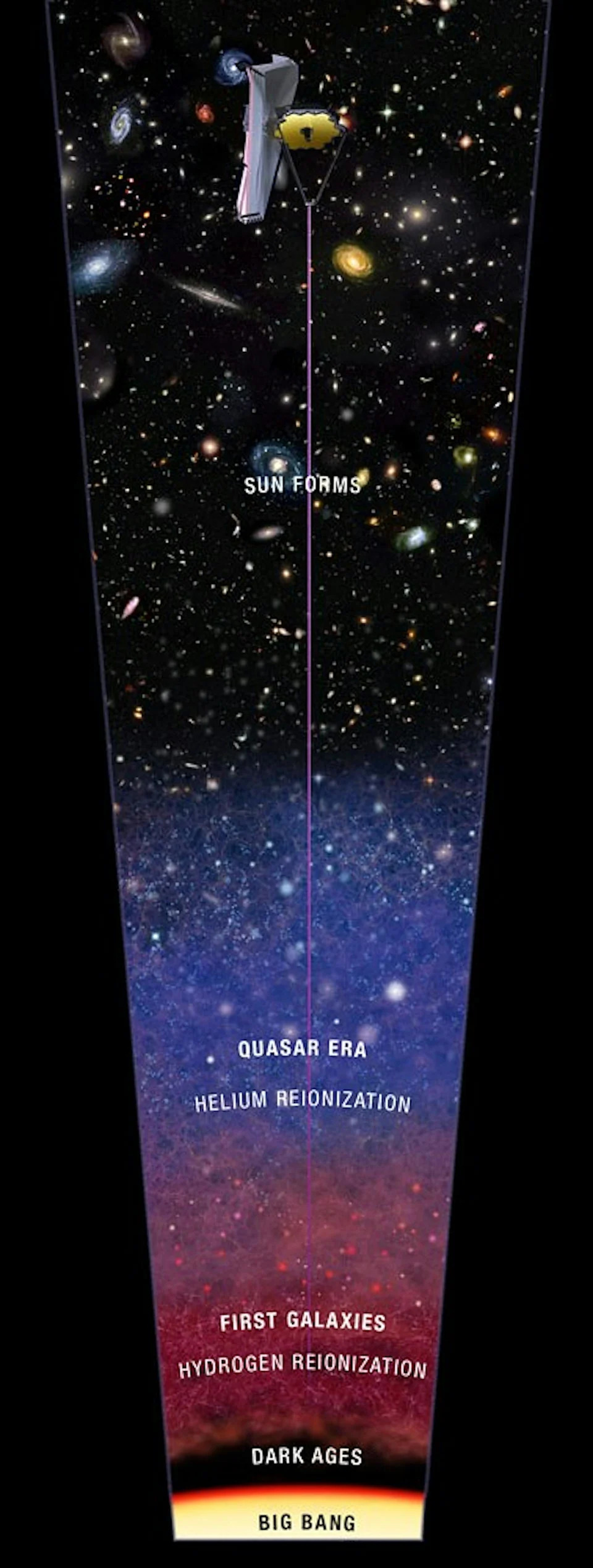
The James Webb Space Telescope can see back 13.5 billion years – back to when the first stars and galaxies began to form.STScI
Recently, JWST observed Earendel, one of the most distant individual stars detected so far. The light we see from Earendel began its journey about 12.9 billion years ago.
Why Not the Very Beginning?
The so-called Big Bang marks the origin of the observable universe about 13.8 billion years ago. But the earliest universe was hot, dense and filled with an opaque plasma that acted like a fog, preventing light from traveling freely. Only after roughly 380,000 years did the universe cool enough for photons to decouple from matter and travel through space — producing the cosmic microwave background (CMB) that satellites have observed in the microwave band.
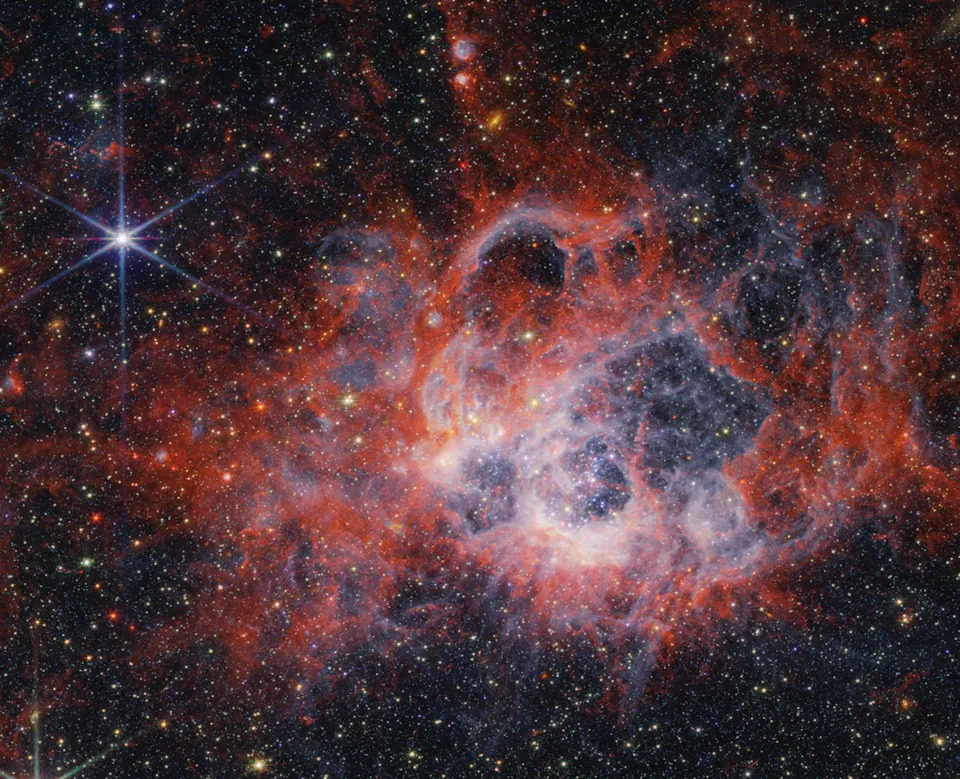
This is a JWST image of NGC 604, a star-forming region about 2.7 million light years from Earth.NASA/ESA/CSA/STScI
Even then, there were no stars or galaxies. The universe spent a long period called the "cosmic dark ages" before the first luminous objects formed a few hundred million years later. JWST was designed to study those first stars and galaxies, not the instant of the Big Bang itself; the CMB and other specialized observatories probe the earlier, opaque epochs in different wavelengths.
Not Just Bigger Mirrors
Seeing earlier times is not simply a matter of making mirrors larger. Different epochs emit different kinds of light, which are stretched to longer (redder) wavelengths by cosmic expansion. JWST operates primarily in the infrared, which is essential for detecting highly redshifted light from the first galaxies. Other instruments observing microwave or radio wavelengths are required to study the universe at the moment photons first escaped the primordial fog.
Why This Matters. By studying the first galaxies and the growth of black holes, astronomers learn how structure formed in the universe, how stars and elements were created, and how planets and atmospheres — potentially habitable worlds — later emerged. JWST gives us a detailed window into that early chapter of the cosmic story.
Author: Adi Foord, University of Maryland, Baltimore County.
Want to Ask a Question? Curious kids (and adults) can send questions to [email protected]. Please include your name, age and city.
Help us improve.





















