
The CD-35 2722 system hosts a Jupiter-mass companion orbiting a brown dwarf, a configuration that does not fit neatly into existing planet-or-moon categories. Using ESO's Very Large Telescope, astronomers detected tiny astrometric wobbles that reveal the massive companion. The team suggests the provisional label "exosatellite," but other researchers argue it may be a planet or a substellar remnant. Further observations are needed to pin down the object's nature and origin.
Massive 'Exosatellite' Detected Orbiting a Brown Dwarf — Planet, Moon, or Something Else?
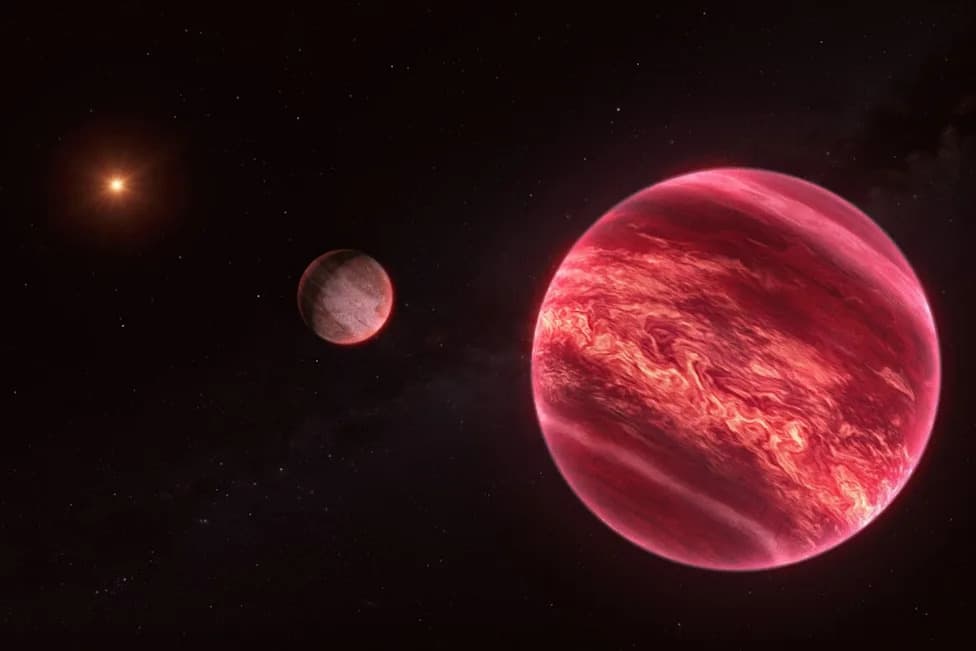
ESO / M. Kornmesser
Astronomers report the discovery of a puzzling, Jupiter-mass object orbiting a brown dwarf in the CD-35 2722 system — a configuration that challenges traditional planet and moon definitions.
The object orbits a brown dwarf, a substellar body larger than a gas giant but smaller than the smallest stars, while that brown dwarf in turn orbits the system's primary star. Because the newly identified body does not orbit the star directly, it does not fit the conventional definition of a planet nor the common notion of a moon.
Study and Detection
The discovery, described in a new paper in Nature led by Kevin Hoy of the European Southern Observatory (ESO), used high-precision observations from ESO's Very Large Telescope (VLT). The team measured tiny, regular wobbles in the brown dwarf's motion — astrometric shifts consistent with the gravitational tug of a nearby, massive companion.
"The exosatellite is clearly massive enough to be a planet, but it does not orbit a star, though it orbits an object that orbits a star," Hoy said. "Being the third wheel in this system makes us want to call it a moon, even if it is nothing like the small, rocky moons we have in our system."
System Properties
The system's primary star, CD-35 2722, has roughly half the mass of the Sun and lies about 72 light-years from Earth. The brown dwarf companion is estimated to have more than 30 times the mass of Jupiter, placing it well into the brown-dwarf regime. The newly detected body has at least the mass of Jupiter.
Debate Over Classification
The team has provisionally dubbed the object an "exosatellite," but astronomers disagree on that label. Some experts, such as Roman Rafikov of the University of Cambridge, describe the pair as a binary (star plus brown dwarf) with the third body best regarded as a planet orbiting one component. Others, like Nader Haghighipour of the University of Hawai'i, suggest the Jupiter-mass object could be a substellar remnant or "failed" stellar core rather than a true satellite.
There is currently no formal International Astronomical Union (IAU) definition that clearly covers such hierarchical, substellar systems, which leaves room for interpretation and further study.
What Comes Next
Further observations and modeling — including continued astrometry, direct imaging, and dynamical studies — are needed to confirm the companion's orbit and mass more precisely and to test competing formation scenarios. These follow-ups will help determine whether the object should be classified as a planet, a moon-like satellite, or a different kind of substellar body altogether.
Why It Matters
The finding highlights how discoveries beyond our Solar System can blur classical categories and push astronomers to refine definitions of planets, moons, and brown dwarfs. Understanding objects like this one improves knowledge of how substellar systems form and evolve.
Help us improve.





















