
Two meteor showers — the Southern Delta Aquariids and the Alpha Capricornids — peak overnight on July 30–31, but a near‑full Buck Moon (about 98% illuminated) will wash out many faint meteors. The Delta Aquariids can reach ~25 meteors/hour under dark skies; the Alpha Capricornids are weaker (~5/hour) but can produce bright fireballs. Best viewing is between midnight and dawn with the moon kept behind you. If you miss them, the Perseids peak on Aug. 12–13 after a new moon, which also brings a total solar eclipse along a narrow path on Aug. 12.
Two Meteor Showers Peak July 30–31 — How to See Them Despite a Near‑Full Moon
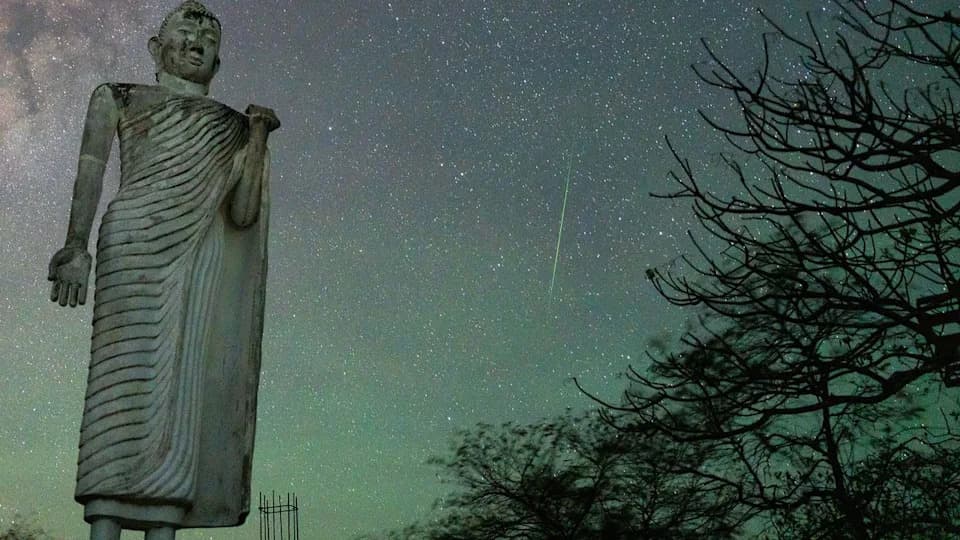
A Delta Aquariid meteor appears over the Buddha statue in Kantale, Sri Lanka, on July 4, 2024. | Credit: NurPhoto via Getty Images
Two meteor showers — the Southern Delta Aquariids and the Alpha Capricornids — reach their peak overnight from Thursday, July 30 into Friday, July 31. Unfortunately for skywatchers, the peaks come just one night after the July Buck Moon, so bright moonlight will limit how many faint meteors you can see.
Moon and shower timing
July's Buck Moon is full on Wednesday, July 29 and will still be about 98% illuminated during the meteor peaks on July 30–31. The Southern Delta Aquariids are active this year from July 12 to Aug. 23 and can produce roughly 25 meteors per hour under ideal, dark-sky conditions. The Alpha Capricornids run from July 3 to Aug. 15 and typically yield about five meteors per hour, but are notable for occasional bright fireballs that can be spectacular even when the sky is moonlit.
Where and when to watch
The best viewing window is between midnight and dawn, when the radiant of the Southern Delta Aquariids (in the constellation Aquarius) is highest in the southern sky. Observers in the southern U.S., Mexico and the Caribbean will generally have an advantage because Aquarius climbs higher at lower latitudes.
Practical viewing tips
- Keep the moon behind you or blocked by a tree, building or hill to reduce glare.
- Find the darkest patch of sky possible and give your eyes at least 20–30 minutes to adapt to the dark.
- Watch with the naked eye — wide fields of view are better than binoculars or telescopes for meteor showers.
- If you plan to photograph meteors, use a wide-angle lens on a tripod, long exposures, and low ISO to reduce moonlit skywash.
If you miss these peaks
Don't worry if the near‑full moon spoils the show. The much more active Perseid meteor shower peaks overnight on Aug. 12–13, just after the Aug. 12 new moon, providing much darker skies and peak rates near 100 meteors per hour in ideal conditions.
Related celestial event — Total Solar Eclipse (Aug. 12)
The Aug. 12 new moon also makes possible a total solar eclipse visible along a narrow path across eastern Greenland, western Iceland and northern Spain; parts of Canada and the northeastern U.S. will see a partial eclipse. Always use proper solar eclipse glasses when observing partial phases — never look directly at the Sun without certified protection.
Even with a bright moon, the overlapping Delta Aquariid and Alpha Capricornid peaks make July 30–31 a good night to practice meteor photography, try for bright fireballs, or simply enjoy some lunar photography under a dramatic near‑full Buck Moon.
Help us improve.





















