
The Dyson Minds 2025 Workshop at MIT convened experts to explore whether advanced civilizations could build Dyson-like megastructures around supermassive black holes and, crucially, what observable signatures those structures would produce. Researchers identified plausible engineering constraints (radiative heating, latency) and suggested concrete observables—infrared excesses, periodic directional signals, and subtle imaging perturbations—that could be sought in datasets such as the Event Horizon Telescope images of M87* and Sagittarius A*. No evidence has been found yet, but the effort produced testable strategies to reprocess archival data and guide future observations.
Could Aliens Build Dyson-Style Megastructures Around Black Holes? MIT Workshop Mapped What to Look For
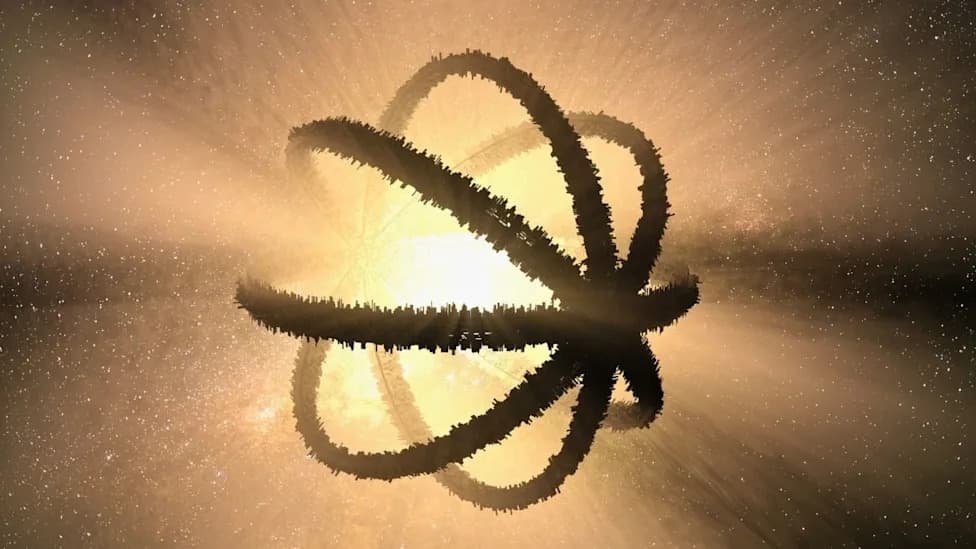
(cokada/iStock/Getty Images Plus)
Last June, more than two dozen leading scientists gathered at the Massachusetts Institute of Technology for the Dyson Minds 2025 Workshop. Over two days, astronomers, astrophysicists, AI researchers, engineers and industry experts examined a provocative but physically grounded question: might advanced civilizations build Dyson-style energy-harvesting megastructures not around stars but around supermassive black holes?
The meeting, organized by Penn State, MIT and The Ultraintelligence Foundation, focused less on sensational claims and more on turning speculation into testable predictions. Olivia Curtis, lead author of the workshop paper and a postdoctoral fellow at the Penn State Extraterrestrial Intelligence Center (PSETI), emphasized that the goal was to identify concrete observables that could be sought in real datasets.
YouTube Thumbnail
Why Black Holes?
Supermassive black holes occupy the centers of most galaxies and can power enormous energy outputs via accretion disks and relativistic jets—sometimes outshining millions of Suns. If a civilization wanted the steepest available energy gradient for computation or industrial processes, the galactic center would be a logical destination.
From Speculation to Science
Workshop participants advanced plausible engineering scenarios and the observational consequences of such structures. Rather than treating alien engineering as the primary hypothesis, they used it as a thought experiment to reveal signatures that would look unusual compared with well-modeled black hole environments.
YouTube Thumbnail
“We wanted to ground everything in physical facts and try to actually think of what physical observables we might be able to detect,” said Curtis. “Even if the ground hypothesis isn’t correct, exploring it often yields new, testable ideas.”
Survivability and Engineering Constraints
The common image of a black hole as a space vacuum is misleading in this context: nothing special happens until you cross the event horizon, and any feasible megastructure would be placed far outside that boundary. Curtis compared the scenario to the fictional black hole Gargantua from Interstellar and noted that a practical structure would sit orders of magnitude farther out than the movie’s accretion disk.
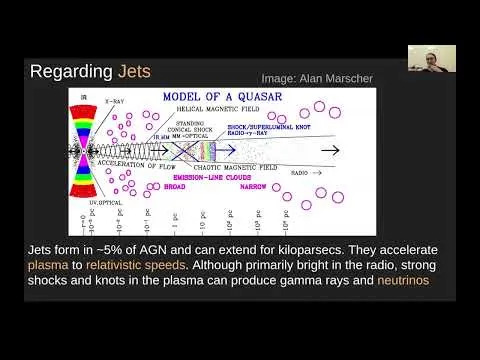
Radiation from an active galactic nucleus can be extreme. Workshop estimates indicate a structure would typically need to be on the order of a parsec (about 3.26 light-years) away from a particularly active supermassive black hole to avoid immediate melting from radiative heating—although the necessary distance depends on the hole’s activity level.
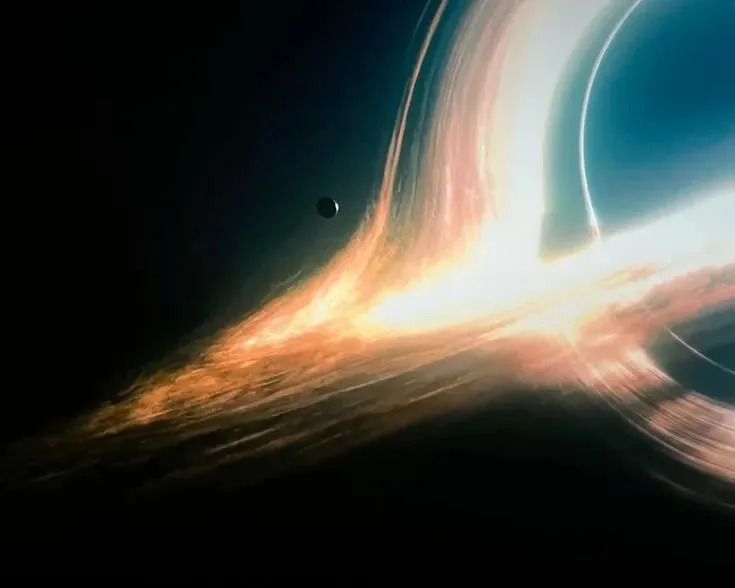
The black hole Gargantua in the movieInterstellar. (Warner Bros. Pictures)
How Would Such A System Operate—and How Could We Detect It?
Participants explored how a distributed, black-hole–centric “data center” might function. Two strategies emerged as plausible: (1) high-bandwidth beamed communications timed during orbital alignments, producing periodic directional bursts; or (2) physically transporting massive storage modules ("hard drives") between nodes, which can be faster than transmitting zettabytes across noisy channels at these scales. Both options could produce observable, periodic signatures.
On the observational side, researchers suggested looking for:

Subscribe to ScienceAlert's free fact-checked newsletter
- Infrared excesses or anomalous spectral signatures compared with modeled accretion-disk emission.
- Periodic or directional signals correlated with orbital dynamics or with accelerated masses being moved between nodes.
- Transient or spatial perturbations in high-resolution imaging that standard processing might smooth over when producing aesthetically clean pictures.
Datasets and Next Steps
Key datasets to re-examine include high-resolution observations from the Event Horizon Telescope (EHT), which produced the resolved images of M87* (2019) and Sagittarius A* (2022). The workshop produced a catalog of observational strategies and signatures that astronomers can hunt for when reprocessing archival data or planning targeted observations, especially in the infrared and time-domain domains.
So far, no convincing evidence for Dyson-style structures around black holes has been found. Nevertheless, the exercise yielded concrete, falsifiable predictions and broadened the range of phenomena researchers will now consider when studying galactic centers.
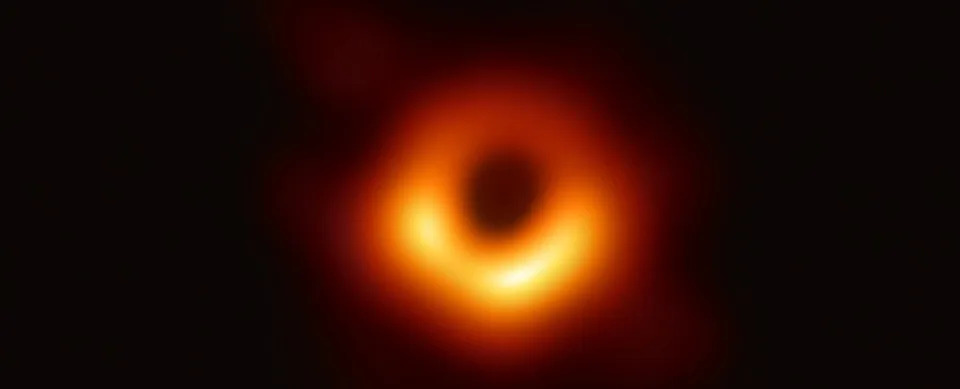
That right there is the supermassive black hole M87*.(EHT Collaboration)
Speculations and Broader Implications
Beyond technosignatures, the workshop revived questions about planet formation and habitability near galactic centers; some studies suggest planets could survive or form in such environments, producing exotic skies and conditions. Whether or not aliens are involved, these lines of inquiry strengthen observational strategies and may lead to unexpected discoveries about black hole environments.
Publication: A workshop summary and recommendations have been published in Publications of the Astronomical Society of the Pacific.
Help us improve.





















