
The Long March-3B was struck by lightning about 30 seconds after liftoff from Xichang, an event captured on video and in photos. China Aerospace Science and Technology Corporation reported the rocket survived and the relay satellite was successfully deployed, though minor damage was not ruled out. The incident echoes past lightning encounters—most notably Apollo 12 (1969) and the 1987 Atlas-Centaur failure—and highlights why agencies maintain strict lightning launch criteria.
Stunning Footage: Long March-3B Struck by Lightning Seconds After Liftoff — Satellite Still Deployed
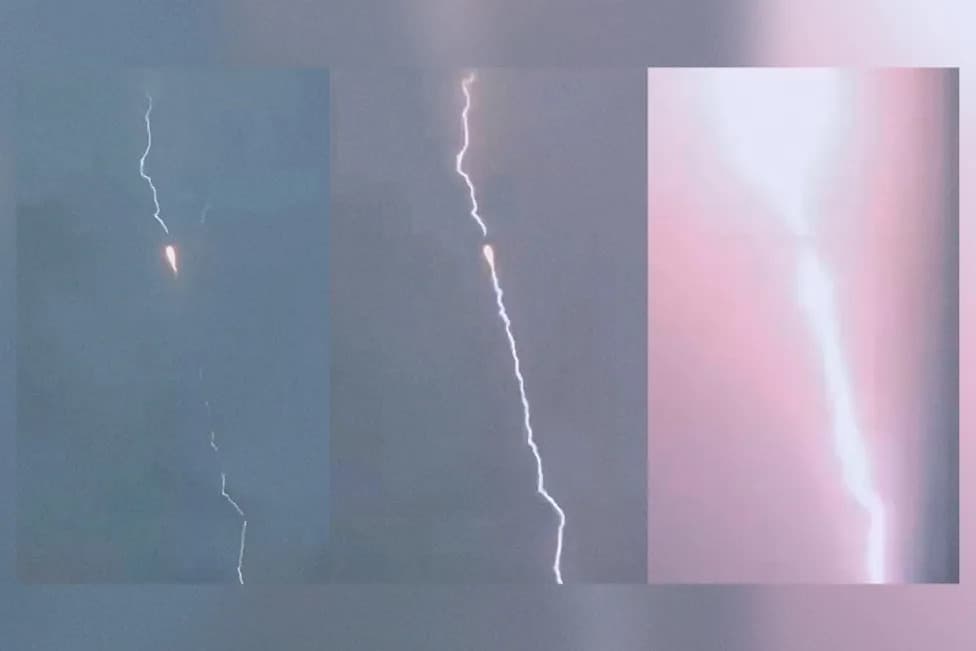
Screenshots via Reddit
A Chinese Long March-3B rocket was struck by lightning roughly thirty seconds after lifting off from the Xichang Satellite Launch Center in southwestern China, footage and photos show. The dramatic moment—captured on video and in a well-timed photograph—prompted audible gasps from spectators as a bolt of lightning appeared to hit the vehicle's tip during ascent.
The launch, carried out on Thursday, had a routine mission: to deliver a communications-relay satellite into geostationary orbit, a task the Long March-3B undertakes regularly. Spectators can be heard reacting in astonishment on the recorded video, and one bystander is captured repeating
"lightning, lightning!"
Official Outcome
The China Aerospace Science and Technology Corporation (CASC) announced that the rocket survived the event and successfully deployed its payload into the planned orbit. CASC did not specify whether any minor, non-mission-critical damage occurred during the strike.
Historical Context
Rockets struck by lightning are rare but not unprecedented. In 1969, NASA's Apollo 12 was hit twice shortly after liftoff, which disrupted some onboard instruments but did not prevent the moon mission from continuing. By contrast, a 1987 lightning strike on an unmanned Atlas-Centaur 67 approximately 48 seconds into flight caused a computer malfunction, a loss of vehicle control, and a midflight breakup.
That 1987 failure and similar incidents prompted agencies to develop stricter weather rules for launches. NASA's Lightning Launch Commit Criteria, for example, imposes tighter constraints on launch conditions to reduce the risk of lightning-related failures.
For now, Chinese mission controllers can report success: the relay satellite reached its intended orbit despite the dramatic visuals. The footage and photo are likely to spark discussion in the space community about weather risk, vehicle resilience, and the role of launch criteria—while giving the public an extraordinary and memorable snapshot of a launch that didn’t go entirely as expected.
Help us improve.





















