
In PBS’s second episode of Once Upon a Time in Space, Michael Foale revisits the May 25, 1997 Progress collision that punctured Mir’s Spektr module. Foale describes how he and cosmonauts Vasily Tsibliev and Alexander Lazutkin stopped the station’s tumble and sealed a dangerous air leak with only about 23 minutes of breathable air left. He attributes the accident to a cost-cutting decision to omit a Ukrainian radar and an ill-advised long-range manual docking test. The episode blends archival footage and candid interviews to explore both the technical failure and the human fallout.
Astronaut Michael Foale Recounts Mir’s 1997 Crisis: How a Cost-Cutting Docking Test Nearly Cost the Station
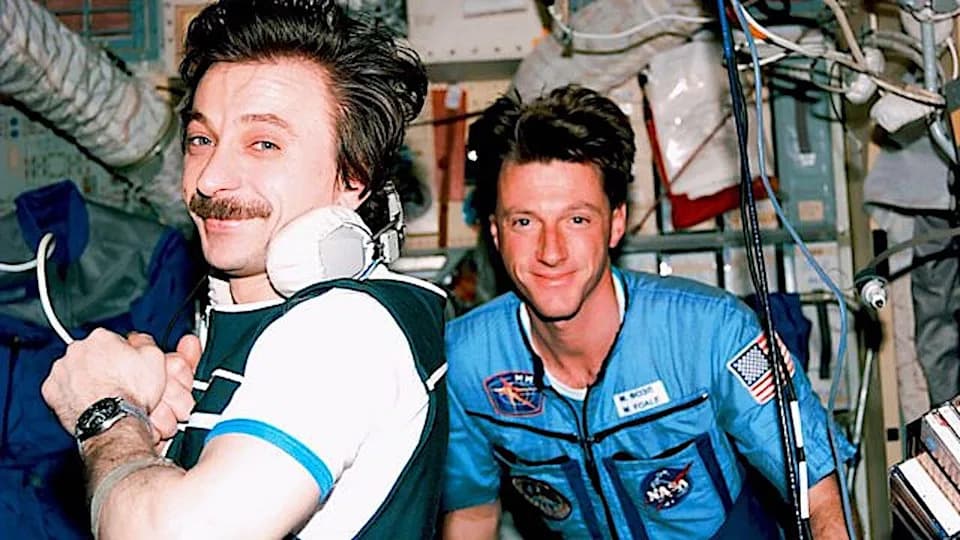
Credit: NASA/BBC/PBS
PBS's Once Upon a Time in Space revisits one of the most dramatic moments in human spaceflight: the May 25, 1997 collision between an unmanned Progress cargo vehicle and the Russian space station Mir, which ruptured the Spektr module and caused a life-threatening depressurization. In the series' second episode, "The Russian Thing," veteran astronaut Michael Foale — who lived through the incident — provides a first-hand account of the collision, the emergency response, and the difficult human consequences that followed.
How the Collision Happened
Foale, a British-American astronaut and six-time spaceflyer who retired from NASA in 2013, explains that the accident resulted from a last-minute, long-range manual docking test performed without a radar unit that, according to Foale, would have cost roughly $2 million to procure from Ukraine. The test used a Progress supply ship that was already loaded with trash and scheduled for de-orbiting. During the manual approach from an unusually long starting distance — about six kilometers — cosmonaut Vasily Tsibliev was unable to accurately judge closing distance and velocity from visual cues alone.
Credit: PBS
"You need distance first, and then you divide by time to get velocity," Foale says. "Without that ability, the closing speed was higher than expected and the Progress' thrusters couldn't stop it in time."
The Progress struck Mir's Spektr module, crumpling part of the module and bending a solar array. The impact opened an unseen breach at the solar array joint, and air began escaping into space.
Emergency Response Aboard Mir
Foale recounts the frantic, cinematic effort to save the station: with roughly 23 minutes of breathable air remaining, Foale and cosmonauts Vasily Tsibliev and Alexander "Sasha" Lazutkin worked to stop Mir's uncontrolled rotation and isolate the leak. They disconnected cables and sealed hatchways to stabilize the station and keep the crew alive.
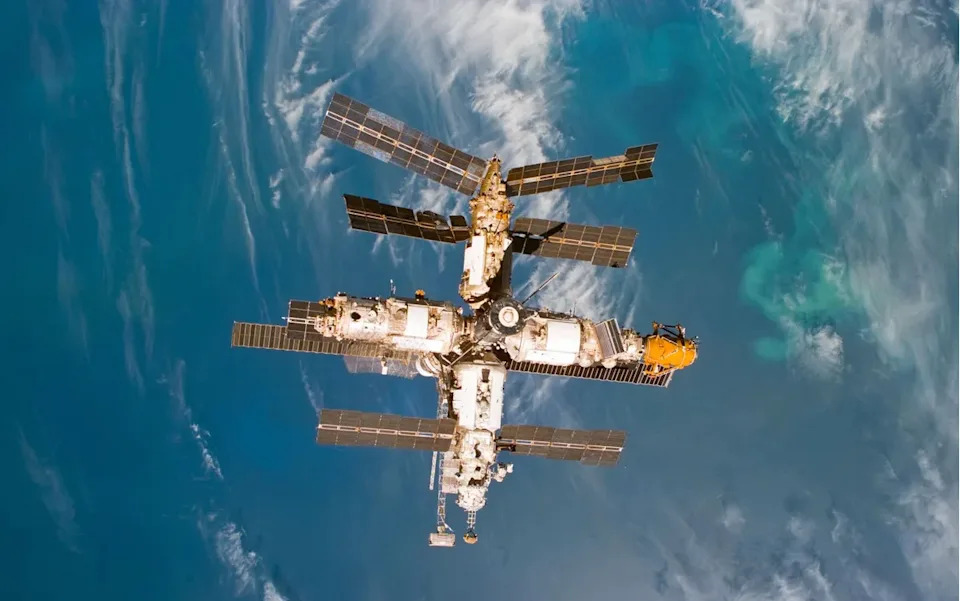
The Soviet space station Mir before being de-orbited in 2001 | Credit: NASA
In the days after the collision, flight controllers sent an adapter intended to restore power from the damaged Spektr module. Plans were made for an internal spacewalk (internal EVA) to reconnect power and wiring inside Spektr; Tsibliev and Lazutkin had been scheduled to perform it. Tsibliev failed a pre-EVA medical check, reportedly the result of stress, and the program's head, Valery Ryumin, later asked Foale over the radio to take the job instead — a request that Foale says humiliated Tsibliev, who had already shouldered public blame for the accident.
Human and Technical Lessons
Foale points to managerial and systemic failures as root causes: an attempt to save money that led to omitting a radar system, the decision by Energia to run a risky last-minute manual rendezvous, and operational pressure that placed human controllers in a hazardous situation. He emphasizes that while Tsibliev publicly accepted blame, the broader context included equipment and policy decisions.
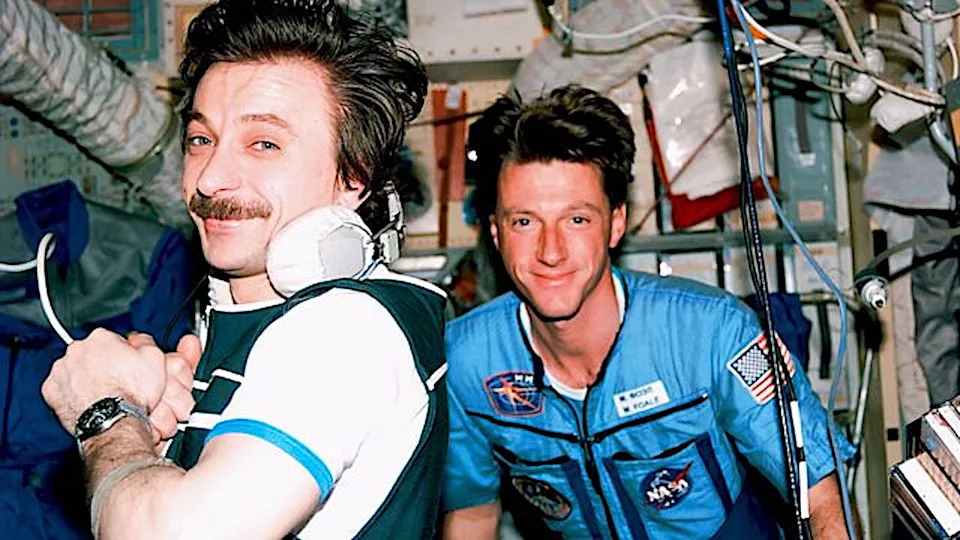
Alexander 'Sasha' Lazutkin (L) and Michael Foale (R) aboard Mir | Credit: NASA/BBC/PBS
Foale Today and the PBS Episode
Reflecting on his career, Foale describes the transition away from active spaceflight as emotionally challenging but says he has found new passions on Earth: soaring and gliding in Texas, biking, and stargazing. He calls James Bluemel's documentary approach perceptive for blending archival footage with candid interviews, and says the series sometimes feels like a fairytale of international cooperation — wondrous, complicated, and imperfect.
Broadcast Details: "The Russian Thing" aired July 21, 2026, at 9:00 p.m. ET on PBS, with further episodes of Once Upon a Time in Space scheduled for July 28 and August 4. Credits for the series and archival images include NASA, BBC, and PBS.
Help us improve.





















