
Reports say Bahrain and Kuwait covertly struck Iranian drone and missile sites earlier this month, with the UAE providing intelligence and air cover. Neither Gulf state has publicly confirmed the operation. Analysts warn the move, if verified, signals a significant escalation in the regional conflict and raises the risk of wider disruption to Gulf security and energy routes.
Bahrain and Kuwait Reportedly Carry Out Secret Airstrikes Inside Iran — UAE Provided Cover, Report Says
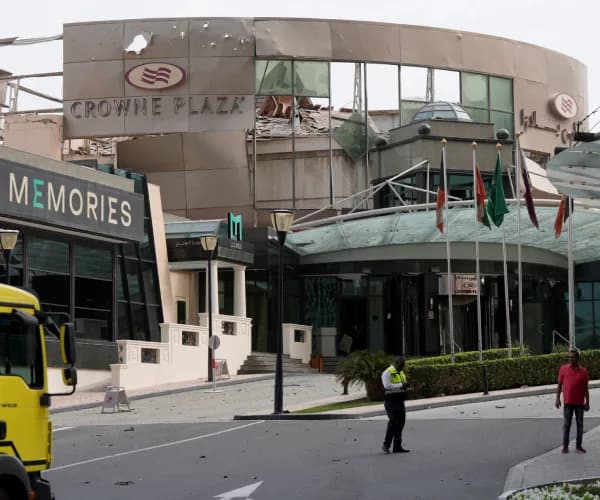
An Iranian military strike in March damaged a hotel in Manama, Bahrain. Bahrain and Kuwait have retaliated against the Islamic Republic. (FADHEL MADAN/AFP via Getty Images)
Bahrain and Kuwait reportedly sent fighter jets into Iranian airspace earlier this month to strike drone and missile storage sites, in what would be the first known direct military retaliation by the two Gulf states against Tehran, The Wall Street Journal reported.
Targets and support. According to people familiar with the operation, the strikes focused on drone and missile depots and other military installations. The United Arab Emirates provided target intelligence and defensive air cover for the mission, the report said.
No public confirmation. Neither Bahrain nor Kuwait has publicly acknowledged the strikes, and spokespeople for both governments did not respond to requests for comment. If verified, the operation would mark a notable expansion of direct Gulf Arab involvement in the conflict with Iran and a departure from the more cautious posture many regional governments have maintained.
Why the strikes took place. Officials familiar with the matter said both countries assessed that, despite operating relatively small air forces equipped mainly with U.S. and European aircraft, they could not allow Tehran to continue striking their territory without responding. Iran has concentrated recent attacks on Bahrain and Kuwait in part because both countries host significant U.S. military installations: Bahrain is home to the U.S. Navy's 5th Fleet, and Kuwait hosts thousands of American service members across multiple facilities.
The report noted that an Iranian military strike in March damaged a hotel in Manama, Bahrain. Kuwait's Foreign Ministry said Iran had struck a power-generation and water-desalination plant, calling the attack on critical civilian infrastructure a dangerous escalation and a violation of international law.
Both Kuwait and Bahrain have repeatedly activated air defenses to intercept Iranian missiles and drones amid the widening conflict, although officials have not reported large numbers of casualties from those incidents. The UAE's Foreign Ministry has urged a reduction in regional tensions and called for the full reopening of the Strait of Hormuz while condemning strikes on Kuwait and Bahrain.
The broader conflict, which escalated after U.S. and Israeli strikes on Iran on Feb. 28, is now in its fifth month. It has disrupted Gulf oil exports through the Strait of Hormuz, hit tourism and investment, and spread to the Red Sea. Iran-backed Houthi forces in Yemen have threatened Saudi-linked commercial shipping near the Bab el-Mandeb Strait, raising concerns about another vital route for global energy supplies.
The United States expanded strikes across Iran recently after Tehran attacked American bases in Bahrain, Kuwait and elsewhere. Analysts say the unfolding confrontation risks deeper regional instability and could force Gulf states to confront Iran more directly if attacks continue.
“The war continuing in the manner that it is playing out right now is their worst-case scenario,” said Dina Esfandiary, a Middle East analyst at Bloomberg Economics. “It affects their very models.”
Umer Karim, a researcher at the University of Birmingham, added: “Gulf countries are beginning to realize this war will continue for some time now. This eventually means that they would have to confront Iran openly.”
Note: This account is based on a Wall Street Journal report citing unidentified people familiar with the operation; the strikes have not been publicly confirmed by Bahrain or Kuwait.
Help us improve.





















