
Quick Summary: Iran's IRGC urged civilians in seven Middle Eastern countries to avoid U.S. military sites and properties tied to former President Trump, warning of danger near American facilities. The IRGC also claimed attacks on U.S. positions in Kuwait and Bahrain, though those claims remain unverified. Regional states and U.S.-led forces reported intercepting drones, missiles and other threats, while U.S. strikes reportedly targeted multiple Iranian military sites. CENTCOM said its actions aim to protect commercial shipping in the Strait of Hormuz.
Iran’s IRGC Urges Civilians in Seven Countries to Avoid U.S. Sites as Tensions Escalate
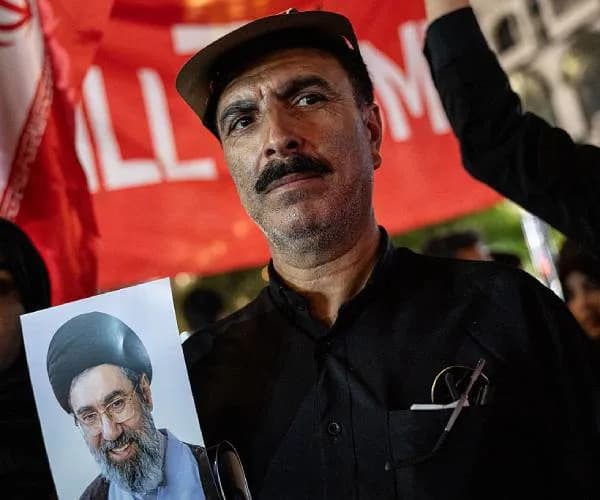
A mourners poses with a photo of Iran's new supreme leader, Mojtaba Khamenei, on July 9 near the Imam Reza Shrine in Mashhad, the nation's spiritual capital and second-largest city, to witness the arrival of the body of slain Supreme Leader Ali Khamenei to be buried at the shrine. (Getty)
Iran’s Islamic Revolutionary Guard Corps (IRGC) on Friday issued a public advisory urging civilians across seven Middle Eastern countries to avoid U.S. military sites, businesses and properties linked to former President Donald Trump, escalating a tense regional standoff.
The advisory, reportedly posted on the messaging app Telegram, named residents of the United Arab Emirates, Bahrain, Jordan, Kuwait, Qatar, Saudi Arabia and Syria. It warned people to stay away from military and security bases, facilities and headquarters, and from any areas showing "military movements or exceptional security measures."
"For your safety, you are urged to immediately stay away from military and security bases, facilities, and headquarters, as well as locations where U.S. forces are deployed," the IRGC message said. It advised maintaining a distance of at least 500 meters (1,640 feet) from any alleged covert accommodations used by U.S. personnel, and specifically mentioned American hotels, banks, companies, high-rise towers and properties associated with the Trump family.
The advisory coincided with renewed IRGC claims that it struck U.S. targets in the Gulf. The paramilitary group said it hit the Udairi base in Kuwait — destroying three ammunition and storage sites — and damaged a watchtower at the U.S. Navy 5th Fleet headquarters in Bahrain. Those claims have not been independently verified.
News outlets reported a range of related incidents on Friday: Bahraini authorities said they intercepted Iranian aerial attacks with no casualties or damage reported; U.S.-led forces reportedly intercepted five explosive drones over Erbil, Iraq; and Jordan's military said it shot down seven missiles and six drones. The Associated Press also reported explosions near Erbil airport, though Iraqi officials said flights continued to operate normally.
U.S. strikes overnight reportedly hit multiple Iranian military locations, with Iranian news agencies Fars and ISNA citing impacts on an IRGC naval base in northern Iran and explosions on Qeshm Island, as well as in Isfahan — home to a major air base and a site linked to Iran's nuclear infrastructure — and in Khuzestan and Fars provinces.
U.S. Central Command (CENTCOM) said its operations were intended to "further degrade Iran's ability to threaten civilian mariners and commercial vessels transiting regional waters," focusing on securing the Strait of Hormuz. U.S. Central Command did not immediately comment on the IRGC's claims of strikes.
What remains clear: the situation is fluid, many of the IRGC's assertions are unconfirmed, and regional actors continue to report interceptions and defensive actions while U.S. forces say they are protecting commercial shipping and personnel.
Help us improve.





















