Archaeologists have excavated a 3,800-year-old kurgan near Yovsanlidere on Azerbaijan's Ceyranchol plain and discovered the skeleton of a man over 2 meters tall clutching a rare four-pronged bronze spear. The tomb contains three chambers—one with the body and grave goods, one with 12 vessels and one left empty—along with decorated pottery, a circular limestone seal, and animal offerings. The grave was capped by two rows of 14 massive limestone slabs; radiocarbon testing and further analyses are planned to refine the chronology and context.
3,800-Year-Old Kurgan Reveals 'Warrior King' Clutching Bronze Spear in Azerbaijan
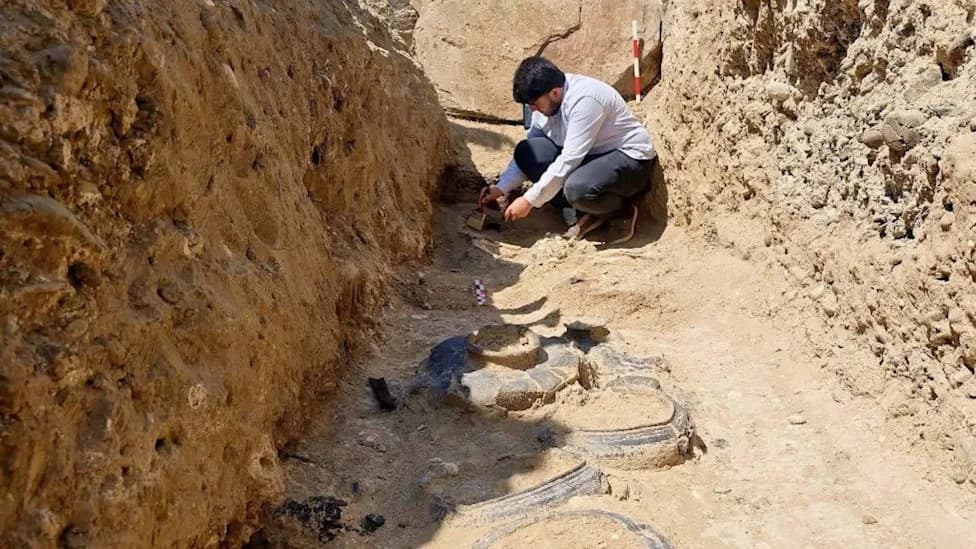
Photo Credit: Ministry of Culture of the Republic of Azerbaijan
Archaeologists working on the Ceyranchol plain in Azerbaijan have uncovered a striking Middle Bronze Age burial that sheds new light on power, warfare and ritual nearly 4,000 years ago. At the heart of a large kurgan near Yovsanlidere, excavators found the skeleton of a very tall man — estimated at more than 6.6 feet (2 meters) — buried in a flexed position with a four-pronged bronze spearhead still held in his hand.
The tomb is divided into three distinct chambers: one housing the body and grave goods, a second containing 12 ceramic vessels, and a third intentionally left empty — a deliberate void that archaeologists interpret as having symbolic or spiritual significance.
Recovered artifacts include decorated pottery, a circular limestone seal that may reflect emerging ideas of social structure or land rights, and animal bones from goat, cow, horse and boar that appear to have been placed as ritual offerings. The spear's unusual four-pronged form is unlike most weapons previously documented in the region and could provide important clues about Bronze Age metallurgy, military practice and status markers.
The grave was capped with two rows of 14 limestone slabs, each slab weighing nearly a ton. The scale and effort required to construct that capstone arrangement point to significant communal investment in honoring the interred individual.
The excavation is part of an ongoing programme led by the Institute of Archaeology and Anthropology of ANAS, supported by Azerbaijan's Ministry of Culture. More than 2,000 people — students, scientists and museum professionals — have participated in the project so far. Project leader Dr. Shamil Najafov has said the team will apply modern analyses, including radiocarbon (Carbon-14) dating, to establish a firmer chronology and to investigate the individual's origins; results are expected to appear in scientific journals and an academic volume.
Dr. Shamil Najafov: "Further laboratory analyses will help us better understand the age, diet and mobility of the individual, as well as the social and technological context of the burial."
Researchers have proposed the label 'Keshikchidagh Kurgans' for this group of mounds. With its rare weapon, carefully arranged offerings, possible ritual spaces and monumental stone cover, this tomb is already reshaping experts' understanding of social complexity and ceremonial practice in the South Caucasus during the Middle Bronze Age.
Help us improve.