
Scientists report the first confirmed occurrence of garnet (andradite) in a Martian meteorite, NWA 8171, held at Canada’s Royal Ontario Museum. Tiny grains (~0.8 × 0.5 mm) were initially mistaken for pyroxene but were verified by chemical analysis. Because NWA 8171 is a breccia, researchers are testing whether the garnet is native to Mars or was delivered by an ancient impact — either outcome would reshape ideas about Mars' thermal and pressure history.
Garnet Found in Martian Meteorite Suggests Unexpected Hot, High‑Pressure History
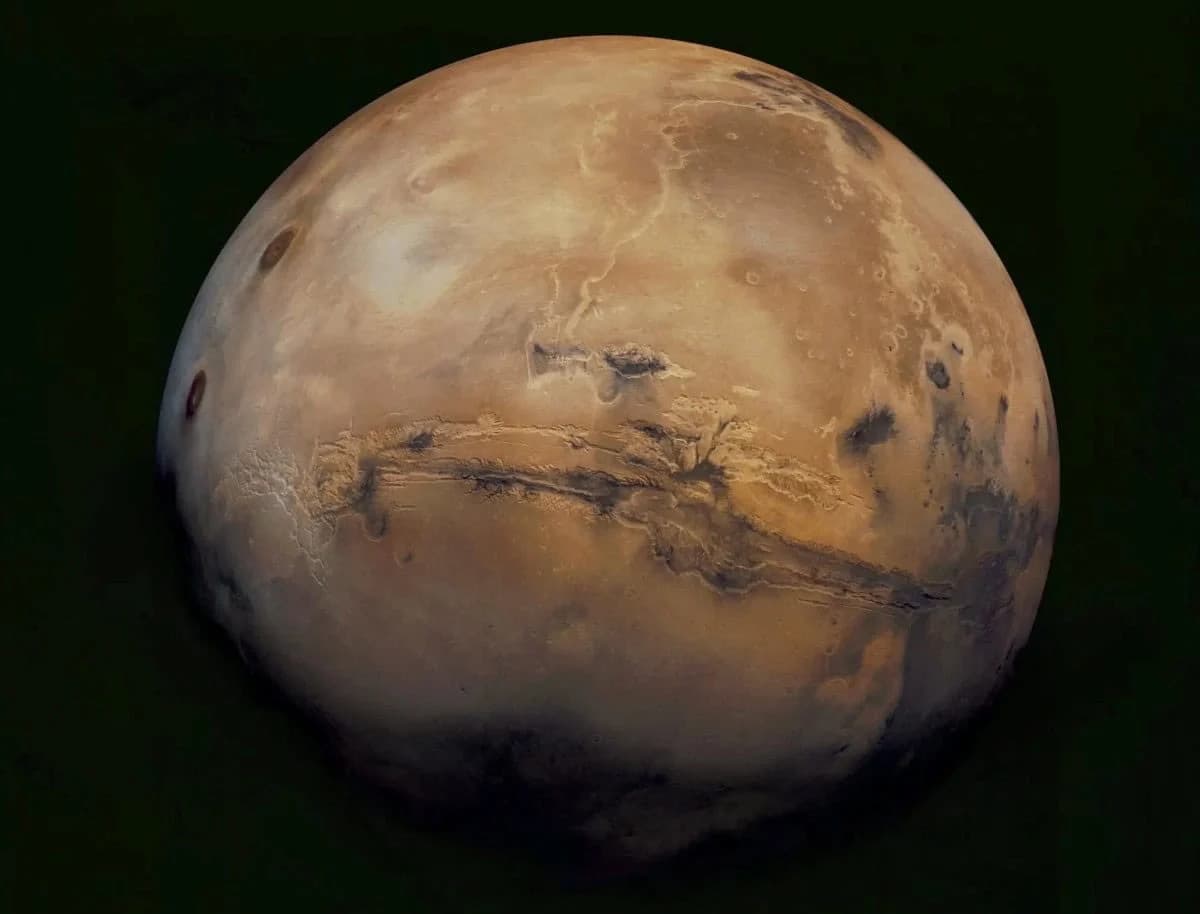
A new discovery of garnet inside the Martian meteorite NWA 8171 is revealing unexpected details about the red planet’s ancient geology | ©Image Credit: NASA/JPL
Scientists have identified garnet — specifically the andradite variety — for the first time in a Martian meteorite, a discovery that raises fresh questions about Mars' geological past.
The specimen, catalogued as NWA 8171 and held in the Royal Ontario Museum (Canada), was analyzed by an international research team and reported in the peer‑reviewed journal Geochemical Perspectives Letters. Tiny grains of andradite, roughly 0.8 by 0.5 millimeters, were found inside a small fragment of the rock. The grains were initially misidentified as pyroxene, a common Martian mineral, but subsequent chemical analyses confirmed their garnet composition.
Why This Matters
On Earth, andradite typically forms during episodes of high temperature, elevated pressure, or through chemical alteration. Its presence in a Martian sample therefore points to one or more processes on Mars that produced similar conditions — scenarios that are not fully captured by current planetary models.
Native or Extra‑Martian?
NWA 8171 is a breccia, a rock made of many fragments cemented together, so researchers are investigating whether the garnet formed on Mars or was delivered to Mars by an ancient impactor and later incorporated into the brecciated material. If native, the garnet would record previously unrecognized crustal processes on Mars; if extra‑Martian, it would tell a different story about material exchange in the early solar system.
Implications and Next Steps
James Darling, a planetary scientist at the University of Portsmouth, said the find “adds a striking new dimension to our understanding of the geology of Mars and opens an exciting new window into the evolution of our planetary neighbor.” The authors propose that NWA 8171 might represent a previously unrecognized class of Martian rock, offering a new way to study how Mars has changed over its ~4.5‑billion‑year history.
Confirmed Martian meteorites are rare: a 2024 survey noted only a few hundred verified samples among tens of thousands of meteorite specimens in global collections. Each confirmed sample originates from material launched off Mars by a sufficiently violent impact, and only a small fraction of those fragments eventually reach Earth. Meteorites like NWA 8171 therefore provide unique opportunities to analyze Martian material in terrestrial laboratories with instruments far more powerful than those that can be flown on spacecraft.
Key sources: Geochemical Perspectives Letters; Royal Ontario Museum; Meteoritical Bulletin Database; University of Portsmouth; 2024 Phys.org survey.
Help us improve.





















