
A Chandra X‑ray Observatory study of Messier 83 has revealed unexpectedly bright, variable X‑ray emission from supernova remnants. Over 14 years of data (2000–2014), roughly half of 22 remnants showed significant brightness changes rather than the steady fade expected for older remnants. Astronomers suggest surviving companion stars feeding black holes or neutron stars, or fallback of explosion debris, could power the flares; similar behavior was also seen in galaxy M51.
Fireworks in a Nearby Galaxy: Unexpected X‑Ray Flares From Supernova Remnants in M83
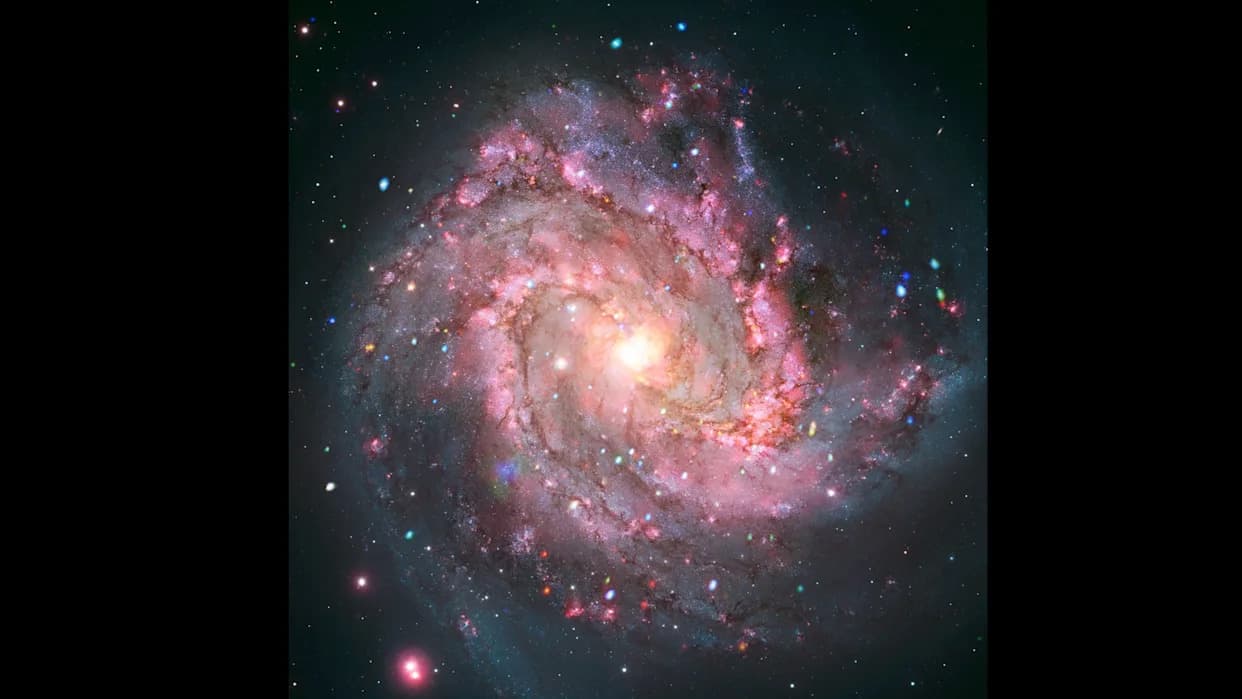
Galaxy M83 in X-ray and optical light.
Early Fourth of July fireworks had nothing on what astronomers spotted in a nearby galaxy. Using NASA's Chandra X‑ray Observatory, researchers detected unusually bright, variable X‑ray emission from supernova remnants in the star-forming galaxy Messier 83 (M83), about 15 million light‑years from Earth. The results are published in The Astrophysical Journal.
What the Team Observed
The team analyzed 14 years of Chandra observations, spanning 2000 through 2014, and focused on 22 X‑ray sources previously identified as supernova remnants. Contrary to expectations that remnants older than roughly 100 years would show a steady, slowly fading X‑ray glow, roughly half of these sources varied noticeably in brightness over the 14‑year interval.
“We knew that individual X‑ray sources could vary dramatically, but finding that so many supernova remnants were behaving this way was a real surprise,” said Andrea Prestwich, a co‑author and astronomer at The Catholic University of America.
Leading Explanations
One case, SN 1957D, has a straightforward explanation: debris from the explosion, first observed nearly 70 years ago, is plowing into surrounding material and producing X‑ray flares. However, that interaction does not account for the variability seen across the rest of the sample.
The researchers propose two plausible mechanisms for the majority of the variable sources:
- Surviving Companion Accretion — In some systems the supernova may have occurred in a binary. The exploding star left behind a compact object (a black hole or ultradense neutron star) while the companion survived. The compact object can then strip material from the companion, producing episodic X‑ray flares.
- Fallback (Cosmic Recycling) — Some of the explosion debris could fall back onto the newly formed compact object, re‑igniting X‑ray emission as material is re‑accreted.
“It may be that this galaxy contains a collection of supernova remnants where one massive star survives the supernova and becomes locked into an orbit with a black hole or neutron star,” said Michael McCollough, co‑author and astrophysicist at Harvard University. Roy Kilgard of Wesleyan University added that fallback accretion could also be at work, and both processes might operate in different systems.
Broader Context
These variable remnants are not unique to M83. A follow‑up study of the nearby star‑forming galaxy M51 found a similar population of variable X‑ray sources associated with supernova remnants, suggesting such systems could be common in galaxies that are producing stars vigorously. Understanding these sources helps astronomers learn how massive stars die, how compact objects interact with companions, and how supernova debris evolves over decades.
Key details: M83 lies about 15 million light‑years away; the analysis covered Chandra data from 2000–2014; 22 remnants were monitored and roughly half showed variability; SN 1957D is a clear example of shock interaction driving X‑rays.
Help us improve.





















