
JWST transit spectra of WASP-121b reveal that the planet’s dawn and dusk terminators have different chemical signatures, with the dusk side leaving a stronger imprint. The data show increased carbon monoxide and reduced water in hotter regions, consistent with thermal dissociation. Findings support powerful eastward winds redistributing heat and suggest silicate mineral clouds may cool the morning side. This approach enables longitudinal, three-dimensional mapping of exoplanet atmospheres and will be applied to more ultrahot giants.
James Webb Finds Dawn and Dusk Have Distinct Chemistry on Hellish Exoplanet WASP-121b
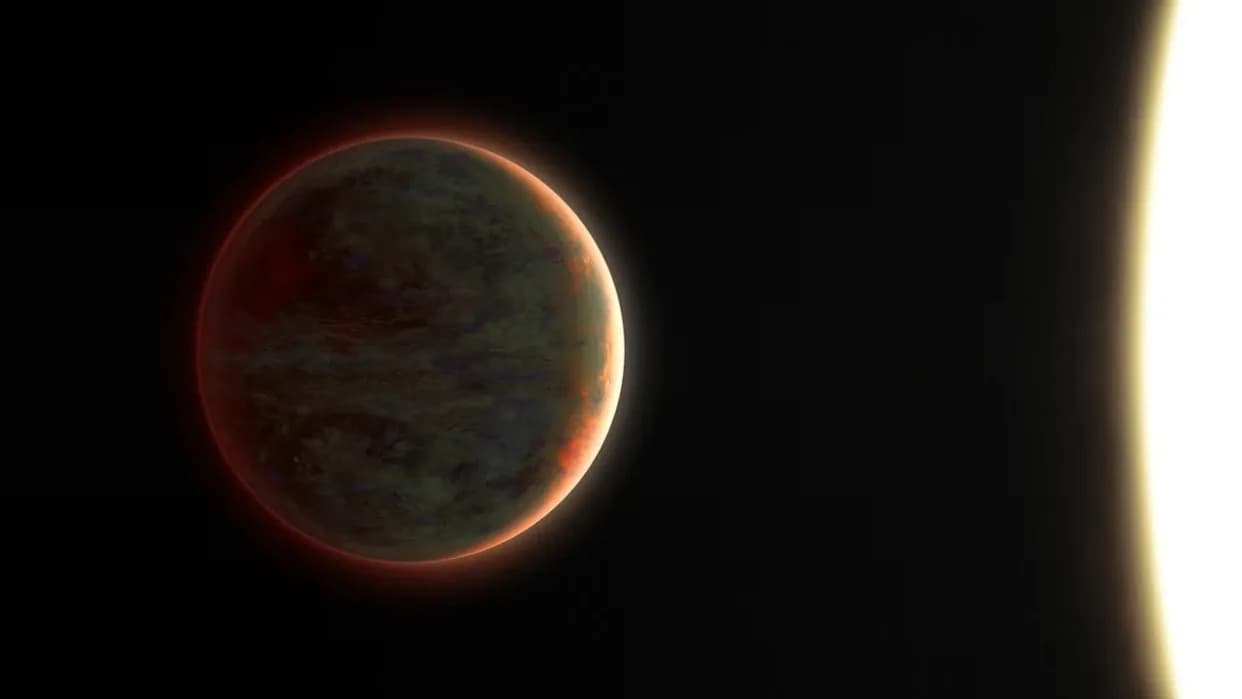
Photo Credit: Patricia Klein and MPIA
New observations from the James Webb Space Telescope (JWST) reveal that the narrow dawn and dusk boundary regions—the terminators—on the ultrahot gas giant WASP-121b have different atmospheric chemistry. Rather than a single, blended signal, the transit spectra change as the planet moves across its star, allowing astronomers to distinguish the two terminators and read out longitudinal differences in composition and temperature.
How the Observation Worked
A team of researchers analyzed starlight filtered through WASP-121b’s atmosphere during a transit. Instead of a single uniform absorption spectrum, the data showed a time-dependent pattern that shifted over the transit. By tracking how the spectral imprint changed, the team could separate the contributions from the dusk and dawn terminators and compare them directly.
Key Findings
The dusk-side terminator produced a stronger spectral imprint than the dawn side, consistent with models predicting powerful eastward winds that carry heat from the blistering dayside toward the nightside. JWST spectra also showed stronger carbon monoxide (CO) features later in the transit and weaker water signatures in the hotter regions. Scientists interpret the reduced water signal as thermal dissociation—extreme heat breaking H2O apart—so molecules that survive high temperatures dominate the chemistry.
“With its unprecedented observational quality, JWST gives us the most detailed glimpses into distant planets to date,” said lead author Cyril Gapp. “By measuring how starlight absorption changes as WASP-121b rotates, we probe its atmosphere longitude by longitude.”
WASP-121b is an extremely hostile world: average dayside temperatures reach roughly 2,770 Kelvin while the nightside falls toward about 1,000 Kelvin, producing dramatic thermal contrasts and strong atmospheric circulation.
Clouds, Circulation, and 3D Maps
Beyond compositional differences, the observations hint that mineral clouds—possibly silicate-based—may be more prevalent on the morning (dawn) side, producing extra cooling there and exceeding prior model expectations. These longitudinal contrasts offer a new path for building three-dimensional maps of exoplanet atmospheres instead of treating them as uniform shells.
The team plans to refine models and apply the same longitudinal transit analysis to other ultrahot gas giants to test whether dawn-dusk chemical asymmetry is common across this class of planets.
Co-author Tom Evans added: “WASP-121b is particularly extreme, with average temperatures on the dayside hemisphere being around 2770 Kelvin, while those on the nightside are closer to about 1000 Kelvin.”
Help us improve.





















