
This week (June 12–19) brings a rare daytime occultation of Venus by the Moon on June 17 visible across much of the U.S., a notable outburst and perihelion for Comet 220P/McNaught, and asteroid 14 Irene at opposition. Venus passes near the Beehive Cluster on June 18, while Saturn and its moon Dione are prominent in the predawn sky on June 19. The guide includes observing tips, magnitudes, and strong safety warnings for daytime viewing.
This Week's Sky: Daytime Occultation of Venus, Comet Outburst, and Midnight Asteroid Views (June 12–19)
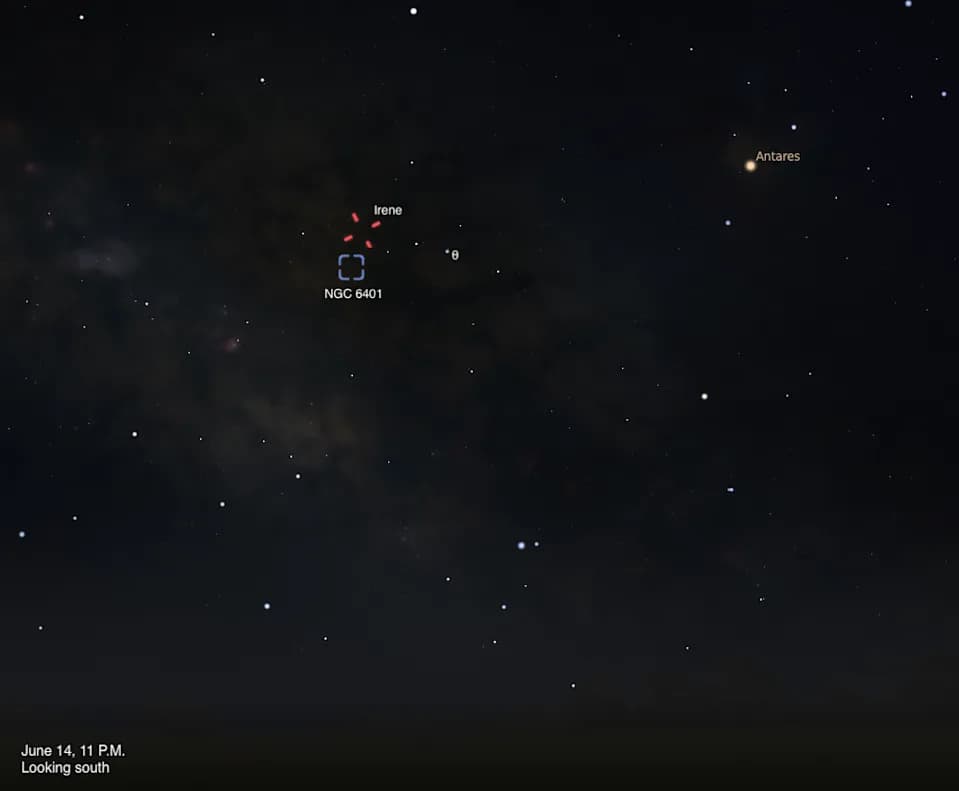
Asteroid Irene floats amid the crowded plane of the Milky Way in Ophiuchus. Even if you have trouble spotting the asteroid, try for nearby globular cluster 6401 instead. Credit: Stellarium
Explore the highlights for June 12–19: close lunar encounters across the sky, a rare daytime occultation of Venus on June 17 visible across much of the U.S., a dramatic comet outburst, and several rewarding telescope targets. Below are nightly notes, observing tips, exact event times (local to 40°N, 90°W), and safety reminders for daylight observing.
Friday, June 12
The Moon passes 6° north of Mars at 5:00 P.M. EDT. You can spot the pair in the early-morning sky today or tomorrow (June 13) about an hour before sunrise, when they will sit roughly 8° above the eastern horizon with the Moon to Mars’ far left.
By late evening Vulpecula the Fox climbs to about 30° above the eastern horizon. That constellation hosts the well-known Dumbbell Nebula (M27), a planetary nebula produced by a dying Sun-like star. The nebula shines at magnitude 7.4 and lies about 3.2° north of magnitude 3.5 Gamma Sagittae.
The Dumbbell spans roughly 8' by 5.7', making it slightly longer than it is wide. To visual observers it often appears bi-lobed, like a dumbbell or hourglass, with a narrow waist; long-exposure images reveal more spherical structure while preserving the two-lobed outline. The nebula’s central star is a magnitude 13.5 white dwarf — the cooling remnant of the progenitor star — and may be visible in larger amateur telescopes.
Sunrise: 5:31 A.M. Sunset: 8:29 P.M. Moonrise: 2:59 A.M. Moonset: 6:06 P.M. Moon Phase: Waning Crescent (6%)
Saturday, June 13
The Moon passes 5° north of Uranus at 3:00 P.M. EDT. Uranus rises just over an hour before the Sun and is only just becoming accessible in the morning sky; it remains a challenging target until the predawn dark improves.
For now, point a telescope toward southern Pisces where Saturn outshines nearby stars. This area recently hosted an extraordinary outburst from Comet 220P/McNaught, which brightened from 18th magnitude to nearly 8th magnitude in a single day. The comet has begun to fade but remains brighter than before the jump, with recent measurements near 12th magnitude.
This morning Comet McNaught sits about 4.7° west of Saturn — a helpful marker when searching roughly two hours before dawn, when the comet is nearly 20° high in the east. The comet reaches perihelion on June 14 and is expected to continue fading, though further surprises are possible. Keep an eye out later in the season for 10P/Tempel, which is inbound for a late-summer perihelion and will become increasingly favorable.
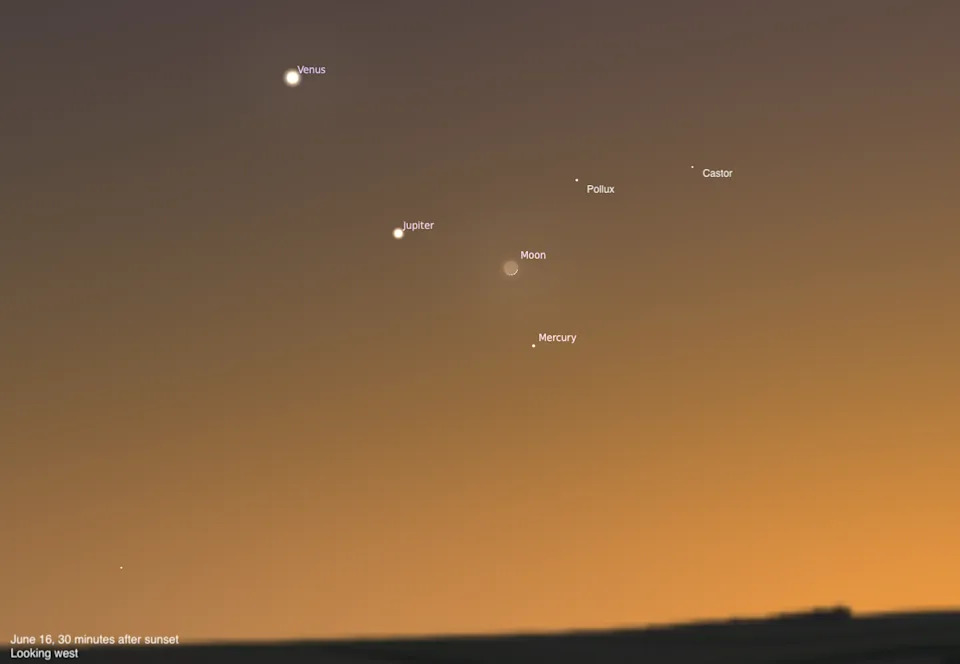
On June 16, the delicate waxing crescent Moon creates an elongated triangle with Jupiter and Mercury in the evening sky. Credit: Stellarium/USGS/Celestia/Clementine
Sunrise: 5:31 A.M. Sunset: 8:30 P.M. Moonrise: 3:40 A.M. Moonset: 7:27 P.M. Moon Phase: Waning Crescent (2%)
Sunday, June 14
The Moon reaches perigee at 7:20 P.M. EDT, coming within 221,952 miles (357,197 km) of Earth. New Moon follows late that night at 10:54 P.M. EDT.
Asteroid 14 Irene approaches opposition overnight (officially listed for 6:00 A.M. EDT on June 15), making now an excellent time to observe it. Irene glows at around mid-9th magnitude and stands roughly 20° high in the south an hour before midnight. It lies in Ophiuchus near the Milky Way, about 3.6° northeast of 3rd-magnitude Theta (θ) Ophiuchi — a region rich with star clusters and nebulae.
Nearby is the compact globular cluster NGC 6401, with an apparent brightness similar to Irene’s. Located about 1.6° southeast of Irene (or 3.9° east-northeast of Theta Oph), the cluster can be an easier visual reference if the asteroid is difficult to pick out against the crowded star field.
Sunrise: 5:31 A.M. Sunset: 8:30 P.M. Moonrise: 4:31 A.M. Moonset: 8:41 P.M. Moon Phase: New
Monday, June 15
Asteroid 14 Irene is at opposition (6:00 A.M. EDT). Later the same day Mercury reaches greatest eastern elongation at 4:00 P.M. EDT, sitting about 25° from the Sun and shining around magnitude +0.5 in the evening sky.
About 30 minutes after sunset a thin waxing crescent Moon (≈2% illuminated) will be roughly 5° above the western horizon. Mercury will appear to its upper left in Gemini, with brighter Jupiter and then Venus further to Mercury’s upper left (magnitudes ≈–1.8 and –4.0 respectively). Mercury sets first shortly after 10:00 P.M. local daylight time; Jupiter and Venus remain visible for at least another half hour, with Venus setting near 11:00 P.M.
Through telescopes: Mercury appears about 38% illuminated and spans ~8″; Venus is ~75% illuminated at ~14″; Jupiter shows a ~32″ disk. You may spot Jupiter’s Galilean moons — Io begins a transit around 9:50 P.M. CDT, with its shadow falling on Jupiter’s cloud tops roughly an hour later (visible from parts of the western U.S.).
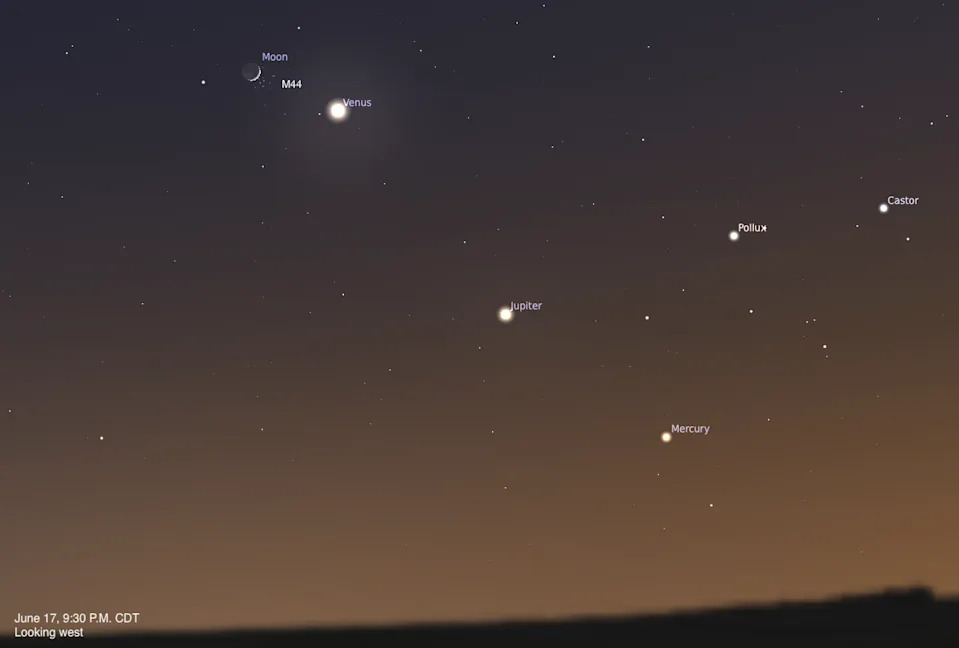
By evening on June 17, the Moon is crossing the Beehive Cluster (M44), having left Venus behind. It's a lovely post-sunset picture. Credit: Stellarium/USGS/Celestia/Clementine
Sunrise: 5:31 A.M. Sunset: 8:30 P.M. Moonrise: 5:36 A.M. Moonset: 9:45 P.M. Moon Phase: Waxing Crescent (2%)
Tuesday, June 16
The Moon passes 3° north of Mercury at 4:00 P.M. EDT. After sunset the Moon will appear above Mercury and form a compact triangle with Mercury and Jupiter. About 30 minutes after sunset the trio will be over 10° high; an hour after sunset they remain roughly 8° above the horizon.
The Moon is a slightly broader crescent (≈6% illuminated). Just north of the Moon is Pollux (Gemini) with Castor nearby; these bright stars are among the first to emerge from twilight and make an attractive grouping suitable for cellphone photography. Venus remains above-left of Jupiter in Cancer.
Note how far the Moon appears from Venus tonight: by tomorrow afternoon the Moon will catch up and pass in front of Venus in a daytime occultation visible across much of the U.S.
Sunrise: 5:31 A.M. Sunset: 8:31 P.M. Moonrise: 6:50 A.M. Moonset: 10:35 P.M. Moon Phase: Waxing Crescent (6%)
Wednesday, June 17 — Daytime Occultation of Venus
The Moon moves from Gemini into Cancer and will pass roughly 0.3° north of Venus at about 4:00 P.M. EDT. Across much of the United States, observers may instead witness the Moon pass directly in front of Venus in a daytime occultation. This is a rare and striking event, but it requires strict safety precautions.
Safety first: Never point binoculars, a camera, or a telescope anywhere near the Sun without proper solar filters. Daytime observing can be hazardous — only experienced observers should attempt to use optics, and they must employ certified solar filters and safe techniques.
Timing varies by location. Example disappearance times: East Coast ≈ 3:49 P.M. EDT; Austin, TX ≈ 2:24 P.M. CDT; Denver ≈ 12:55 P.M. MDT. For detailed disappearance and reappearance times for many locations, consult the International Occultation Timing Association (IOTA): http://www.lunar-occultations.com/iota/bstar/0617venus.htm (times there are in Universal Time; convert to your local zone).
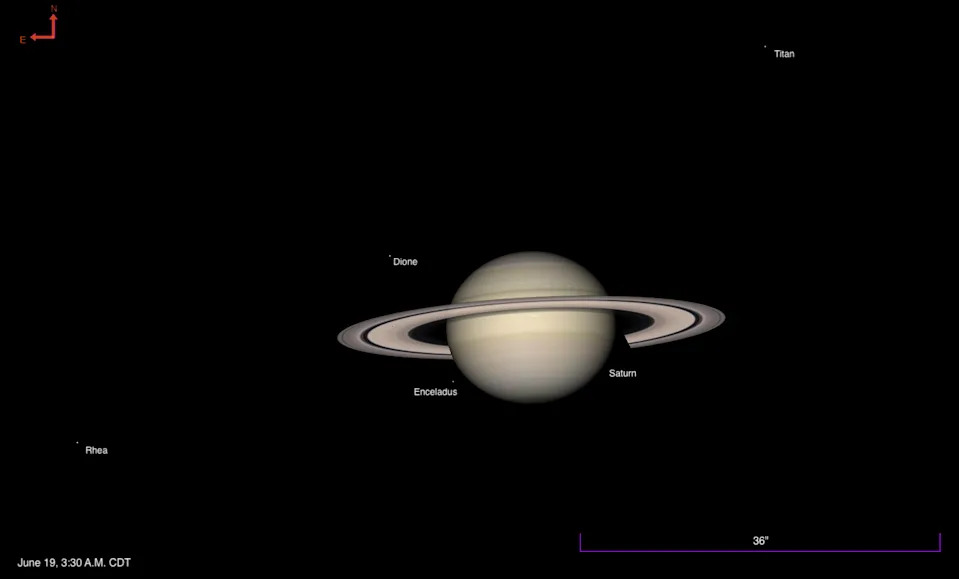
Two hours before sunrise in the Central time zone, Dione is still approaching Saturn from the northeast. The small moon will pass due north of Saturn about two hours after this, shortly before 4:30 A.M. PDT. Note that 12th-magnitude Enceladus may not be visible. Credit: Alison Klesman (via TheSkyX)
After sunset the Moon will cross the Beehive Cluster (M44) in central Cancer; Venus will lie roughly 2° to the Moon’s lower right. The Moon also occults several cluster stars — these post-sunset occultations are safe to observe with binoculars or a telescope as the sky darkens. Eastern U.S. observers will mostly see stars disappear behind the Moon; western observers will more often see stars reappear from behind the bright lunar limb, which is a more subtle effect to catch.
Sunrise: 5:31 A.M. Sunset: 8:31 P.M. Moonrise: 8:09 A.M. Moonset: 11:14 P.M. Moon Phase: Waxing Crescent (13%)
Thursday, June 18
Tonight after sunset Venus skims close to the Beehive Cluster (M44) in central Cancer, appearing just ~1.3° from the cluster’s center. The Beehive spans nearly 100′ and has a combined magnitude near 3.7; Venus, at magnitude ≈ –4.0, is dramatically brighter and makes a striking binocular or low-power telescope sight.
The Moon has shifted into Leo and will appear below the Sickle asterism. Regulus (Alpha Leonis, mag ~1.4) marks the bottom of the Sickle’s handle; the curve of stars that forms the Sickle (Eta, Gamma, Zeta, Mu, and Epsilon Leo) outlines the backward question-mark shape that identifies Leo’s head and mane.
Sunrise: 5:31 A.M. Sunset: 8:31 P.M. Moonrise: 9:28 A.M. Moonset: 11:46 P.M. Moon Phase: Waxing Crescent (22%)
Friday, June 19
Saturn dominates the early-morning sky, shining near magnitude +1.0 in dim Pisces. One of Saturn’s moons, Dione (mag ~10), passes due north of the planet this morning. With a dark sky and a telescope, you can track its motion relative to Saturn.
Two hours before sunrise Saturn is nearly 20° high in the east, near the border of southern Pisces and northern Cetus. Through a telescope you’ll see Saturn’s ring system and easily spot Titan just northwest of the planet; Dione is closer in and lies to Saturn’s northeast. As the morning progresses it draws near and passes due north of Saturn shortly before 4:30 A.M. PDT — an event most observable from the U.S. West Coast where the sky will still be darker at that hour. A short exposure photograph may reveal Dione even if visual detection is difficult in twilight.
The Moon passes 0.3° south of Regulus in Leo at 11:00 A.M. EDT; by evening it will appear upper-left of Regulus after sunset.
Sunrise: 5:31 A.M. Sunset: 8:32 P.M. Moonrise: 10:41 A.M. Moonset: — Moon Phase: Waxing Crescent (32%)
About The Author: Alison Klesman is Senior Editor at Astronomy Magazine. She holds a Ph.D. in astronomy and has worked on topics ranging from minor planets to supermassive black holes.
Notes: All times given are local for 40° N, 90° W unless noted. Event times and magnitudes may vary slightly with updated measurements; check local ephemeris tools or the IOTA page for updated occultation timings.
Help us improve.





















