
JWST and ALMA observations of the merging system CRISTAL‑02, seen about one billion years after the Big Bang, reveal a massive cold‑gas outflow that is ejecting material at roughly twice the galaxy's star‑formation rate. Although CRISTAL‑02 is forming stars rapidly, the wind could quench future star formation in under 50 million years. The finding suggests merger‑driven winds may explain the abundance of massive, inactive galaxies in the early universe.
JWST and ALMA Reveal 'Galaxy‑Killing' Wind That May Explain Why Massive Early Galaxies Died Young
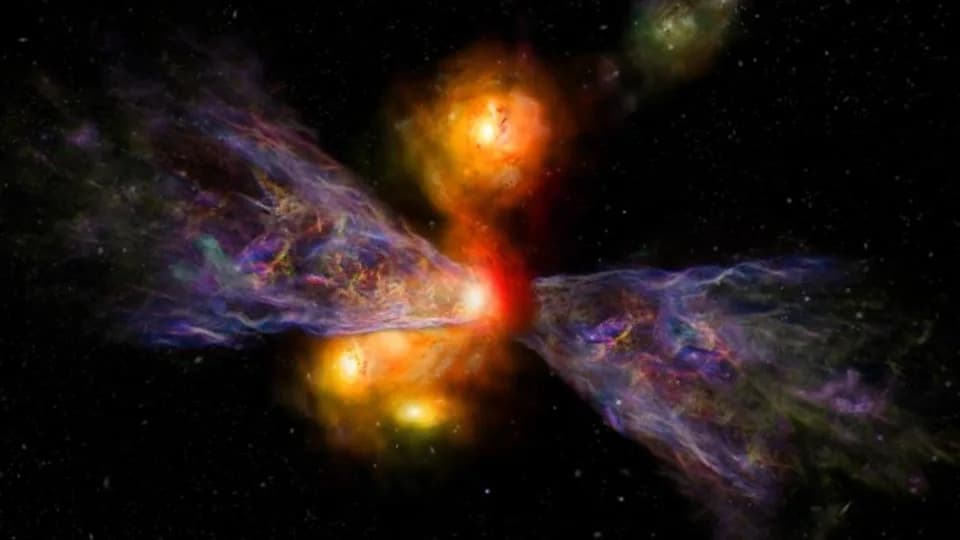
Credit: Joshua Worth
Using observations from the James Webb Space Telescope (JWST) and the Atacama Large Millimeter/submillimeter Array (ALMA), astronomers have discovered a powerful, galaxy‑scale wind that may explain why many massive galaxies in the early universe appear to have stopped forming stars much sooner than expected.
The team studied a system called CRISTAL‑02, as it appeared about one billion years after the Big Bang, and found two contrasting behaviors: the system is forming stars at roughly twice the rate of similar galaxies from that epoch, yet it is also ejecting cold gas in a vast, high‑speed plume. JWST and ALMA data show this outflow is removing material at a rate about twice the galaxy's star‑formation rate.
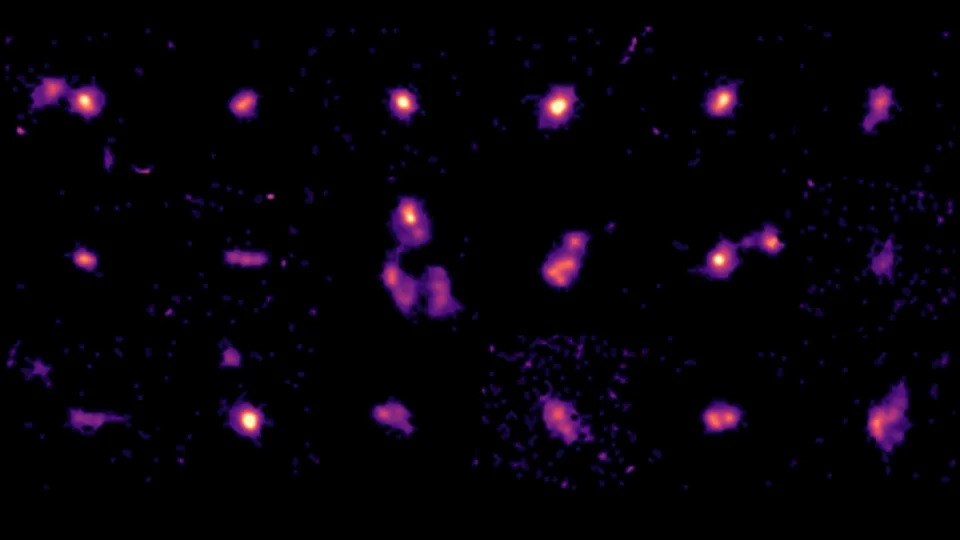
The 18 galaxies from the ALPINE-CRISTAL-JWST survey including CRISTAL-02 | Credit: Andreas Faisst (Caltech) and the ALPINE-CRISTAL-JWST Survey team
Lead author Rebecca Davies of Swinburne University of Technology described dense regions of the early universe as "very active cities," where collisions and mergers trigger intense starbursts. Those massive, short‑lived stars then explode as supernovas and can drive powerful winds that expel the gas needed for future star formation.
Because CRISTAL‑02 is actually a compact group of galaxies in the final stages of a merger, gas is being funneled into galactic centers, feeding starbursts that are soon followed by supernova‑driven blowouts. If the observed outflow continues at the same pace, the galaxy could be largely quenched in under 50 million years, providing a natural explanation for the population of massive "dead" galaxies seen in the young cosmos.
Researchers also report that nearly half of similarly massive early galaxies show signs of interaction or merging with close companions, suggesting that merger‑driven winds may have been a common quenching mechanism in the early universe. The discovery, published June 10 in Monthly Notices of the Royal Astronomical Society: Letters, ties detailed JWST imaging with ALMA's sensitivity to cold gas to reveal how galaxies may have effectively "self‑destructed" their ability to form stars.
Why it matters: The combination of intense star formation and powerful outflows in merging systems helps explain how many early massive galaxies "lived fast and died young," resolving a long‑standing puzzle in galaxy evolution.
Help us improve.





















