
JWST spectra of GLIMPSE-17775, magnified by the gravitational lens Abell S1063, show multiple spectral signatures consistent with a rapidly accreting supermassive black hole enshrouded in dense, partially ionised gas. Emission features point to electron scattering, fluorescence, helium absorption and an "iron forest," all expected from an obscured black hole growth phase. A weaker Balmer Break may result from dilution by a massive host galaxy. The findings, published June 10 in The Astrophysical Journal, strengthen the hypothesis that some "little red dots" represent transient, heavily obscured black hole growth in the early universe.
JWST Spectra Strengthen Case That ‘Little Red Dots’ Are Growing, Obscured Black Hole Stars
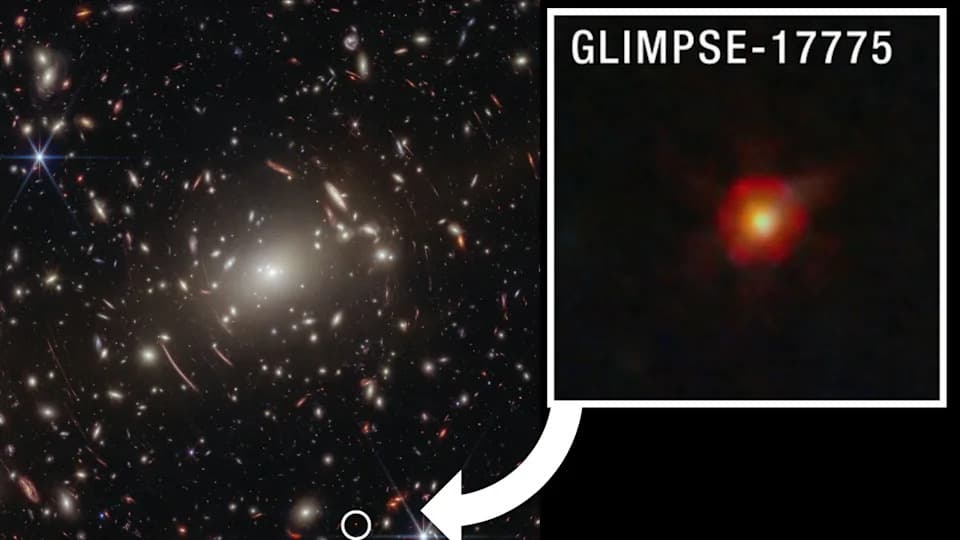
An image of the galaxy cluster Abell S1063 and the little red dot known as GLIMPSE-17775. | Credit: NASA, ESA, CSA, V. Kokorev (University of Texas at Austin), A. Pagan (STScI)
Astronomers using the James Webb Space Telescope (JWST) report new, deep spectral evidence that some of the mysterious “little red dots” seen in early-universe surveys may be black hole stars — rapidly accreting, growing supermassive black holes enshrouded by dense, partially ionised gas.
Deep Spectrum Reveals Multiple Clues
The object, designated GLIMPSE-17775, was observed as it existed roughly 1.8 billion years after the Big Bang while JWST was targeting the galaxy-cluster gravitational lens Abell S1063. Lensing by Abell S1063 magnified the source, effectively turning about 30 hours of telescope time into the equivalent of roughly 80 hours of exposure and yielding one of the deepest spectra yet obtained for a little red dot.
According to the research team, this exceptionally rich spectrum contains several independent signatures consistent with a luminous, rapidly feeding black hole whose light is filtered through a thick cocoon of gas and dust. Rather than matching the patterns expected from a rotating star-forming gas cloud, several emission features point to electron scattering — a hallmark of radiation emerging through an optically thick envelope.
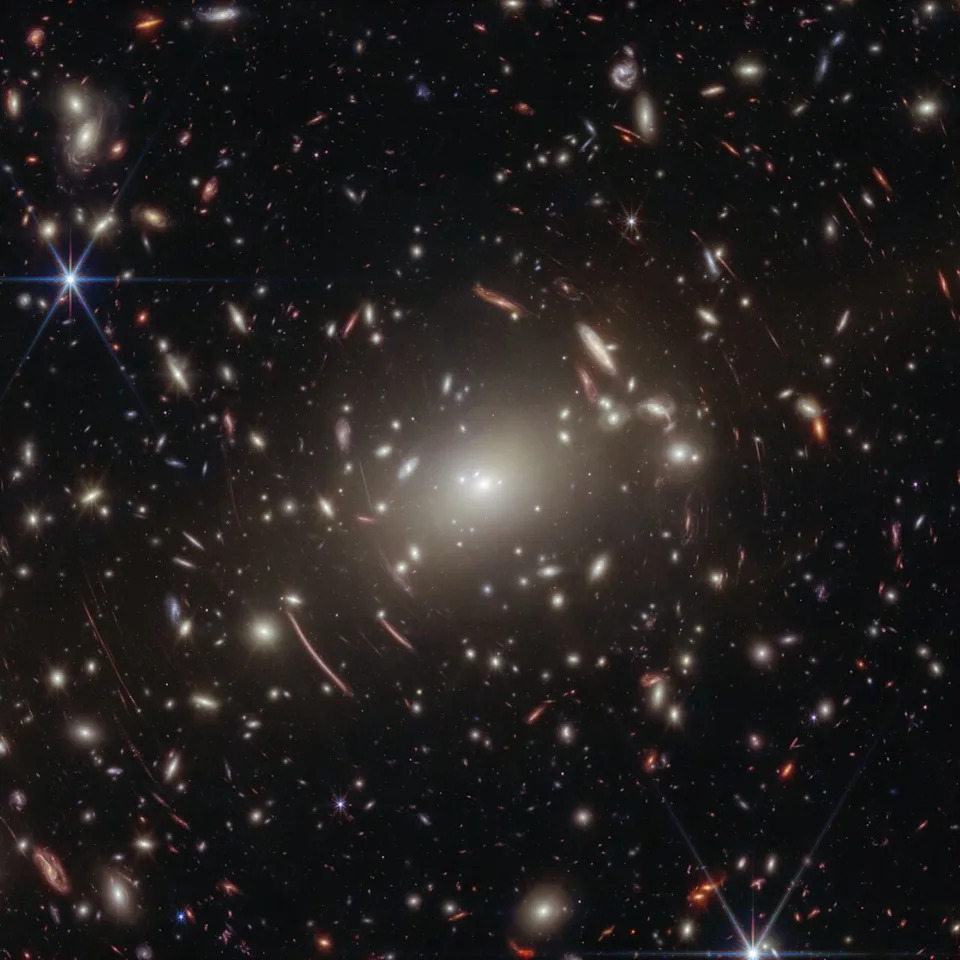
The galaxy cluster Abell S1063, a gravitational lens seen by the JWST. | Credit: NASA, ESA, CSA, V. Kokorev (University of Texas at Austin), A. Pagan (STScI)
"When we saw the spectrum for the first time, it was like having all the pieces of a puzzle scattered on the floor," said Vasily Kokorev of the University of Texas at Austin. "We picked up each piece, measured the lines, and started combining them into a mosaic... and we realized that there was something there."
Key Spectral Signatures
- Electron Scattering: Emission-line profiles indicate photons have been scattered by free electrons in a dense medium, not produced by simple disk rotation.
- Fluorescence and Helium Absorption: Features consistent with fluorescence and helium-absorbing radiation suggest a dense, partly ionised shroud surrounding the source.
- Iron Emission 'Forest': A cluster of iron lines — described by the team as an "iron forest" — is expected if a central engine produces high-energy photons that excite surrounding heavy elements.
These combined signatures match predictions for an obscured, rapidly accreting supermassive black hole — sometimes called a black hole star — rather than a typical, unobscured active galaxy or a pure stellar population.
Explains X-Ray Faintness And A Weaker Balmer Break
The black hole star interpretation also helps explain why many little red dots are faint in X-rays: dense gas cocoons should absorb high-energy photons. GLIMPSE-17775’s spectrum notably lacks a strong Balmer Break (a characteristic dip in the continuum seen in some other little red dots). The team suggests this break is weakened here because additional starlight from a massive host galaxy dilutes the feature.
Context And Next Steps
Little red dots first gained attention after JWST began returning data in 2022, appearing in significant numbers around 600 million years after the Big Bang and becoming rarer by roughly 2 billion years. Until now, no single object had produced a spectrum with multiple converging indicators supporting the black hole star scenario. GLIMPSE-17775 provides one of the most complete datasets to date, strengthening the case that at least some little red dots are transient, heavily obscured phases of supermassive black hole growth.
The observations were collected while searching for so-called Population III stars in the fields behind Abell S1063. The research was published on June 10 in The Astrophysical Journal. The authors stress that while the evidence is compelling, additional observations across wavelengths and more examples will be needed to confirm whether this interpretation applies to most little red dots or if alternative explanations remain viable.
Help us improve.





















