
Pakistan and Lebanon's army chiefs met in Rawalpindi and pledged to deepen defence cooperation as Islamabad continues mediating between the US and Iran. The visit took place amid renewed fighting around Lebanon, though Iran and Israel signalled a temporary pause. US officials said negotiators were in the "final throes" of a deal. The conflict escalated after Hezbollah launched rockets in early March and Israel responded with airstrikes and a ground offensive that have resulted in thousands of reported deaths.
Pakistan, Lebanon Army Chiefs Pledge Deeper Defence Ties As Mediation Over Middle East War Stalls
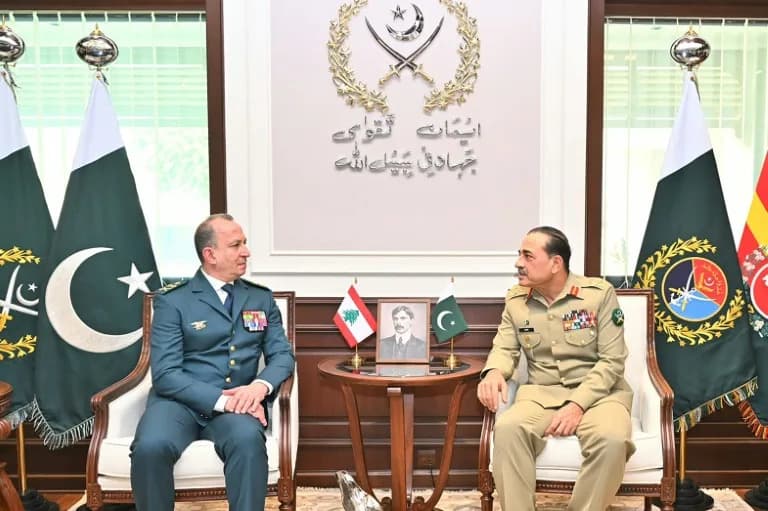
This handout photograph taken and released on June 9, 2026 by Pakistan's Inter-Services Public Relations (ISPR) shows Pakistan's Army Chief and Field Marshal Syed Asim Munir (R) speaking with General Rodolphe Haykal, Commander-in-Chief of the Lebanese Armed Forces during their meeting in Rawalpindi. (Handout)(Handout/Pakistan's Inter-Services Public Relations (ISPR)/AFP)
Pakistan and Lebanon's army chiefs agreed on Tuesday to deepen defence cooperation during a meeting in Rawalpindi, as international mediation to end the months-long Middle East war has shown little progress.
Islamabad has been mediating between the United States and Iran, and Tehran has insisted that any settlement must address the situation in Lebanon, where Israel has been engaged with Iran-backed Hezbollah.
Lebanese Army Chief Rodolphe Haykal travelled to Pakistan on Saturday to meet his Pakistani counterpart, General Asim Munir. A Lebanon-based source told AFP the visit was connected to the broader peace negotiations.
According to a statement from the Pakistan Army's media wing, the two commanders discussed "matters of mutual interest, the evolving regional security environment, defence cooperation and prospects for enhancing bilateral military relations." The statement said General Munir reaffirmed the Pakistan Army's commitment to expanding defence collaboration with the Lebanese Armed Forces. Haykal was received with a guard of honour ahead of the meeting in Rawalpindi.
Fighting in and around Lebanon has been central to recent, intermittent efforts to secure a formal end to the wider war. Hostilities intensified during Haykal's visit, though Iran and Israel indicated on Monday that they had paused active exchanges.
US President Donald Trump, who has expressed frustration at the slow progress of talks, said negotiators were in the "final throes" of reaching an agreement.
Lebanon was drawn into the broader conflict after Hezbollah militants fired rockets into Israel on March 2, which the group said was in retaliation for earlier strikes linked to the wider regional confrontation. Israel responded with extensive airstrikes and a ground offensive that, according to reports, have left nearly 3,600 people dead. Exchanges of fire with Hezbollah have continued sporadically despite an ongoing ceasefire.
Pakistan's Prime Minister Shehbaz Sharif said a US-Iran deal to end the war was "about to be achieved" before fresh fighting between Iran and Israel erupted on Sunday. Even after a ceasefire that began on April 17, the Israeli military announced a so-called "Yellow Line" inside Lebanese territory roughly a dozen kilometres from its northern border — an area where Israeli ground troops and Hezbollah have clashed and where rockets have continued to be fired toward Israel.
The visit underscores Pakistan's diplomatic role and the regional sensitivity of Lebanon's involvement in the conflict. Military-to-military cooperation between Islamabad and Beirut is now positioned as part of broader efforts to stabilise an increasingly volatile front.
Help us improve.





















