
The Gemini Multi-Object Spectrograph on Gemini North has produced a dramatic new image of NGC 1514, the Crystal Ball Nebula, revealing fine structure in a dying star’s gas shell shaped by a companion star. Located about 1,500 light-years away in Taurus, the nebula’s red and blue colors trace hydrogen and oxygen emissions isolated by spectrograph filters. The companion’s roughly nine-year orbit sculpts the expanding material, and astronomers continue to monitor planetary nebulae because their ~10,000-year phase shows observable changes over decades.
Crystal Ball Nebula Reveals Spectacular Final Act of a Dying Star in New Gemini Image
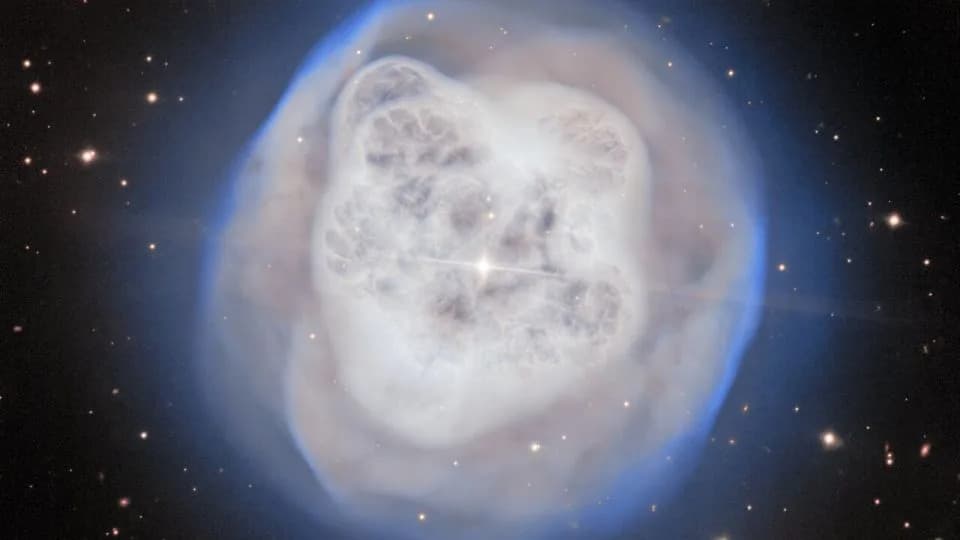
A new image captured by NOIRLab shows a planetary nebula nicknamed the Crystal Ball Nebula. - International Gemini Observatory/NOIRLab/NSF/AURA
A newly released image from the Gemini Multi-Object Spectrograph on the Gemini North telescope captures NGC 1514 — the so-called Crystal Ball Nebula — in striking detail. Mounted on Gemini North atop Maunakea in Hawaii, the instrument reveals the complex structure of a dying star paired with a close companion.
The planetary nebula lies roughly 1,500 light-years away in the constellation Taurus. A light-year is the distance light travels in one year — about 5.88 trillion miles (9.46 trillion kilometers) — so the light in the image left the nebula around 1,500 years ago.
“It’s a way to share with people just how amazing our universe is,” said astronomer Travis Rector, a member of the NOIRLab team that obtained the image. He explained that the target was chosen for its visual appeal rather than as a specific science target.
Binary Dance Shapes the Nebula
The Crystal Ball Nebula contains a binary star system: two stars that formed together and orbit a common center. In this pair one star has reached the end of its life and is shedding its outer layers; the other companion orbits roughly every nine years. That orbital motion stirs and sculpts the expanding shell of gas, producing the nebula’s unusual, cloudlike shape.
“The first star is blowing off its outer layers. The other star, just by virtue of orbiting around that first star, kind of turns things up and makes these beautiful complex shapes,”
Colors, Composition, and Observing at Different Wavelengths
The vivid reds and blues in the Gemini image come from filters in the spectrograph that isolate emission from specific elements. The reddish tones trace hot hydrogen, while the bright blues indicate emission from hot oxygen — two of the strongest lines in planetary nebulae.
Astronomers note that the nebula can look very different at other wavelengths. As Jan Cami of Western University observed, viewing the same object with the James Webb Space Telescope or other instruments can reveal features that appear to make it a completely different object, which is why multiwavelength observations are important.
Why Planetary Nebulae Matter
Despite being discovered more than two centuries ago (William Herschel first recorded NGC 1514 in 1790), the object still yields new insights as telescope technology improves. Planetary nebulae represent a short but revealing phase of stellar evolution — typically lasting on the order of 10,000 years — which makes it possible to track measurable changes in decades. Monitoring these objects helps astronomers measure how fast stars lose mass and how the central star’s temperature evolves over time.
Images like this also help bridge scientific discovery and public wonder. As Cami put it: “I’ve seen many images and at some point you think you’ve seen most of it, and then you get something like this and — oh my god — it’s spectacular again.”
Help us improve.





















