
The Nancy Grace Roman Space Telescope is now scheduled to launch on August 30, 2026, about eight months earlier than previously planned. Engineers completed a final inspection of its 7.9-foot infrared primary mirror and are packing the observatory for shipment to Kennedy Space Center for prelaunch checks and rehearsals. With a field of view roughly 100 times larger than Hubble's, Roman will head to the Sun–Earth L2 point to operate alongside the James Webb Space Telescope, studying dark energy and the prevalence of planetary systems while providing wide-field survey data for the astronomy community.
NASA Moves Nancy Grace Roman Telescope Launch Up to August 30, 2026 — New Wide-Field Observatory Readies for Falcon Heavy
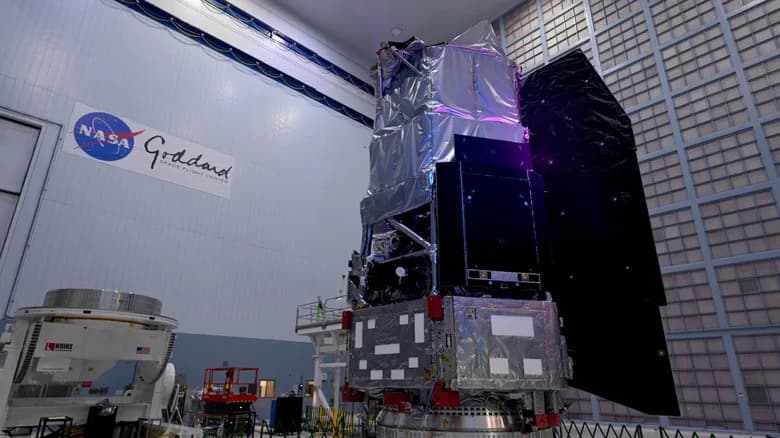
A spacecraft with the NASA Goddard logo in the background. - NASA/Scott Wiessinger
NASA is targeting an August 30, 2026 launch for the Nancy Grace Roman Space Telescope, moving the mission up by roughly eight months from earlier plans. Engineers at NASA's Goddard Space Flight Center completed a final inspection in late May of the observatory's infrared primary mirror and are now preparing the telescope for shipment to Kennedy Space Center for prelaunch processing.
Final Mirror Check
Technicians verified that the 7.9-foot (2.4-meter) primary mirror sustained no contamination during testing and remains properly aligned following a "shake test." That mirror will collect and focus faint light from distant stars and galaxies as Roman pursues its science goals: probing dark energy and assessing how common planetary systems like our own are across the galaxy.
Shipping and Launch Preparations
Roman is being packed for transport from Goddard in Greenbelt, Maryland, to Kennedy Space Center in Florida later this month. Once it arrives at Kennedy, the observatory will undergo a detailed inspection to confirm it survived the trip intact. In the weeks before liftoff, the spacecraft will complete a series of tests and rehearsals, be loaded with fuel, encapsulated in a protective payload fairing and then mounted atop a SpaceX Falcon Heavy for launch.
Why Roman Matters
Named for NASA's first chief astronomer, Nancy Grace Roman, the telescope will offer a field of view roughly 100 times larger than Hubble's. That wide field will let Roman image far more sky in far less time, enabling large surveys that can reveal the large-scale structure of the universe, discover countless new exoplanets via microlensing and provide statistically powerful constraints on dark energy.
Working With Webb and The Science Community
After launch, Roman will travel to the Sun–Earth L2 Lagrange point to operate alongside the James Webb Space Telescope. While Webb delivers ultra-deep, high-resolution views, Roman will map vast swaths of sky and deliver data and observing resources that astronomers worldwide can use for a broad range of investigations.
"All this work will culminate in Roman delivering never-before-seen views of the universe," NASA said in its announcement.
What's Next
If testing and transport go as planned, the mission will proceed through final launch preparations and the Falcon Heavy campaign leading to liftoff on August 30, 2026. Scientists and the public should expect an influx of wide-field survey data that will complement targeted observations from other flagship observatories.
Help us improve.





















