
Researchers led by Kovi Rose have linked the long-period radio transient ASKAP J1745-5051 to a magnetic cataclysmic variable: a white dwarf accreting from a red-dwarf companion. The system emits matching radio and X-ray pulses every 81 minutes, and SOAR optical spectra confirm an ~81-minute orbital period. Because ASKAP J1745-5051 combines magnetism, accretion, orbital motion, and multiwavelength emission, it may serve as a template for decoding other LPTs.
New 'Rosetta Stone' For Mysterious Cosmic Pulses — ASKAP J1745-5051 Unites Radio, X‑Ray And Binary Accretion
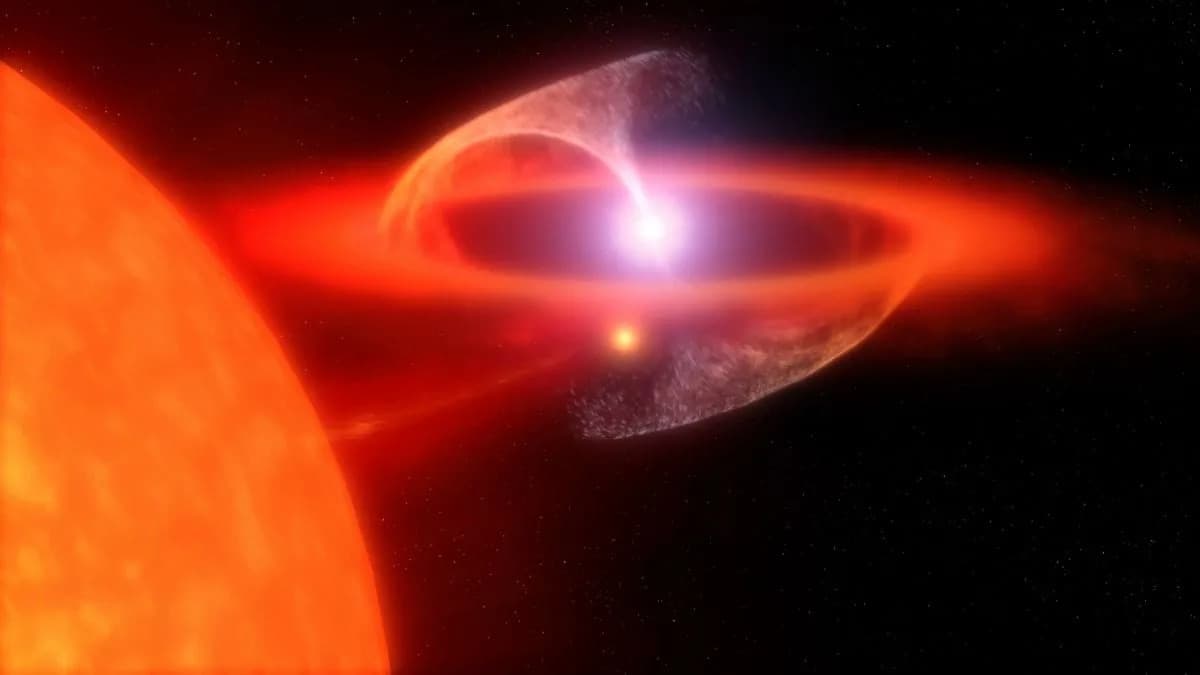
An artist's impression of a cataclysmic variable binary. (Science Photo Library/Photolibrary Video/Getty Images)
Astronomers may have found a key to decoding a puzzling class of slow, repeating radio signals from deep within the Milky Way. A new study links one of these long-period radio transients (LPTs) — ASKAP J1745-5051 — to a magnetic cataclysmic variable: a strongly magnetized white dwarf accreting material from a close red-dwarf companion.
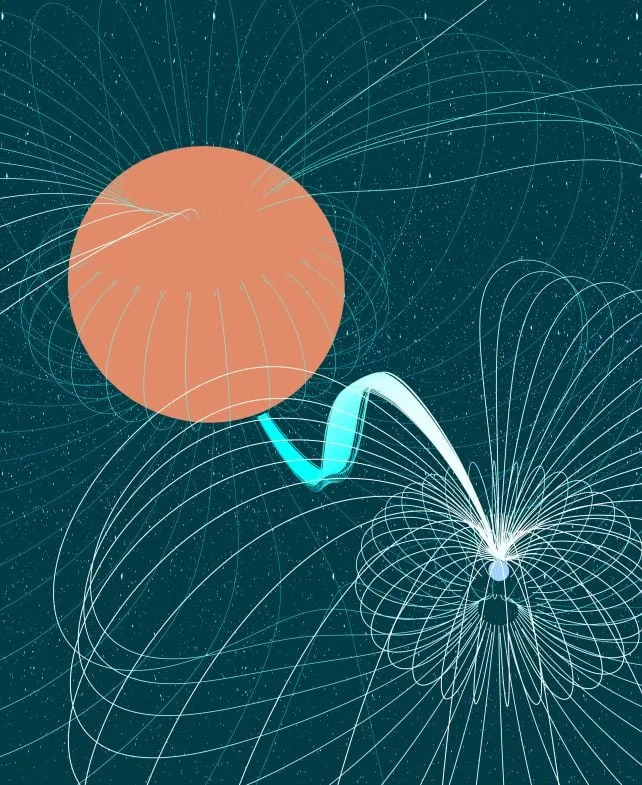
An artist's impression of a magnetic cataclysmic variable binary. (Carl Knox/OzGrav/Swinburne and Dr Joshua Preson Pritchard/CSIRO)
What Was Found
ASKAP J1745-5051 produces bright radio flares every 81 minutes (about 1.35 hours). Those radio pulses are accompanied by matching X-ray bursts detected by NASA's Swift observatory and the Einstein Probe X-ray Telescope. Optical spectra from the Southern Astrophysical Research (SOAR) Telescope reveal a white-dwarf binary at the same sky position and confirm an orbital period of roughly 81 minutes — a striking multiwavelength match that pins down the system's nature.
YouTube Thumbnail
Long-period radio transients have puzzled astronomers for years. This is the first case where we can clearly see both stars and the accretion process in action, said Tara Murphy of the University of Sydney and the ARC Centre of Excellence for Gravitational Wave Discovery (OzGrav).
Why This Matters
This object brings together traits that earlier LPTs showed separately: strong magnetism, periodic radio emission, X-ray production, clear orbital motion, and active accretion. Previous notable LPTs included GLEAM-X J162759.5−523504.3 (which flashed every 18.18 minutes) and ILT J1101+5521 (linked in 2025 to a close red-dwarf/white-dwarf pair whose interacting magnetic fields produce radio bursts). ASKAP J1832-0911 added complexity by showing X-rays as well. ASKAP J1745-5051, however, is the first to unite these features in one system, making it a promising template — a Rosetta Stone — for interpreting other mysterious LPTs.
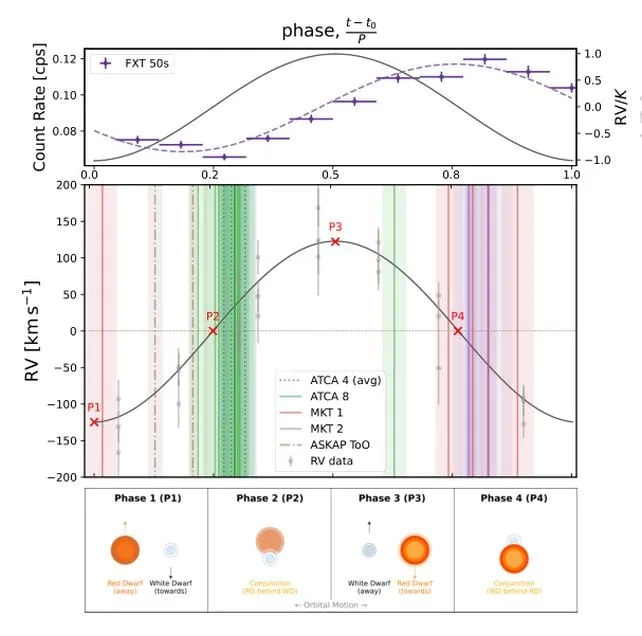
A graph that maps the X-ray emission (top), radio emission (middle) and orbit (bottom). (Rose et al.,Nat. Astron., 2026)
How It Works
In magnetic cataclysmic variables the white dwarf's magnetic field channels gas stripped from the companion onto its magnetic poles. When this infalling material slams into the white dwarf's surface it heats to millions of degrees, producing X-rays. At the same time, interactions between the stars' magnetic fields and accelerated gas produce coherent radio pulses similar to mechanisms proposed for other LPTs.

Subscribe to ScienceAlert's free fact-checked newsletter
Observations And Context
The discovery was made with CSIRO's ASKAP radio telescope on Wajarri Yamaji Country in Western Australia. Distance estimates remain uncertain because of the system's complex environment: current estimates place it between about 1,300 and 30,000 light-years away. The findings are published in Nature Astronomy and were led by Kovi Rose of the University of Sydney.
This multiwavelength identification marks real progress in understanding a small but growing family of unusual radio transients. Each new well-characterized example helps astronomers piece together how magnetic fields, accretion, and binary dynamics produce the slow, repeating radio signals that have baffled observers.
Each new discovery is helping us piece together the bigger picture, said Kovi Rose. We're only just beginning to understand this new class of cosmic events.
Help us improve.





















