
Physicists are exploring whether quantum chromodynamics (QCD), the theory of the strong force that confines quarks, could induce vacuum effects resembling dark energy. A new paper uses the PNJL model to connect QCD vacuum structure to cosmic expansion and fits the idea to low-redshift data (quasars, H II galaxies, Type Ia supernovae). Bayesian fits of an extra exponent 'd' returned values near zero, meaning the model reproduces current observations. Upcoming observatories like ESA's Euclid and the Vera C. Rubin Observatory will provide the precision needed to confirm or refute this proposal.
Could the Strong Force That Holds Atoms Together Also Push the Universe Apart?
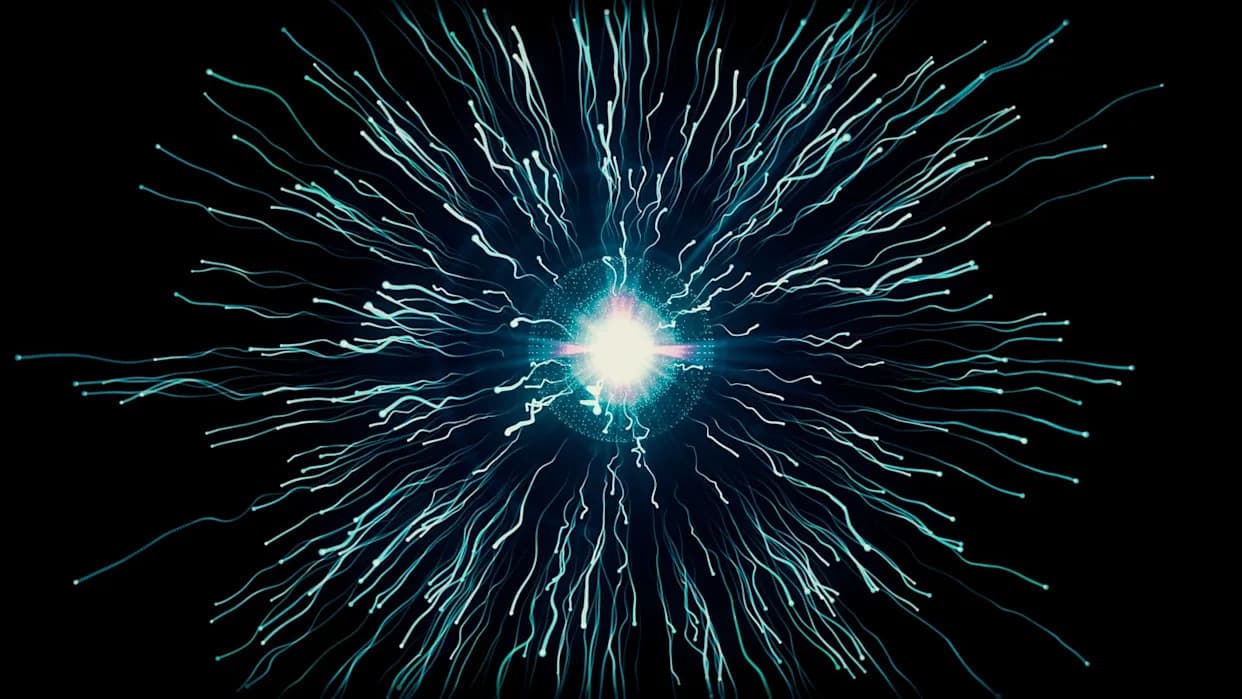
Is This Force Responsible for Universe Expansion?EDUARD MUZHEVSKYI / SCIENCE PHOTO LIBRARY - Getty Images
Humanity's picture of the cosmos has changed dramatically in just over a century. In the 1920s Edwin Hubble showed the universe is expanding, and in 1998 astronomers discovered that expansion is accelerating. That late-20th-century surprise led physicists to posit a pervasive dark energy — often modeled as Einstein's cosmological constant in the Lambda Cold Dark Matter (ΛCDM) framework — but deep theoretical tensions remain.
Why Physicists Are Unsatisfied
Lambda CDM explains many observations, yet it faces a serious theoretical crisis known as the cosmological constant problem: naive quantum-field estimates of vacuum energy exceed the observed dark-energy density by roughly 120 orders of magnitude. This enormous mismatch has motivated physicists to explore alternatives and look for mechanisms rooted in established microphysics that could produce an effective dark-energy–like contribution.
The New Proposal: QCD And Vacuum Effects
A recent paper in the journal Universe proposes one such alternative. The authors investigate whether phenomena associated with quantum chromodynamics (QCD) — the theory of the strong nuclear force that binds quarks and gluons into protons, neutrons and other hadrons — could induce vacuum effects that mimic dark energy. The idea centers on quark confinement and the nontrivial structure of the QCD vacuum.
Using the Polyakov–Nambu–Jona-Lasinio (PNJL) model, a well-known effective framework for QCD thermodynamics, the researchers analyze how the expanding Universe might alter QCD's vacuum structure and whether those changes can produce an effective contribution to cosmic expansion. In their words, “Quantum Chromodynamics ... features a rich vacuum structure shaped by phenomena such as confinement and spontaneous chiral symmetry breaking. The expansion of the Universe could influence the QCD vacuum structure, potentially inducing effective contributions to dark energy.”
Confronting Observations
The team tested their framework against low-redshift probes: quasars, H II galaxies, and Type Ia supernovae. They introduced an extra exponent, labeled d, to parametrize the QCD-related contribution and used Bayesian methods to fit current data. Their fits returned values of d that are close to zero, indicating this QCD-based term can closely reproduce the expansion history measured by present observations.
Outlook: How To Decide If It’s Right
While intriguing, the QCD hypothesis is one of several alternatives aiming to explain dark energy. Decisive tests will require far more precise expansion measurements. Upcoming facilities such as the European Space Agency's Euclid telescope and the Vera C. Rubin Observatory are designed to deliver the stringent data needed to confirm or rule out mild departures from a pure cosmological constant.
In short, the same microphysical force that glues atomic nuclei together could, in principle, leave a subtle imprint on cosmological expansion. The next generation of surveys will tell us whether quark-level physics plays any role in the dark-energy puzzle.
Help us improve.





















