
June's short Northern Hemisphere nights still offer memorable skywatching: a three-night alignment of Mercury, Venus and Jupiter with a crescent Moon from June 16–18; the summer solstice on June 21 at 4:24 a.m. EDT; and the June 29 full "Strawberry Moon," which will be a micromoon at about 252,441 miles (≈406,222 km) from Earth. These events are visible to the naked eye under clear skies.
June Night Sky: 'Strawberry Moon' and a Three‑Planet Meet‑Up
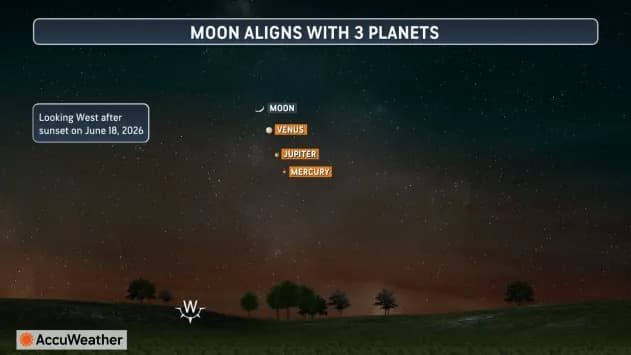
A 'Strawberry Moon' and three-planet meetup headline June's night sky
June brings the Northern Hemisphere's shortest nights, but warmer evenings and clear skies make it a great month for easy-to-see celestial events. From a compact planetary gathering to the first full moon of summer, here are the highlights to watch in the night sky.
June 16–18: Crescent Moon Joins Three Planets
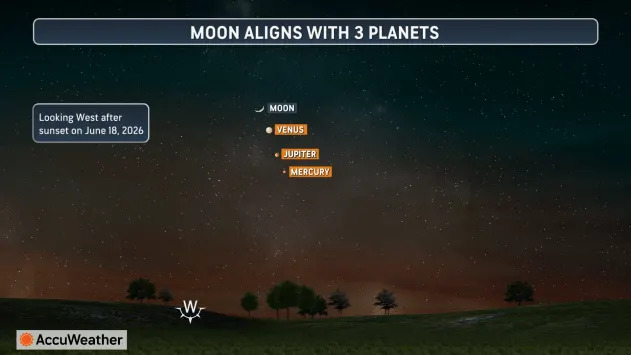
Mid-month will feature one of June's most eye-catching displays: Mercury, Venus and Jupiter will cluster low in the western sky after sunset. A slim crescent Moon will join the trio on the nights of June 16, 17 and 18, creating a compact alignment that's visible to the naked eye under clear skies.
AccuWeather.com
Viewing tips: Look toward the western horizon shortly after sunset. Venus and Jupiter will be the brightest and easiest to spot; Mercury will sit lower and be much fainter, so a clear horizon and binoculars can help.
June 21: Summer Solstice
Astronomical summer begins on Sunday, June 21 at 4:24 a.m. EDT. In the Northern Hemisphere this marks the longest day and shortest night of the year, when the Sun's most direct rays fall over the Tropic of Cancer. South of the equator, the June solstice signals the start of astronomical winter.
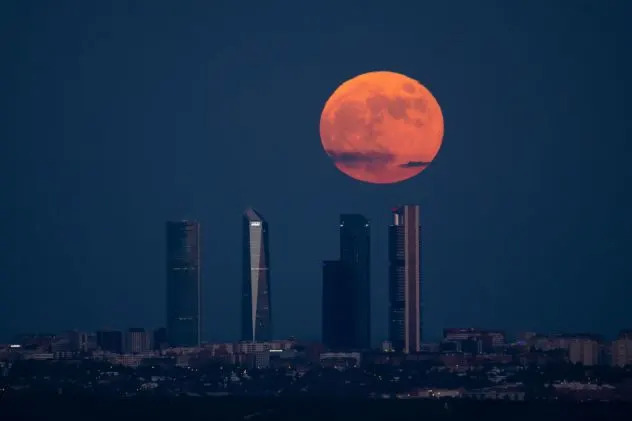
The full moon of June also known as Strawberry Moon rises over the Four Towers Business area skyscrapers in downtown Madrid. (Photo by Marcos del Mazo/LightRocket via Getty Images)
June 29: Strawberry Moon (a Micromoon)
The first full moon of summer rises on Monday, June 29. Traditionally called the "Strawberry Moon" for the short strawberry-harvest season, it also bears other folk names such as the Green Corn Moon, Blooming Moon and Birth Moon.
This full moon will be a micromoon — slightly smaller in apparent size because it occurs shortly after the Moon reaches apogee, its farthest point from Earth. TimeandDate lists the Moon's distance for this event at about 252,441 miles (≈406,222 km), compared with the Moon's average distance of roughly 238,800 miles (≈384,400 km).
Final Notes
All three events are easily visible with the naked eye from many locations in the Northern Hemisphere under clear skies. For the best views, find a dark spot with a clear western horizon after sunset for the planetary meet-up and watch the horizon line around moonrise on June 29 for the Strawberry Moon. Check local times and weather conditions before heading out.
Help us improve.





















