
A new study argues that many sub‑Neptune exoplanets may not form distinct metallic cores. Above roughly 4,000 K, hydrogen and molten silicate become fully miscible, and planets retaining more than ~1% of their mass in hydrogen could have homogeneous, convecting interiors rather than a separate core and mantle. This miscibility can explain the observed radius gap and radius–period trends, and predicts young sub‑Neptunes should appear puffier as hydrogen slowly exsolves over hundreds of millions of years. The idea is testable with JWST and future transit surveys, though it depends on extrapolated high‑pressure physics.
Most Common Exoplanets May Lack Earth‑Like Cores — New Study Says Hydrogen Can Mix With Rock
Credit: forplayday/iStock/Getty Images
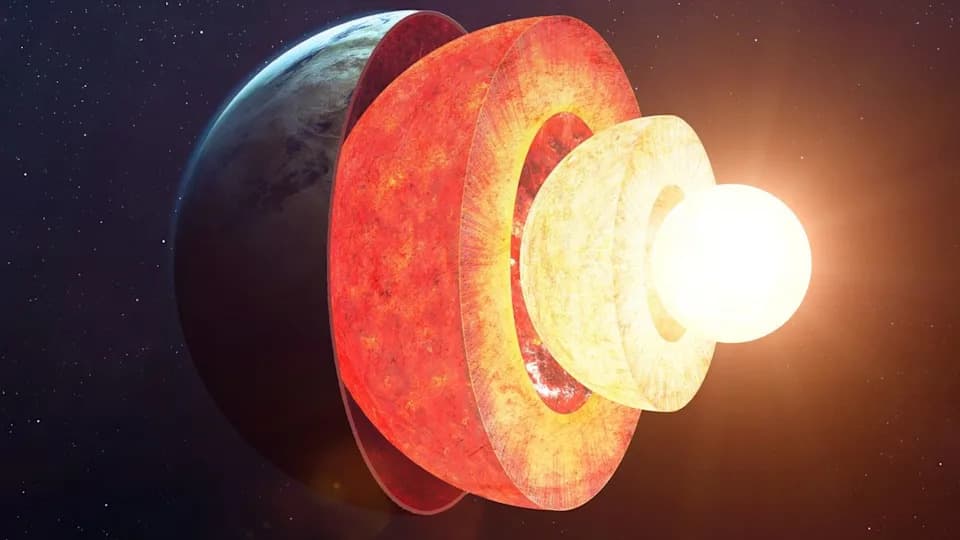
For decades, astronomers pictured rocky worlds with a tidy internal layering: a dense metallic core, a silicate mantle and a thin atmosphere — the structure that describes Earth. A new study submitted to the Astrophysical Journal and available on arXiv challenges that picture for the galaxy’s most frequently observed class of planets: sub‑Neptunes.
Sub‑Neptunes are planets larger than Earth but smaller than Neptune, and their slightly smaller cousins — super‑Earths — probably lost much of their hydrogen envelopes long ago. The conventional view treats these planets as scaled versions of Earth with varying amounts of residual gas: iron sinks to form a core, silicates form a mantle, and hydrogen sits on top as an atmosphere.
However, the new models emphasize that at the extreme pressures and temperatures inside many sub‑Neptunes the physics changes. Above roughly 4,000 K, hydrogen and molten silicate become fully miscible — they behave as a single continuous fluid rather than two separate layers. When that happens, adding enough hydrogen fundamentally alters interior structure.
Key result: If a planet accretes less than about 1% of its mass as hydrogen, it can form a distinct metallic core like Earth. But planets that retain more hydrogen than that threshold are likely to develop a largely homogeneous, convecting fluid interior in which iron, silicate and hydrogen are mixed together down to within a few thousand kilometres of the centre — effectively no separate core or mantle.
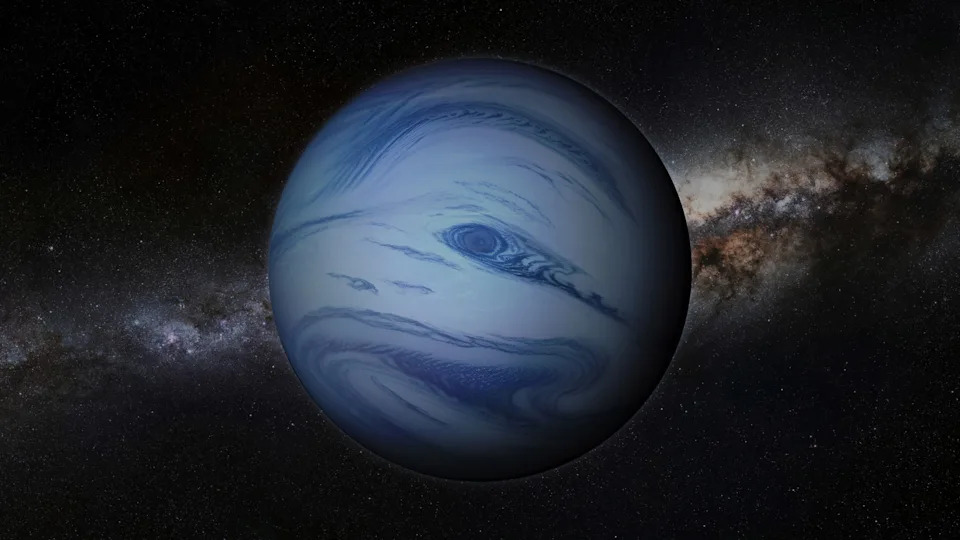
Artist's impression of a sub-Neptune exoplanet. | Credit: Pablo Carlos Budassi/Stocktrek Images/Getty Images
Why It Matters
Internal structure controls how a planet cools, how it holds onto or loses atmosphere, and how its radius evolves. The authors show that a miscible interior can naturally reproduce several observed features of the exoplanet population that layered models struggle to explain.
Two notable successes: the model can help explain the observed radius gap — a deficit of planets between typical super‑Earth and sub‑Neptune sizes — and the way measured planet radii depend on orbital period.
In these models, young sub‑Neptunes can sequester a large fraction of their hydrogen inside the miscible interior. As the planet cools and the miscibility region shrinks, hydrogen gradually exsolves — it literally bubbles out of the rock — and migrates into the outer envelope over hundreds of millions of years. That ongoing release slows contraction, so young sub‑Neptunes should appear puffier than standard layered models predict.
Observational Tests And Caveats
The idea is testable. If hydrogen is slowly exsolving from planet interiors, sub‑Neptunes orbiting very young stars (tens of millions of years old) should show systematically larger radii for their ages. JWST and upcoming transit surveys are already discovering young systems where this signature could be measured.
Important caveats remain. The models rely on theoretical extrapolations of material behavior at pressures and temperatures not yet fully reproducible in laboratories, although high‑pressure experiments are improving rapidly. Uncertainties in internal heat budgets and the statistical (inverse) modeling approach also affect the strength of the conclusions. The result is plausible and provocative, but not yet definitive.
Bottom line: The most common rocky‑like planets in the galaxy may not have small, dense metallic cores like Earth. Instead, a mixed hydrogen–rock interior could be the norm, making Earth’s familiar core‑and‑mantle architecture an exception rather than the rule.
Help us improve.





















