
China will launch Shenzhou-23 from Jiuquan with three crew members, including Hong Kong’s first astronaut to fly on a Chinese mission. One astronaut is expected to remain aboard Tiangong for about a year to study radiation effects, bone-density loss and psychological stress. The flight will test an autonomous rapid rendezvous and docking procedure as part of preparations for a possible crewed lunar landing by 2030 and a proposed lunar base by 2035.
China Launches Shenzhou-23; One Astronaut To Spend About a Year Aboard Tiangong as Beijing Eyes 2030 Moon Goal
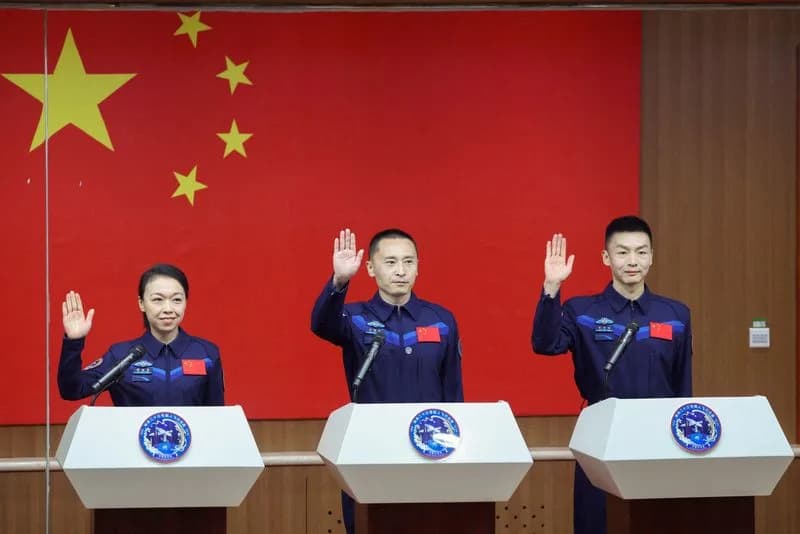
Astronauts Zhu Yangzhu, Zhang Zhiyuan, and Lai Ka-ying, who is the first astronaut from Hong Kong, gesture as they attend a press conference before the Shenzhou-23 spaceflight mission to China's Tiangong space station, at Jiuquan Satellite Launch Center, near Jiuquan, Gansu province, China, May 23, 2026. REUTERS/Maxim Shemetov
JIUQUAN, China — China is set to launch the Shenzhou-23 spacecraft on Sunday, sending three crew members to the Tiangong space station and marking a potential record long-duration stay for one astronaut of roughly one year. The mission underlines Beijing's accelerating push toward a crewed lunar landing by 2030 and a proposed permanent lunar base with Russia by 2035.
Launch Details
The Shenzhou-23 capsule is scheduled to lift off at 11:08 p.m. local time (1508 GMT) from the Jiuquan Satellite Launch Center in northwest China aboard a Long March-2F Y23 rocket. The crew includes commander Zhu Yangzhu, pilot Zhang Yuanzhi and payload specialist Li Jiaying — a former Hong Kong police inspector who will be the first person from Hong Kong to fly on a Chinese space mission.

Astronaut Lai Ka-ying, who is the first astronaut from Hong Kong, raises her hand as she attends a press conference with fellow crew members Zhu Yangzhu and Zhang Zhiyuan (both not pictured), before the Shenzhou-23 spaceflight mission to China's Tiangong space station, at Jiuquan Satellite Launch Center, near Jiuquan, Gansu province, China, May 23, 2026. REUTERS/Maxim Shemetov
Mission Plan And Objectives
One of the three crew members will remain aboard Tiangong for about a year, which would set a national record if completed (the world record is 14½ months, set by a Russian cosmonaut in 1995). The China Manned Space Agency said the decision on which astronaut will extend the mission will be made later based on operational progress.
Primary goals include: testing an autonomous rapid rendezvous and docking procedure with Tiangong's core module; conducting long-duration human physiology research on radiation exposure, bone-density loss and psychological stress; and rehearsing procedures and technologies intended for future lunar missions.
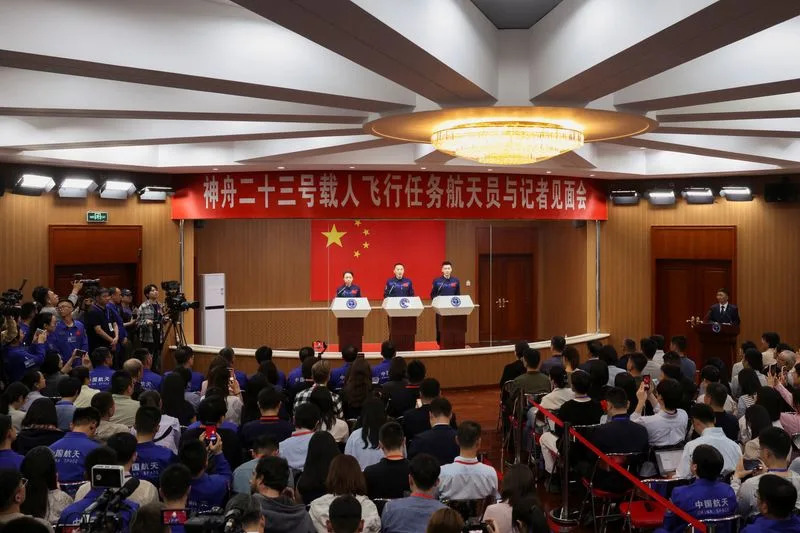
Astronauts Zhu Yangzhu, Zhang Zhiyuan, and Lai Ka-ying, who is the first astronaut from Hong Kong, attend a press conference before the Shenzhou-23 spaceflight mission to China's Tiangong space station, at Jiuquan Satellite Launch Center, near Jiuquan, Gansu province, China, May 23, 2026. REUTERS/Maxim Shemetov
Context: Lunar Ambitions And Global Activity
China’s Shenzhou programme has conducted nearly a dozen crewed missions to Tiangong as the country builds experience with longer stays in low-Earth orbit. Beijing is also developing hardware for a 2030 crewed lunar landing — including the heavy-lift Long March-10 rocket, the Mengzhou crew capsule and the Lanyue lander — and has described a longer-term plan to establish a permanent lunar base with Russia by 2035. Chinese officials say public timelines are deliberately conservative.
This mission occurs amid heightened international activity in lunar exploration. NASA aims for a crewed moon landing around 2028 and has recently flown the Artemis II crewed lunar test. Separately, SpaceX conducted a largely successful uncrewed test of its Starship vehicle, designed for frequent launches and future lunar missions.

Astronauts Zhu Yangzhu, Zhang Zhiyuan, and Lai Ka-ying, who is the first astronaut from Hong Kong, walk to attend a press conference before the Shenzhou-23 spaceflight mission to China's Tiangong space station, at Jiuquan Satellite Launch Center, near Jiuquan, Gansu province, China, May 23, 2026. REUTERS/Maxim Shemetov
Scientific Experiments And Operational Tests
Onboard experiments will study the physiological impacts of extended microgravity and space radiation and assess psychological resilience during long-duration missions. Beijing has also reported biological experiments — including samples of human stem cells sent to Tiangong earlier — intended to investigate long-term survival and reproduction-related processes in microgravity.
The Shenzhou-23 mission will perform the first autonomous rapid rendezvous and docking with Tiangong’s core module as a rehearsal for the more complex automated lunar-orbit rendezvous planned between the Mengzhou capsule and the Lanyue lander during the moon campaign.
Operational Note
China's recent missions have included contingencies: Shenzhou-22 launched ahead of schedule in November to recover astronauts after the Shenzhou-20 vehicle was damaged by orbital debris. China is also training international partners' astronauts; two Pakistani trainees could visit Tiangong on a short-duration mission this year.
What To Watch: Which crew member remains for the year-long stay, how the autonomous rapid docking performs, and whether experiments produce actionable data for future lunar missions.
(Reporting by Laurie Chen; editing and synthesis for clarity and style)
Help us improve.





















