
Dr Oliver Johnson of King's College London says the risk of Ebola for casual World Cup visitors is low because Ebola is not airborne and transmission usually requires direct contact with someone who is visibly ill. The 48-team tournament runs June 11–July 19 across the U.S., Canada and Mexico. An outbreak in eastern DR Congo with roughly 600 suspected cases and 130+ deaths has prompted a WHO emergency declaration and already disrupted DR Congo's preparations. Enhanced screening and travel restrictions — including U.S. entry bans and checks at Washington Dulles — may slow airport processing and add logistical costs.
Ebola Risk Low For World Cup Fans — Airport Screening And Travel Curbs Could Disrupt Logistics
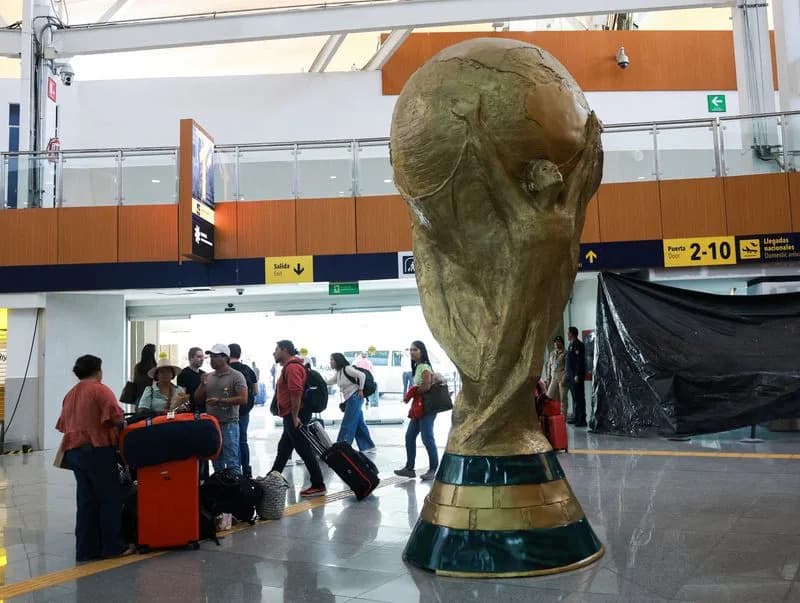
Passengers stand beside a giant replica of the World Cup trophy displayed at Mexico City International Airport, ahead of the World Cup starting on June 11, in Mexico City, Mexico, May 15, 2026. REUTERS/Henry Romero
By Iain Axon
JOHANNESBURG, South Africa, May 22 (Reuters) - The likelihood that casual visitors to the World Cup will be affected by the Ebola outbreak in eastern Democratic Republic of Congo (DR Congo) is low, according to Dr Oliver Johnson, a global health academic at King's College London. However, intensified screening and travel restrictions are likely to complicate travel and tournament logistics.
The expanded 48-team tournament, co-hosted by the United States, Canada and Mexico, runs from June 11 to July 19. The DR Congo outbreak has produced around 600 suspected cases and more than 130 deaths, prompting the World Health Organization to declare a public health emergency of international concern.
The outbreak has already disrupted the DR Congo national team's preparations: pre-tournament events in Kinshasa were cancelled and some plans were moved to Belgium. U.S. authorities have barred entry to non-U.S. passport holders who have been in DR Congo, Uganda or South Sudan in the past 21 days, forcing some Congo-based staff to leave earlier than planned.
Dr Oliver Johnson: Ebola poses a very low risk to casual visitors because it is not airborne and typically requires direct contact with someone who is visibly ill; in high-income settings cases have been rare and are usually identified and contained quickly.
U.S. health authorities have introduced enhanced screening for travellers arriving at Washington Dulles who have recently been in affected countries. Health agencies are coordinating with FIFA and local officials to assess and manage potential risks.
Johnson warned that heightened screening and travel checks could lengthen airport queues, increase operational stress and add costs to U.S. preparations. He also noted the potential for last-minute measures, such as broader travel bans or additional screening, if the outbreak spreads beyond DR Congo.
Practical advice for fans: maintain good hand hygiene, avoid close contact with people who are unwell, and avoid stigmatizing travellers or communities from affected areas to help preserve the inclusive spirit of the World Cup.
The DR Congo squad is expected to arrive in the United States on June 10 or 11 and will be based in Houston. They open their campaign against Portugal in Houston, before facing Colombia in Guadalajara and Uzbekistan in Atlanta.
(Reporting by Iain Axon; additional writing by Pearl Josephine Nazare in Bengaluru.)
Help us improve.





















