
The article argues that U.S.–China “strategic stability” must be grounded in enforceable accountability rather than diplomatic rhetoric. It warns against lifting sanctions on Chinese firms tied to Iran and urges continued use of targeted tools — including Section 311, export controls, and sanctions — to disrupt arms and dual‑use supply chains. The piece calls for clear, public consequences for Chinese coercion toward Taiwan and for verification mechanisms to test Beijing’s promises.
Strategic Stability With China Requires Enforceable Accountability — Not Empty Rhetoric
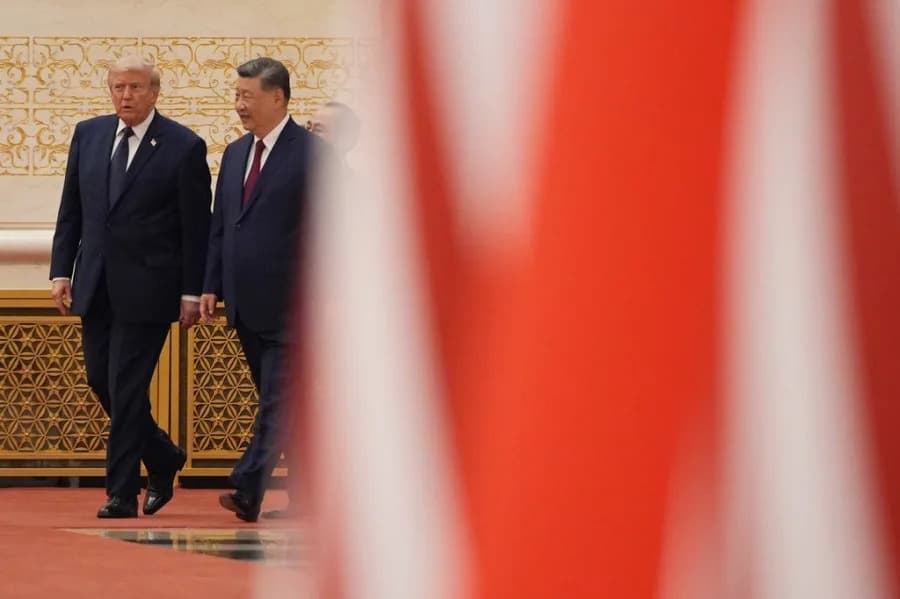
President Trump and President Xi Jinping closed their Beijing summit using nearly identical language about pursuing a “constructive” relationship and advancing “strategic stability.” But diplomatic phrasing should not be mistaken for concrete restraint. With China, genuine stability depends on clear, enforceable accountability — not unverified promises.
Mr. Trump has reportedly considered lifting sanctions on Chinese firms tied to Iranian oil trade. He should refrain. Chinese financial institutions that facilitate sanctions evasion are more exposed to targeted U.S. measures now than in recent years. Given China’s economic strain — a fragile housing market, a banking sector weighed down by nonperforming loans, and persistently high youth unemployment — Washington should not trade away leverage for vague assurances from the Chinese Communist Party.
Use Targeted Tools, Not Blanket Relief
Instead of relief, the United States should retain and, where appropriate, expand calibrated tools to compel behavioral change. Those tools include targeted sanctions, tighter export controls, and authorities such as Section 311 of the USA PATRIOT Act, which can restrict dollar access for banks or jurisdictions that enable illicit finance. Employed selectively, these measures can pressure Beijing while minimizing unintended economic fallout.
Test Promises, Verify Actions
Xi’s reported pledge not to supply military equipment to Iran warrants skepticism. Beijing made a comparable assurance in 2015 about not militarizing South China Sea features, yet China proceeded to build and militarize bases across the region. New reporting that China may have supplied shoulder-fired missiles to Iran — and that some Chinese firms are reportedly planning further arms shipments — means Xi’s statements must be tested through verification, monitoring, and accountability mechanisms.
Even absent direct transfers of conventional arms, dual-use items remain a critical concern. China remains a major supplier of precursor chemicals and components used in Iran’s missile and drone programs — systems that have threatened U.S. forces, Israel, and Gulf partners. Cutting off those supply lines requires sustained pressure and careful enforcement of export controls, not immediate sanctions relief.
Deterring Coercion Toward Taiwan
The same principles apply to Taiwan. When Xi warns that missteps could spark “clashes and even conflicts,” he reframes the issue to make defensive U.S. or Taiwanese actions appear provocative. The record shows China as the principal aggressor: military intimidation, diplomatic isolation, and probes of U.S. resolve continue. Treating coercion as a problem solved by U.S. restraint risks equating prudence with capitulation.
Washington should be explicit about consequences. The White House could publicly identify which state-controlled Chinese institutions — major state-owned banks, trading firms, and strategic-sector companies — would face sanctions if Beijing moved against Taiwan. It should also support legislation such as the STAND With Taiwan Act, which would codify robust responses and reduce ambiguity about U.S. commitments.
A Policy of Firm, Verified Stability
President Trump has long argued that China’s trade distortions — state-subsidized dumping, forced technology transfer, industrial subsidies, and intellectual-property theft — require consequences. The same logic must govern U.S. policy on Iran and Taiwan: Beijing should not be allowed to convert “stability” into a veto over American policy by labeling any countermeasure as destabilizing.
In practice, this means: retain leverage, demand verifiable commitments, expand targeted economic tools where necessary, and publicly tie consequences to clearly defined actions. Accountability will be portrayed by Beijing as escalation — but stability without enforceable responsibility is an illusion, and a costly one.
Max Meizlish is a Research Fellow in the Center on Economic and Financial Power at the Foundation for Defense of Democracies.
Copyright 2026 Nexstar Media, Inc. All rights reserved.
Help us improve.





















